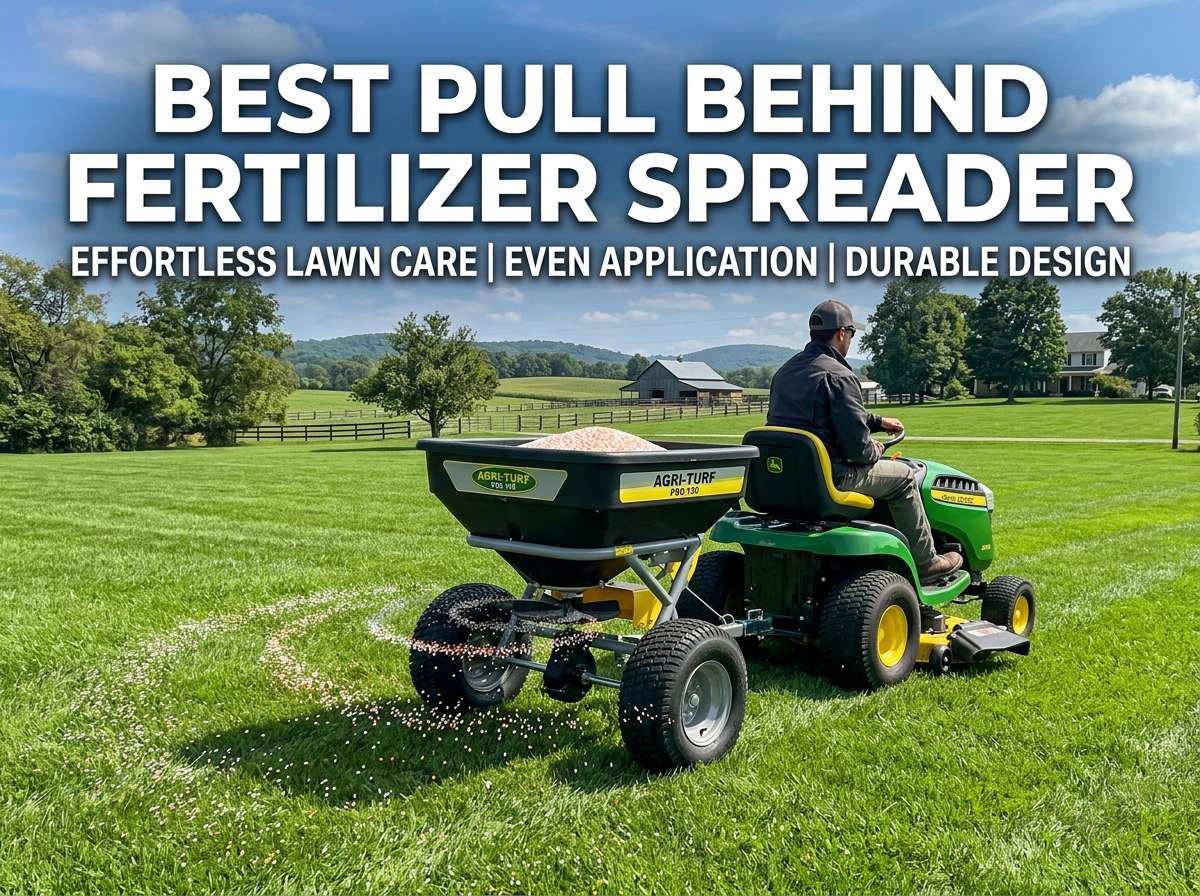
3 Best Pull Behind Fertilizer Spreader In 2026
If you take lawn care seriously, you already know that spreading fertilizer by hand or with a small handheld spreader gets old really fast. Your arm gets tired, coverage is uneven, and you end up spending twice as long on a job that should take 20 minutes. That’s exactly where a pull behind fertilizer spreader changes the game.
In this article
These tow-behind spreaders attach to your riding mower, ATV, or garden tractor, and they cover a wide swath of ground in a single pass. You sit down, drive around your yard, and the machine does the heavy lifting. Whether you’re dealing with a half-acre suburban lawn or a multi-acre rural property, there’s a model out there that fits your situation.
In this roundup review, we’re breaking down three of the most popular pull behind broadcast spreaders on the market right now — the Agri-Fab 130 lb Pull Behind Broadcast Spreader, the Scotts Turf Builder EdgeGuard Mini Broadcast Spreader, and the VEVOR 130LBS Tow Behind Broadcast Spreader. We’ll cover everything from how they perform in the real world, what they’re built for, their best use cases, honest pros and cons, and which type of person should buy each one.
By the end of this article, you’ll know exactly which spreader makes the most sense for your lawn and your budget.
Why a Pull Behind Fertilizer Spreader Is Worth It
Before we jump into the reviews, let’s talk about why this type of spreader even matters.
A tow behind broadcast spreader attaches to any standard riding mower or utility vehicle with a hitch. Once it’s connected, you load your material into the hopper — fertilizer, grass seed, salt, ice melt, or even lime — and drive. The spreader spins the material out in a wide arc behind you, covering a large area fast.
Compared to a push spreader, the pull behind version covers more ground per pass and takes zero physical effort. Compared to a manual hand crank spreader, the coverage is far more even and consistent. That means healthier grass, fewer missed spots, and a lawn that actually looks good from the street.
The key things to look for in a tow behind spreader are hopper capacity, spread width, settings accuracy, tire quality, and how easy it is to hook up and use. All three spreaders we’re reviewing today have different strengths in those areas, so let’s get into it.
Product Reviews
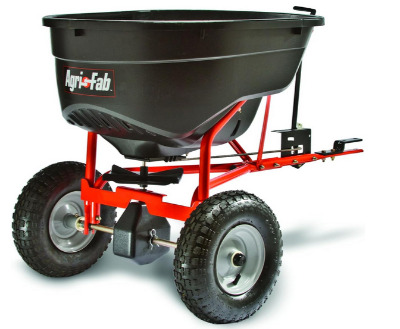
Agri-Fab Pull Behind Broadcast Spreader (130 lb Hopper Capacity, 12 Ft Spread Width)
Product Overview
The Agri-Fab brand has been around for decades in the lawn and garden world, and their 130 lb pull behind broadcast spreader is one of their most popular sellers. This is a full-size tow behind spreader designed for large lawns and properties. It holds up to 130 pounds of material at a time, which means fewer refill stops on bigger jobs.
The spread width is listed at 12 feet, which is generous for a residential spreader. It uses a universal hitch system so it should hook up to most standard riding mowers and garden tractors without a problem. The hopper is open-top style, which makes loading fast and easy.
This spreader handles fertilizer, grass seed, salt, ice melt, and other granular materials. It’s the kind of tool you use at the start of the season when you’re putting down a full treatment across a big piece of property.
Key Features Explained Simply
130 lb Hopper: This is a large capacity hopper. To put it in perspective, a standard 40 lb bag of fertilizer fits in here easily, and you still have room for more. For lawns over an acre, this means you can do a big portion of the job without stopping to refill.
12-Foot Spread Width: The spreader throws material about 6 feet to each side as you drive. That means each pass covers a 12-foot wide strip. On an open lawn, you can knock out a lot of ground in just a few passes. This is wider than most entry-level spreaders.
Universal Hitch: The hitch system is designed to fit a wide range of tow points. Most riding mowers with a standard receiver hitch will work. The connection is simple — no special adapters needed in most cases.
Flow Rate Control: There’s an adjustable flow gate on the bottom of the hopper. You open it more for heavy applications and close it down for lighter ones. The settings are clearly marked so you can dial in how much material you want to put down.
Poly Hopper Construction: The hopper is made from poly (polyethylene) material, which is rust-resistant and easy to clean out after use. This matters a lot because fertilizer can be corrosive over time, and a metal hopper will eventually show wear.
Best Use Cases
This spreader is a natural fit for homeowners with large lawns, people managing small farms, or anyone who maintains a property larger than half an acre. It works well for seasonal fertilizing runs, overseeding in fall, putting down pre-emergent weed control in spring, and spreading ice melt on long driveways in winter.
If you have a riding mower and a big yard, this spreader is going to save you hours of work every season.
Real-World Usage Insight
In practice, the Agri-Fab spreader performs best when you keep it moving at a steady speed. Stopping and starting mid-application can cause uneven coverage because the spinner keeps running when you slow down. Most users find that a consistent driving pace gives them clean, even results.
The flow gate can be a little tricky to get exactly right on the first use, so it’s worth doing a small test pass on a section of driveway or gravel before you commit to your lawn. This lets you see the actual spread pattern and adjust the flow rate accordingly.
Assembly out of the box takes around 20 to 30 minutes for most people. The instructions are decent but not outstanding — a few extra photos would help. That said, most of the parts snap or bolt together in an obvious way.
Pros
- Very high hopper capacity means fewer refills on large properties
- Wide 12-foot spread width covers ground fast
- Universal hitch fits most standard riding mowers
- Rust-resistant poly hopper holds up over time
- Handles multiple materials — fertilizer, seed, salt, and ice melt
- Good value for the capacity and features offered
Cons
- Assembly instructions could be clearer for first-time buyers
- No deflector shield included to keep material off driveways or flower beds
- Spinner can throw material unevenly if driving speed changes a lot
- The flow gate markings may not be perfectly calibrated to all spreader charts
Performance Discussion
Spreading performance is strong for open-lawn applications. The 12-foot width means you’ll cover a standard residential lot relatively quickly. The spinner disc is driven by the ground-contact wheels as you pull the unit, so it only spins when the spreader is actually moving — a smart passive design that prevents over-application when you stop.
Coverage evenness is good at steady speeds. Where it can struggle is on slopes or uneven terrain, where the material in the hopper can shift and cause slightly inconsistent flow. For flat lawns, this is rarely an issue.
Ease of Use
Attachment to a mower is straightforward. The hitch pin goes in, you connect the flow-control cable to your mower’s handle or lever, and you’re ready to go. Once everything is set up, operating the spreader is simple — drive in a pattern, overlap your passes slightly, and you’re done.
Cleaning up after use is important with any fertilizer spreader. The poly hopper rinses out easily with a hose, and the spinner assembly wipes down without much effort.
Value for Money
At its price point, the Agri-Fab 130 lb spreader is one of the better large-capacity options available for residential use. You’re getting a lot of hopper space, a wide spread width, and solid build quality for a price that’s significantly less than commercial-grade spreaders. For a homeowner who wants to do the job right without breaking the bank, this is a strong buy.
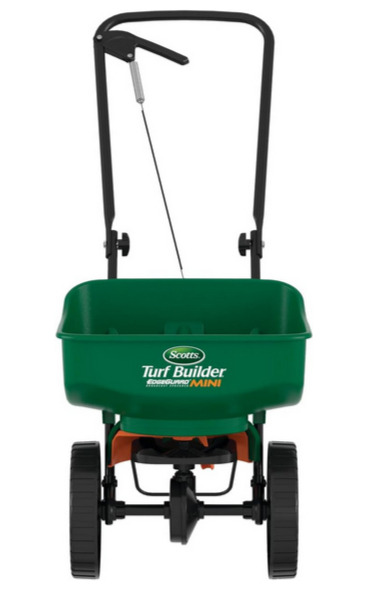
Scotts Turf Builder EdgeGuard Mini Broadcast Spreader
Product Overview
The Scotts Turf Builder EdgeGuard Mini is a different animal from the Agri-Fab. Rather than being a traditional tow behind unit, the Scotts EdgeGuard Mini is primarily a push spreader — but it earns its place in this roundup because it’s one of the most recommended spreaders for homeowners who don’t have a riding mower and are working with a small to mid-sized lawn up to 15,000 square feet.
Scotts is one of the most trusted names in lawn care products, and their spreaders are designed to work seamlessly with their own line of fertilizers and lawn treatments. The EdgeGuard Mini is compact, easy to store, and comes with one of the most useful features in any broadcast spreader — the EdgeGuard technology that closes off one side of the spread to keep material off driveways, sidewalks, and garden beds.
It holds enough product to cover up to 15,000 square feet at a time, which is about a third of an acre. For most suburban lawns, that’s more than enough to do the whole job in one fill.
Key Features Explained Simply
EdgeGuard Technology: This is the standout feature. When you flip the EdgeGuard switch, a flap closes off the right side of the spreader. This means material only goes to the left side — perfect for spreading right next to a driveway, sidewalk, or flower bed without wasting product or making a mess. It’s a small feature with a big practical impact.
Holds Up to 15,000 sq ft of Product: The hopper size is calibrated for product coverage, not weight. Scotts designs the hopper to hold enough of their standard fertilizer bags to cover most residential lots without stopping.
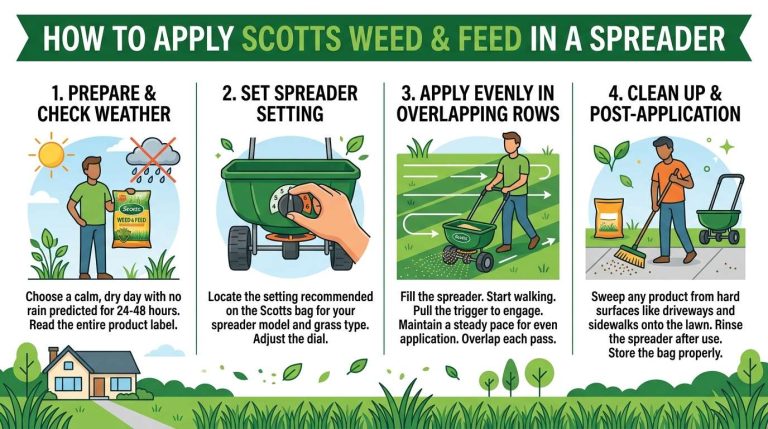
Precision Flow Control: Scotts includes a clearly marked settings dial that matches up with the recommended settings printed on their fertilizer bags. This removes the guesswork. If you’re using Scotts Turf Builder, you just set the dial to the number on the bag and you’re good.
Durable Construction: The hopper is rust-resistant, and the wheels are designed for smooth rolling on grass. The folding handle reduces storage space, which is a nice touch for people with smaller garages or sheds.
Easy Assembly: This spreader comes mostly pre-assembled. Most people have it ready to use in under 10 minutes.
Best Use Cases
The Scotts EdgeGuard Mini is ideal for suburban homeowners with smaller lawns — typically under 10,000 to 15,000 square feet. It’s the right tool if you’re dealing with a standard house lot, want clean edges along your driveway or garden, or prefer not to deal with the storage requirements of a larger tow behind unit.
It works great for regular fertilizing cycles, spreading grass seed in bare patches, applying pre-emergent weed control, and putting down ice melt on walkways and short driveways in winter.
If you don’t own a riding mower and your lawn is manageable on foot, this is probably the most practical spreader in this roundup.
Real-World Usage Insight
The EdgeGuard feature is something users consistently praise in real-world use. Spreading fertilizer near a driveway without the EdgeGuard usually means granules end up on concrete and eventually wash into storm drains — wasted product and an environmental concern. With the EdgeGuard active, you can run your passes right along the edge of a hard surface without any of those issues.
The precision settings are also a big deal in daily use. With other spreaders, you might have to guess at the right setting and do a test pass. With the Scotts system, the settings dial numbers match directly to the bag instructions, so first-time users can get it right without trial and error.
One practical note: this spreader works best on relatively flat terrain. On hilly lawns, controlling your walking pace and the spreader’s flow can be trickier.
Pros
- EdgeGuard technology prevents material waste and keeps edges clean
- Settings dial matches Scotts product bag recommendations exactly
- Very easy to assemble and start using right away
- Compact and easy to store
- Great for smaller lawns up to 15,000 sq ft
- Trusted Scotts brand with a long track record
Cons
- Not designed for towing behind a mower — push-only operation
- Not ideal for properties larger than 15,000 square feet
- Smaller capacity means more refills on larger areas
- Works best with Scotts brand products; settings may need adjustment for other brands
- Not suitable for very rough or uneven terrain
Performance Discussion
For push spreader performance, the Scotts EdgeGuard Mini delivers clean, consistent results. The spread pattern is even and the flow control is accurate. The EdgeGuard shield genuinely works as advertised and keeps spread material where you want it.
The spinner mechanism is smooth and rarely clogs, even with denser granule products like some pre-emergent weed controls. Fertilizer, grass seed, and standard ice melt all move through the system without much trouble.
One area where performance drops off is with very fine or very coarse materials outside the standard range. Extra-fine granules can clump in humid conditions, and very coarse materials may not spread as evenly. For standard Scotts products, though, it performs excellently.
Ease of Use
This is one of the easiest spreaders to use in the market. Assembly is fast, the settings are clear, and the EdgeGuard mechanism is a simple flip of a lever. Walking at a normal pace gives you consistent coverage. The handle height is comfortable for most adult users, though taller individuals might find it slightly low.
Cleaning is straightforward — empty any remaining product, rinse the hopper, and let it dry before storage.
Value for Money
The Scotts EdgeGuard Mini is priced in the mid-range for push spreaders, and the value is strong for what you get. You’re paying for the EdgeGuard feature, the precision settings system, and the Scotts brand reliability. For a homeowner with a standard suburban lot who wants to do the job cleanly and correctly, this spreader is worth every penny.
If you’re buying Scotts lawn products anyway — and many homeowners do — having the matching spreader just makes the whole experience smoother.
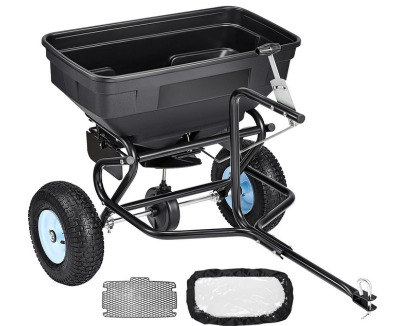
VEVOR Tow Behind Broadcast Spreader (130LBS Capacity, 13-inch Tires, 9.8 ft Spreading Width)
Product Overview
The VEVOR tow behind broadcast spreader is the newcomer in this lineup, but it’s been gaining attention fast among lawn care enthusiasts and budget-focused buyers. VEVOR as a brand has grown quickly in the power tools and outdoor equipment space, offering feature-rich products at competitive prices.
This particular spreader stands out because it offers dual functionality — it can be used as both a tow behind spreader (attached to a mower or ATV) and a push spreader (operated on foot). That versatility makes it an appealing option for people who want one tool that works in multiple situations.
It holds 130 lbs of material, has 13-inch pneumatic tires for better terrain handling, comes with 30 adjustable settings, and spreads at a 9.8-foot width. It handles fertilizer, grass seed, salt, and ice melt, just like the Agri-Fab.
Key Features Explained Simply
Dual Tow and Push Function: The VEVOR can be hitched to a mower or ATV for large-area coverage, or it can be pushed by hand using the included handle setup. This is unique in this price range and gives it a flexibility advantage over single-mode spreaders.
130 lb Hopper Capacity: Same capacity as the Agri-Fab, so you can load a big bag of fertilizer and keep moving without stopping. The hopper is wide at the top, which makes loading from bags easy.
13-Inch Pneumatic Tires: Bigger tires with actual air in them (not solid plastic tires) make a real difference on uneven ground. The pneumatic tires absorb bumps and keep the spreader rolling smoothly over rough terrain, hills, and grassy ground. This is a genuine upgrade over spreaders with smaller plastic wheels.
30 Adjustable Settings: The flow control has 30 distinct settings, which gives you very fine control over how much material comes out. This is more adjustment range than most spreaders in this category offer.
9.8-Foot Spread Width: Slightly narrower than the Agri-Fab’s 12-foot width, but still very respectable. You’ll cover ground efficiently, just slightly fewer square feet per pass.
Stainless Steel and Poly Construction: Key components use stainless steel hardware to resist rust, while the hopper body is poly for easy cleaning.
Best Use Cases
The VEVOR spreader fits well for homeowners who have both a riding mower and occasionally need to push the spreader into areas the mower can’t reach — like around garden beds, near fences, or in tight spots. It’s also a good fit for people who use an ATV or small tractor on larger properties.
The 130 lb capacity makes it practical for properties over an acre, and the 30 settings give you precision for different types of applications from heavy fertilizing to light grass seed spreading.
It’s a solid all-rounder, especially at its price point.
Real-World Usage Insight
Users who have tried the VEVOR note that the bigger tires genuinely help on rougher ground. Compared to smaller-wheeled competitors, the 13-inch pneumatic tires handle bumpy, uneven lawns without getting stuck or bouncing the spreader around in a way that affects coverage.
The push handle, when assembled, is functional but slightly on the basic side. It works fine for occasional push use, but if you plan to push this spreader regularly over long distances, a dedicated push spreader with ergonomic handles would be more comfortable.
Setting up the tow hitch is simple, and the flow control cable connects to most standard mower setups without an issue. The 30-setting dial does require a bit of initial calibration to figure out which setting corresponds to which material and application rate, since the markings are more generic than the Scotts-specific system.
Pros
- Dual-use design works as both tow behind and push spreader
- Large 130 lb hopper handles big jobs
- 13-inch pneumatic tires perform better on rough terrain
- 30 adjustable settings allow fine-tuned control
- Stainless steel hardware resists rust
- Very competitive pricing for the feature set
Cons
- Push handle is functional but not as ergonomic as a dedicated push spreader
- Spread width of 9.8 ft is slightly less than Agri-Fab’s 12 ft
- Settings calibration may take some trial and error
- Assembly takes some time and instructions could be more detailed
- Brand is newer, so long-term durability is less proven than established names
Performance Discussion
Tow-behind performance from the VEVOR is solid. The spread pattern is reasonably even at consistent driving speeds, and the 30-setting control lets you get precise with your application rates once you’ve done a calibration test. The pneumatic tires provide smoother pulling than small solid-wheel designs, which reduces bouncing and keeps the spread consistent.
In push mode, performance is adequate. The wheels roll well on flat to moderately uneven ground, and the hopper feeds material consistently. The main limitation is that push operation with a 130 lb hopper fully loaded is genuinely heavy — you’ll want to keep fills partial if you’re walking long distances.
For tow behind use on lawns from one to three acres, this spreader handles the job well at a price that’s hard to argue with.
Ease of Use
Hitching to a mower is easy. The tow point is standard, and connection takes just a few minutes. The flow gate lever is accessible from the mower seat, which is a good design choice. In push mode, the handle assembly adds a few minutes to setup, but the conversion from tow to push mode is manageable.
Calibrating the 30 settings is the main learning curve. It’s worth spending 15 minutes doing a test run on a hard surface before the first lawn application.
Value for Money
The VEVOR spreader is one of the best value options in this roundup. You’re getting 130 lb capacity, 13-inch pneumatic tires, dual-mode functionality, and 30 settings at a price that undercuts comparable products from bigger brands. For a buyer who wants maximum features per dollar, the VEVOR is a compelling choice.
Comparison Insights: How These Three Stack Up
| Feature | Agri-Fab 130 lb | Scotts EdgeGuard Mini | VEVOR 130 lb |
|---|---|---|---|
| Capacity | 130 lbs | ~15,000 sq ft | 130 lbs |
| Spread Width | 12 ft | ~8–10 ft | 9.8 ft |
| Tow Behind | Yes | No | Yes |
| Push Mode | No | Yes | Yes |
| EdgeGuard | No | Yes | No |
| Tire Size | Standard | Push wheels | 13-inch pneumatic |
| Settings | Basic | Scotts-matched | 30 settings |
| Best For | Large lawns | Small–mid lawns | All-purpose versatility |
| Price Range | Mid-high | Mid | Budget to mid |
The Agri-Fab wins on pure spread width at 12 feet, making it the fastest option for covering a large open property. The Scotts EdgeGuard Mini wins on ease of use and precision settings, particularly if you’re a Scotts product user. The VEVOR wins on versatility and value, offering more features per dollar than either of the other two.
If your main priority is covering a large lawn fast, go Agri-Fab. If your main priority is clean edges and a small suburban lot, go Scotts. If you want the most flexibility and the best price-to-feature ratio, go VEVOR.
Buying Guide: What to Look For in a Pull Behind Fertilizer Spreader
Hopper Capacity
Hopper size directly affects how often you stop to refill. For lawns under half an acre, a 15,000 sq ft push spreader is fine. For larger properties, you want at least a 100 lb hopper, and the 130 lb range is ideal for one to three acres without constant stops.
Spread Width
Wider spread width means fewer passes to cover the same area. A 12-foot spread is noticeably faster than a 9 or 10-foot spread on large open lawns. On smaller or irregular lawns, spread width matters less because you’re maneuvering around obstacles anyway.
Settings and Calibration
Clear settings that match common product bag recommendations take the guesswork out of application rates. The Scotts system does this best for Scotts products. For other brands, you’ll need a settings chart — most spreader manufacturers provide one for common products.
Tire Quality
Bigger, pneumatic (air-filled) tires handle uneven terrain far better than small solid plastic wheels. If your lawn has bumps, slopes, or rough sections, tire quality directly affects how evenly the spreader performs.
Hitch Compatibility
Make sure the spreader’s hitch system matches your mower or ATV. Most residential riding mowers use a standard 1/2-inch pin-and-clevis style hitch, which all three tow-behind options in this review support.
Material Compatibility
Most broadcast spreaders handle fertilizer, grass seed, salt, and ice melt. Make sure the one you buy lists the specific materials you plan to use. Some materials — especially very fine powders or irregular granules — can cause clogging or uneven flow in spreaders not designed for them.
Build Quality and Materials
Poly hoppers resist rust and clean up easily. Stainless steel hardware on key fasteners extends the life of the spreader, especially if you use it for salt or ice melt, which are highly corrosive.
Storage Footprint
If garage or shed space is limited, look for spreaders that fold down or disassemble for storage. Push spreaders like the Scotts EdgeGuard Mini are much more compact than tow behind units.
Who Should Buy Each Spreader
Buy the Agri-Fab 130 lb Pull Behind Spreader if:
- You have a large lawn of half an acre or more
- You own a riding mower or garden tractor with a standard hitch
- You want the widest possible spread coverage per pass
- You spread multiple types of material — fertilizer, seed, salt, ice melt
- You want a brand with decades of reputation in lawn equipment
Buy the Scotts Turf Builder EdgeGuard Mini if:
- Your lawn is smaller — under 15,000 square feet
- You don’t own a riding mower and prefer to walk and push
- You use Scotts brand fertilizers and lawn care products
- Clean edges along driveways, sidewalks, and garden beds matter to you
- You want a spreader that’s ready to use in under 10 minutes
- Storage space in your garage or shed is limited
Buy the VEVOR Tow Behind Broadcast Spreader if:
- You want one spreader that does both tow behind and push operation
- Budget is a primary consideration and you want the most features per dollar
- You have an ATV, utility vehicle, or mower with a standard hitch
- Your terrain is rough or uneven and you want better tires
- You want fine-grained control over application rates with 30 settings
Common Mistakes to Avoid When Using a Pull Behind Spreader
Not Calibrating Before the First Use
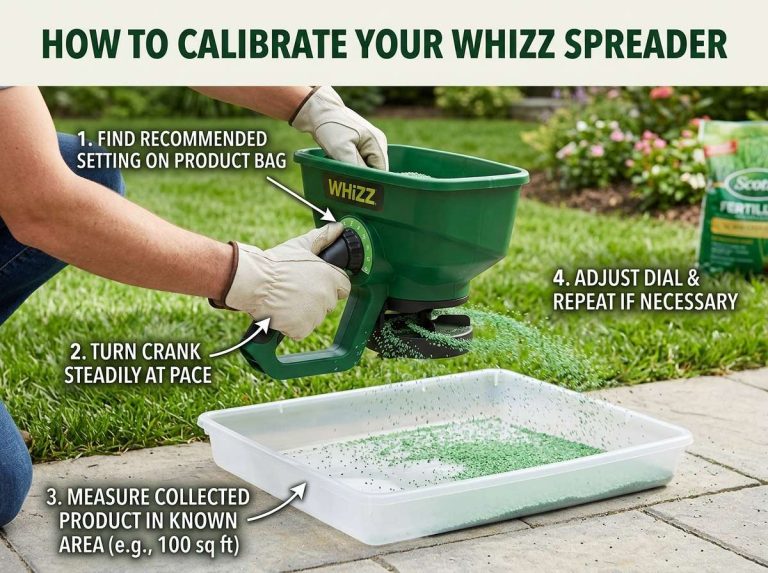
The biggest mistake new spreader owners make is loading up the hopper and heading straight out to the lawn without doing a calibration test first. Every spreader and every product combination gives slightly different results. Take 10 minutes to do a test spread on concrete or gravel, look at the pattern, and adjust the flow rate before you commit to the lawn.
Overlapping Passes Too Much or Too Little
If you overlap your passes too much, you apply double the recommended rate in some areas — this can burn grass and waste product. Too little overlap and you get visible stripes where product coverage is low. A good rule is to overlap by about 1 to 2 feet on each pass for even coverage without overdoing it.
Spreading in High Wind
Broadcast spreaders throw material into the air in a wide arc. In windy conditions, that material gets blown off course easily. Spreading fertilizer or pre-emergent on a windy day leads to uneven coverage and wasted product. Try to spread on calm mornings or evenings.
Leaving Fertilizer or Salt in the Hopper
Never store a spreader with product left in the hopper. Fertilizer attracts moisture and can clog the flow gate. Salt and ice melt are corrosive and will damage the spreader’s hardware and hopper over time if left sitting. Always empty, rinse, and dry the spreader after each use.
Running at Inconsistent Speeds
Spread rate is linked to how fast you move. Slow down and the spread gets heavier. Speed up and it thins out. Aim for a consistent driving or walking pace across your entire lawn to keep application even.
Using the Wrong Settings for the Product
Application rates vary a lot by product type and lawn condition. Using the wrong setting can result in under-fertilizing (weak results) or over-applying (lawn damage and wasted money). Always check the product bag for the recommended spreader settings and cross-reference with your specific spreader’s chart.
Ignoring Wet Grass or Soil
Spreading on wet grass causes granules to stick to the blades rather than falling to the soil level. This can lead to uneven absorption and in some cases fertilizer burn on the grass blades themselves. Let the lawn dry out before spreading, or apply early in the morning before dew forms.
Maintenance Tips to Keep Your Spreader Running Well
Lawn spreaders are pretty simple machines, but a little care goes a long way in keeping them working well season after season.
After every use, empty any remaining material and rinse the hopper thoroughly with a garden hose. Pay attention to the spinner disc and the flow gate area, as granules tend to collect there. Let everything dry completely before you store the spreader, especially if you’re heading into a long off-season.
At the start of each season, check all the moving parts — spinner, flow gate, wheels, and hitch. Look for any signs of rust on metal parts and treat them with a light coat of WD-40 or similar lubricant. If the spreader has pneumatic tires, check the tire pressure.
If you live in a humid climate, storing the spreader in a dry spot (not just under a tarp) will dramatically extend its life. Moisture is the main enemy of any spreader, especially in the flow mechanism and the spinner assembly.
Final Verdict: Which Pull Behind Fertilizer Spreader Is the Best?
After going through all three options in detail, here’s the honest bottom line.
The Agri-Fab 130 lb Pull Behind Broadcast Spreader is the top pick for people with large lawns who already own a riding mower. The 12-foot spread width is genuinely the widest in this group, and the 130 lb hopper is large enough to handle big jobs without constant refills. The brand reputation is strong, the build quality is solid, and it handles every common spreading material well. If you have an acre or more to cover and you want to do it fast, this is the spreader to get.
The Scotts Turf Builder EdgeGuard Mini is the best pick for suburban homeowners with smaller lawns who want clean, precise applications without a lot of setup or fuss. The EdgeGuard feature alone is worth the price for anyone with long driveways or neat garden borders. The matching settings system with Scotts products makes it the most user-friendly option in this roundup. It’s not a tow behind unit, but for its intended use case, it’s excellent.
The VEVOR Tow Behind Broadcast Spreader is the best value pick for buyers who want the most functionality per dollar. The dual tow/push design, 130 lb capacity, 13-inch pneumatic tires, and 30 settings make it a genuinely well-equipped spreader at a price that’s hard to beat. It’s the smart choice for people who want flexibility, a newer brand with solid reviews, and a lower price point.
There’s no single best spreader for everyone — it really comes down to your lawn size, the equipment you already own, and your priorities around precision vs. coverage vs. budget. But with any of these three options, you’re upgrading from hand spreading or small handheld units in a significant way. Your lawn will thank you.
Frequently Asked Questions
Can I use these spreaders for ice melt and salt? Yes, all three spreaders listed here are designed to handle salt and ice melt in addition to fertilizer and grass seed. Just make sure to rinse the spreader out thoroughly after each use, as salt is corrosive.
What size lawn do I need before a pull behind spreader makes sense? A good rule of thumb is that if your lawn is larger than about 10,000 square feet (roughly a quarter acre), a tow behind spreader starts making real sense for saving time and effort. Smaller lawns are often well-served by push or handheld spreaders.
Do I need a riding mower to use a tow behind spreader? Not necessarily. Any vehicle or equipment with a compatible hitch can tow a spreader — including ATVs, UTVs, garden tractors, and some larger walk-behind mowers. Just check the hitch type before you buy.
How do I know the right settings for my fertilizer? Start with the settings chart included with your spreader, or check the product bag for recommended settings. Many brands list settings for popular spreader models right on the bag. When in doubt, do a test pass on concrete first.
Can I spread grass seed and fertilizer at the same time? Some people do apply them together in one pass, but most lawn care pros recommend separate passes to ensure accurate rates for each product. Mixing can also cause calibration issues since the two materials have different weights and granule sizes.
How do I store a pull behind spreader off-season? Empty and rinse it completely, let it dry, then store it in a dry, covered area. A garage or shed is ideal. If you must store it outside, use a waterproof cover and make sure the flow gate is closed to keep moisture and insects out.

Hi, I’m Mary, the founder of GardenCure.com. I’m passionate about creating healthy, beautiful gardens and well-kept lawns. I share practical experience and trusted advice on garden and lawn gear that truly works. With the support of my dedicated research team, our writers produce honest, in-depth reviews using reliable, authentic sources—helping you choose the right tools with confidence for your outdoor space.