
5 Best Herbicide for Bermuda Grass In 2026
Bermuda grass is tough. It spreads fast, roots deep, and doesn’t give up easily. If you’ve ever tried to control weeds in a bermuda grass lawn — or tried to stop bermuda grass from invading a flower bed — you already know the headache.
In this article
The right herbicide makes a huge difference. The wrong one can damage your lawn, waste your money, or just flat-out not work.
This guide reviews five of the best herbicide for bermuda grass products available right now. Some are designed to protect bermuda grass from weeds. Others are made to kill bermuda grass when it shows up where you don’t want it. We’ll cover both sides so you know exactly what you’re buying.
Each review breaks down how the product works, who it’s best for, what it does well, and where it falls short. There’s also a buying guide at the end to help you pick the right one for your situation.
Top Product List
Why Bermuda Grass Control Is So Tricky
Bermuda grass is one of the most resilient warm-season grasses out there. It’s used on golf courses, sports fields, and home lawns across the southern United States for good reason — it handles heat, foot traffic, and dry spells like a champ.
But that same toughness is what makes it so hard to manage. Bermuda spreads through stolons (above-ground runners), rhizomes (underground runners), and seeds. That’s three different ways it can grow and take over.
When you’re protecting a bermuda grass lawn from weeds, you need a product that targets broadleaf weeds or grassy weeds without hurting the bermuda. When you’re removing bermuda grass from a garden bed or ornamental area, you need something strong enough to actually kill those deep roots.
That’s why there’s no single “best” product for every situation. The best herbicide for bermuda grass depends entirely on your goal.
Let’s break down each product so you can make a smart call.
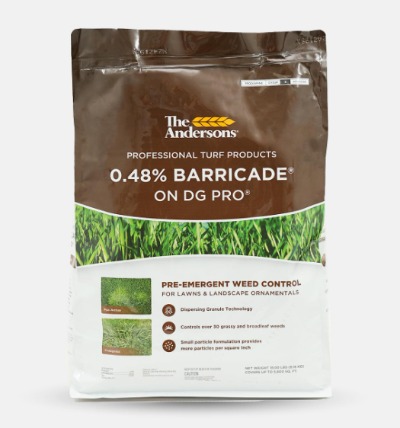
1. The Andersons Barricade Professional-Grade Granular Pre-Emergent Weed Control
Product Overview
The Andersons Barricade is a professional-grade pre-emergent herbicide in granular form. It uses prodiamine as its active ingredient — a proven weed preventer that stops weed seeds from germinating in the first place.
This is not a product that kills weeds you can already see. It works before weeds even sprout. Think of it like a barrier in the soil that blocks germination at the root level.
The 18-pound bag covers up to 5,800 square feet, which is solid coverage for most residential lawns.
Best Use Cases
This product is best for homeowners who want to keep their bermuda grass lawn weed-free throughout the growing season. It works well against crabgrass, annual bluegrass, foxtail, spurge, and other common lawn weeds.
It’s also useful for lawn care professionals who manage multiple properties and need a reliable pre-emergent they can count on season after season.
Apply it before weed season kicks in — before soil temperatures hit around 55°F at a 4-inch depth. Early spring application is the most common approach, but a fall application also helps prevent cool-season weeds.
Key Features Explained Simply
Prodiamine as Active Ingredient: Prodiamine is one of the most effective pre-emergent herbicides available. It binds to soil particles and creates a barrier that stops weeds before they emerge. It’s the gold standard in professional turf management.
Granular Format: The granular form makes it easy to spread with a broadcast spreader. You don’t need to mix anything or deal with liquid sprayers. Just load the spreader and walk.
Long-Lasting Residual Control: Barricade stays active in the soil for a long time — often through an entire growing season — which means fewer applications compared to other pre-emergents.
Safe for Established Bermuda Grass: Once bermuda grass is fully established, Barricade does not harm it. The bermuda continues to grow normally while weeds are blocked at the germination stage.
Professional Grade: This isn’t a watered-down consumer product. The Andersons formulates this at the same concentration used by professional lawn care operators.
Real-Life Usage Insight
Lawn care pros often choose prodiamine-based products over pendimethalin (another common pre-emergent) because prodiamine has a lower risk of staining and doesn’t break down as quickly in heat. The Barricade formulation takes full advantage of this.
You apply it with a spreader, water it in, and it goes to work in the soil. The key is timing. Apply it too late and weed seeds have already germinated — the product won’t help at that point. Apply it correctly and you can dramatically reduce the weeding you do all season.
One thing to keep in mind: this product will prevent grass seed germination too. Don’t apply it if you plan to overseed your lawn in the coming months.
Pros
- Effective against a wide range of broadleaf and grassy weeds
- Easy granular application with a standard spreader
- Long residual control reduces the number of treatments needed
- Safe for established bermuda grass
- Professional-grade concentration gives better results than many consumer products
- Cost-effective per square foot when used correctly
Cons
- Will not kill weeds that are already growing — strictly pre-emergent
- Cannot be used if you plan to seed the area soon after application
- Requires watering in after application for activation
- May be more product than a very small lawn needs
Performance Discussion
Barricade performs consistently well when applied at the right time. Lawns treated before weed season see a clear reduction in crabgrass and other annual weeds. It doesn’t eliminate 100% of weeds in all cases — no pre-emergent does — but it significantly cuts weed pressure across the season.
The prodiamine binds well to soil and doesn’t break down quickly from rain or irrigation, which directly contributes to its long residual activity. That extended protection is the main reason lawn care professionals keep coming back to it.
Ease of Use
This is one of the simpler herbicide applications you’ll make. Calibrate your spreader, apply the granules at the recommended rate, and water it in. No mixing, no spray equipment, no complex setup.
Value for Money
At roughly $0.01–$0.02 per square foot of coverage, this product delivers excellent value — especially compared to liquid pre-emergents that require more equipment to apply. For a 5,800 sq ft lawn, one bag handles the full job.
Verdict: Best Pre-Emergent for Bermuda Grass Lawns
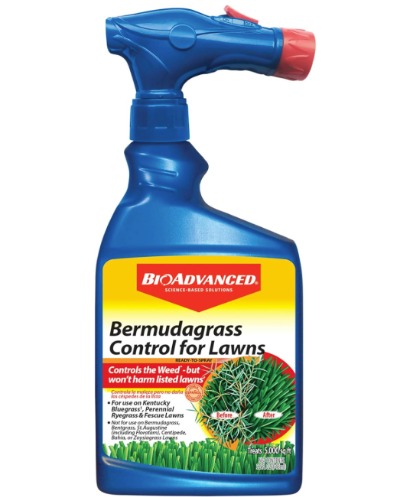
2. BioAdvanced Bermudagrass Control for Lawns
Product Overview
This one has a very direct name — and it does exactly what it says. BioAdvanced Bermudagrass Control is specifically made to kill bermuda grass that’s growing where you don’t want it. It targets bermuda grass in cool-season lawns like tall fescue, bluegrass, or ryegrass without harming those grasses.
The active ingredients are fluazifop-P-butyl and triclopyr. Together, they target bermuda grass selectively, allowing your desirable grass to keep growing while bermuda slowly dies off.
The 32 oz bottle comes with a ready-to-spray hose-end attachment, so there’s no mixing required at all.
Best Use Cases
This product is ideal for homeowners with cool-season lawns who are dealing with bermuda grass creeping in from neighboring properties or old lawn areas. Bermuda grass is a common invader in fescue and bluegrass lawns, and it can quickly take over large patches.
It’s not the right product if you want bermuda grass and are just trying to control weeds in it. This product targets bermuda grass itself — it will kill it.
It works best when bermuda grass is actively growing during warmer periods. Dormant bermuda grass doesn’t absorb the herbicide effectively.
Key Features Explained Simply
Selective Control: It kills bermuda grass without harming most cool-season lawn grasses. This selectivity is the key selling point and what separates it from generic grass killers.
Ready-to-Spray Format: The hose-end sprayer makes application very simple. Connect to your hose, point, and spray. No tank mixing required.
Dual Active Ingredients: Fluazifop targets grasses at the cellular level, disrupting fatty acid synthesis. Triclopyr adds broadleaf control as a bonus, helping with any broadleaf weeds growing in the same area.
Covers 5,000 Sq Ft: The 32 oz bottle has solid coverage for a typical affected zone.
Multiple Applications Expected: Because bermuda grass has deep rhizomes, the label recommends follow-up applications for full control. This is standard for bermuda grass removal — not a flaw in the product.
Real-Life Usage Insight
Bermuda grass control in cool-season lawns is one of the most frustrating lawn problems out there. Many homeowners try regular grass killers and end up damaging their entire lawn. This product solves that problem through selectivity.
You’ll likely need two to three applications spaced a few weeks apart for complete control of established bermuda grass patches. The above-ground growth dies first, but the underground rhizomes take more time. Be patient — the results come with persistence.
Apply when bermuda grass is actively growing and temperatures are consistently warm. Avoid applying if rain is expected within 24 hours.
Pros
- Specifically designed to kill bermuda grass selectively
- Safe for most cool-season grasses like tall fescue and bluegrass
- Ready-to-spray design requires no mixing equipment
- Dual active ingredients address both grass and broadleaf issues
- Works on both stolons and rhizomes over time with repeated treatment
Cons
- Multiple applications are usually required for full control
- Does not work well on dormant bermuda grass
- Not suitable if you want to keep bermuda as your lawn grass
- Results take two to three weeks per application to fully appear
- Hose-end sprayers can be imprecise compared to calibrated tank sprayers
Performance Discussion
BioAdvanced Bermudagrass Control works. The selectivity is genuine — cool-season grasses come through the treatment without significant damage while bermuda grass slowly yellows and dies back. The fluazifop component is highly effective at targeting bermuda’s growth mechanism, and the results are visible with repeated applications.
Ease of Use
The ready-to-spray hose-end attachment keeps things simple. There’s no calibration or mixing. Attach to a hose and spray. The main challenge is getting even coverage without over-applying in any one spot.
Value for Money
At around $20–$25 for a 32 oz bottle covering 5,000 sq ft, the price is reasonable for what you get. Needing multiple bottles for a serious infestation adds up, but it’s still far cheaper than replanting a cool-season lawn from scratch.
Verdict: Best for Removing Bermuda Grass from Cool-Season Lawns
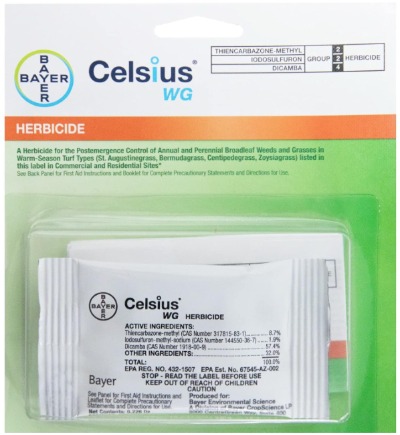
3. Prime Source Celsius WG
Product Overview
Prime Source Celsius WG is a professional-grade post-emergent herbicide that controls a wide range of weeds in bermuda grass, zoysia, and centipede lawns. The active ingredients are thiencarbazone-methyl, iodosulfuron-methyl-sodium, and dicamba — a combination that handles both grassy and broadleaf weeds in one application.
This is a water-dispersible granule (WG) product. The 0.226 oz packet is a single-use, easy-mix portion that you dissolve in water and apply with a sprayer.
It’s the kind of product used by lawn care professionals — now packaged in a format home users can actually work with.
Best Use Cases
Celsius WG is best for homeowners and lawn care pros who have an established bermuda grass lawn and need to control post-emergent weeds — weeds that are already growing and visible in the turf.
It handles a long list of problem weeds: crabgrass, dallisgrass, clover, dandelion, kyllinga, dollarweed, and many more. If you’ve got multiple weed types mixed into your bermuda lawn, this is one of the few products that can address all of them in one application.
Key Features Explained Simply
Three Active Ingredients: Thiencarbazone-methyl, iodosulfuron-methyl-sodium, and dicamba create a multi-mode-of-action product. Weeds can’t easily develop resistance, and the product covers a wider spectrum than single-ingredient herbicides.
Selective for Bermuda Grass: Celsius targets weeds without harming established bermuda grass. Bermuda is notably tolerant of this formula, even at higher application rates.
Single-Use Packet: The pre-measured 0.226 oz packet dissolves easily in water. No bulk containers, no measuring out powder, no guessing.
Low Use Rate: Celsius works at very low application rates. This makes it cost-effective and reduces the chemical load applied to your yard.
Effective Against Hard-to-Kill Weeds: Dallisgrass and kyllinga are notoriously difficult to control selectively. Celsius is one of the few selective options that actually handles both in bermuda turf.
Real-Life Usage Insight
Celsius WG has a strong following among lawn care professionals in the southeastern United States where bermuda grass is king. Many turf managers rely on it as their go-to post-emergent for mixed weed populations.
For home users, the single-packet format removes a major barrier. One packet mixes into a specific volume of water and you apply it with a pump or backpack sprayer.
Results typically show within one to three weeks depending on the weed species. Some weeds take longer than others. Kyllinga and dallisgrass require patience and sometimes a follow-up application. Adding a non-ionic surfactant to the mix improves coverage and absorption significantly.
Pros
- Broad-spectrum control — handles grassy and broadleaf weeds in one product
- Selective for bermuda grass — won’t damage your established lawn
- Easy-mix single-use packet removes measuring errors
- Works on tough weeds like dallisgrass, kyllinga, and crabgrass
- Professional-grade formula trusted by turf industry pros
- Low use rate makes it economical per square foot of treatment
Cons
- Requires a pump sprayer for application — extra equipment needed
- Results take one to three weeks to fully appear
- Heavy infestations may need a follow-up application
- Non-ionic surfactant is sold separately but strongly recommended
- Higher per-unit cost compared to basic broadleaf killers
Performance Discussion
Celsius WG consistently outperforms simpler post-emergent products in terms of weed spectrum and selectivity. The three-way active ingredient combination gives it a reach that single-ingredient products simply can’t match.
For bermuda grass lawns, it’s one of the safest and most effective post-emergent options on the market. Bermuda tolerates the treatment well, and even somewhat stressed turf bounces back without long-term damage.
Ease of Use
There’s a small learning curve if you’ve never worked with WG herbicides before. You’ll need a pump sprayer, clean water, and a surfactant. But the single-packet format removes the measuring step, which is the most common source of error for home applicators.
Once you’ve done it once, the process is straightforward.
Value for Money
Celsius WG packets cost more per unit than basic broadleaf killers, but the broad-spectrum performance more than justifies the price. You’re getting professional-level results without paying for a lawn care service. For homeowners dealing with multiple weed types in bermuda turf, this is one of the best investments you can make.
Verdict: Best Post-Emergent for Mixed Weed Problems in Bermuda Grass Lawns
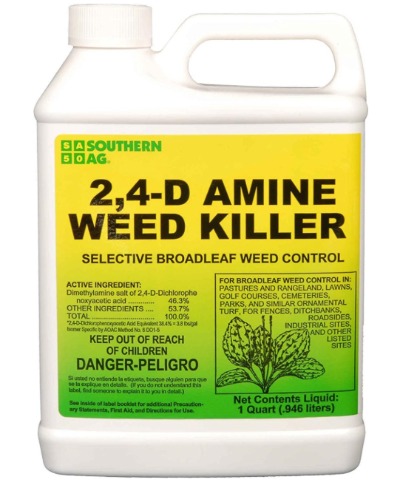
4. Southern Ag Amine 2,4-D Weed Killer – 32 oz (Quart)
Product Overview
Southern Ag Amine 2,4-D is one of the most classic broadleaf weed killers you’ll find anywhere. The active ingredient — 2,4-dichlorophenoxyacetic acid — has been used for decades to control broadleaf weeds in lawns, pastures, and fields across the country.
The 32 oz concentrate gives you a large number of applications from a single bottle. You dilute it with water and apply it with a sprayer. It targets broadleaf weeds like dandelions, clover, plantain, chickweed, and dozens of others while leaving grasses like bermuda unharmed at the correct application rate.
Best Use Cases
This product is best for homeowners dealing with common broadleaf weeds in their bermuda grass lawn who want a no-frills, affordable solution that works.
It’s ideal for dandelions, clover, plantain, and similar weeds. It does not control grassy weeds like crabgrass or dallisgrass — for those, you’d need a different product or combination approach.
It also works well in pastures, rights-of-way, and non-cropland areas where broadleaf weed control is needed without disturbing grassy vegetation.
Key Features Explained Simply
2,4-D Active Ingredient: One of the most studied and widely used herbicide active ingredients in the world. Highly effective on a broad range of broadleaf weeds and backed by decades of real-world results.
Amine Formulation: The amine form of 2,4-D is less volatile than ester formulations. That means a lower risk of vapor drift to nearby sensitive plants on warm days — a meaningful advantage for lawns near gardens and trees.
Concentrated Formula: The 32 oz bottle produces many gallons of ready-to-use spray, giving you excellent volume per dollar spent.
Broad Broadleaf Control: Controls over 50 types of broadleaf weeds — one of the widest ranges available from any single active ingredient.
Trusted Brand: Southern Ag has manufactured agricultural and lawn care chemicals for decades. This is a well-established, reliable product line.
Real-Life Usage Insight
2,4-D is about as old school as it gets in lawn care chemistry, but it still works extremely well for what it does. If your bermuda grass lawn has a clover or dandelion problem, a single application at the labeled rate takes care of most of it within two weeks.
The key is dilution. Follow the label carefully. Too little won’t control the weeds effectively. Too much can cause temporary yellowing of bermuda grass. At the correct rate, bermuda handles 2,4-D well.
Don’t apply when bermuda grass is coming out of dormancy or under heat or drought stress. The lawn is more vulnerable during those transitions and more likely to show temporary injury.
Avoid spraying near broadleaf ornamentals, vegetables, or trees whose root zones extend into the treated area. 2,4-D can drift and cause damage to broadleaf plants you want to keep.
Pros
- Extremely affordable — one of the lowest cost-per-application options available
- Effective on a wide range of broadleaf weeds
- Amine formulation has lower volatility than ester forms — safer near ornamentals
- Concentrated formula covers a large area from one bottle
- Well-established, research-backed active ingredient with a long proven track record
- Widely available at garden centers and online
Cons
- Does not control grassy weeds like crabgrass or dallisgrass
- Can cause temporary stress or yellowing in bermuda grass if over-applied
- Requires careful dilution — measuring errors lead to poor results or turf injury
- Not safe near broadleaf garden plants, vegetables, or ornamentals
- Wind drift is still a risk even with amine form — apply on calm days only
Performance Discussion
2,4-D does exactly what it’s supposed to do for broadleaf weeds. Decades of use in turf management confirm its effectiveness. In bermuda grass lawns, it controls common broadleaf weeds reliably. Results are typically visible within a week, with weeds fully dead in two weeks. For persistent weeds or heavy infestations, a follow-up application may be needed.
Ease of Use
This is a concentrate that requires mixing. You need a sprayer and a measuring cup. The mixing instructions are on the label, but attention to dilution is required. Once mixed, application is simple — spray the affected areas and avoid drift onto neighboring plants.
Value for Money
Southern Ag 2,4-D is one of the best values in the herbicide market. A 32 oz bottle at typical application rates produces anywhere from 1 to 3 gallons of spray, which covers a large area. The per-square-foot cost is very low. For budget-conscious homeowners with broadleaf weed problems in bermuda turf, this is the smart buy.
Verdict: Best Budget Option for Broadleaf Weed Control in Bermuda Grass
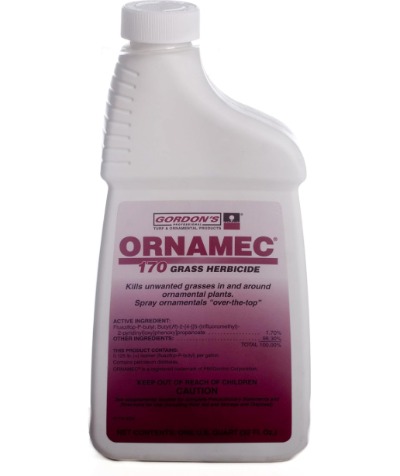
5. Gordon’s Ornamec 170 Grass Herbicide – 32 Ounces
Product Overview
Gordon’s Ornamec 170 is a selective post-emergent grass herbicide. The active ingredient is fluazifop-P-butyl at 18.4%, which targets grasses specifically — including bermuda grass — while leaving broadleaf ornamental plants, shrubs, and ground covers completely unharmed.
This is the product landscapers and gardeners reach for when bermuda grass or other grassy weeds invade ornamental beds, areas around trees, or ground cover plantings where you can’t use a non-selective herbicide.
The 32 oz concentrate mixes with water and a surfactant for application with a pump or backpack sprayer.
Best Use Cases
Ornamec 170 is perfect for garden beds, ornamental landscapes, foundation plantings, and areas where bermuda grass is creeping in around plants you want to protect.
It’s designed for use around ornamentals — broadleaf plants, shrubs, trees, and ground covers. Since fluazifop targets grasses selectively, those plants are safe while bermuda grass and other grassy invaders are eliminated alongside them.
It’s also a common choice along fences, driveways, and other hardscape edges where bermuda spreads from turf into unwanted zones.
Key Features Explained Simply
Fluazifop-P-Butyl at 18.4%: High-concentration formulation of one of the most reliable selective grass killers available. Fluazifop works by inhibiting acetyl-CoA carboxylase, an enzyme grasses need for fatty acid production. Broadleaf plants don’t rely on this pathway the same way, which is why they’re unaffected.
Selective for Broadleaf Plants: Broadleaf ornamentals, shrubs, and most ground covers show no damage when the product is applied correctly. You can spray directly in and around many ornamental plantings.
Post-Emergent Action: Kills grass that is actively growing. Works on both above-ground growth and underground rhizomes over time.
Concentrate Formula: A little goes a long way at the label rate. The 32 oz bottle covers a significant area.
No Persistent Soil Activity: Ornamec 170 does not linger in the soil in a way that would prevent future planting — a real advantage if you plan to replant an area after removing bermuda grass.
Real-Life Usage Insight
Gardeners dealing with bermuda grass invasion into flower beds know the struggle well. Hand pulling doesn’t work — the rhizomes break and regrow immediately. Non-selective herbicides kill everything in sight. Ornamec 170 solves this problem cleanly by killing the bermuda grass while leaving ornamentals alone.
Mix the product with water and a non-ionic surfactant — the surfactant is important and improves results significantly. Apply on a calm, dry day when bermuda grass is actively growing.
Results come in stages. Visible top growth begins to show stress within one to two weeks. Underground rhizomes take longer and often require a second application for complete elimination of well-established bermuda patches.
Pros
- Selectively kills bermuda grass and grassy weeds without harming broadleaf ornamentals
- High concentration fluazifop delivers reliable results on tough bermuda infestations
- Safe to use around established shrubs, trees, and ground covers
- Post-emergent action treats existing growth directly
- No soil residual that would prevent future planting in treated areas
- Long track record of trusted use in professional landscaping
Cons
- Requires mixing with water and a non-ionic surfactant (sold separately)
- Multiple applications often needed for heavy bermuda grass infestations
- Only works on actively growing bermuda grass — not effective on dormant plants
- Results take one to two weeks to become fully visible
- Concentrate requires careful measurement to avoid misapplication
Performance Discussion
Ornamec 170 is a reliable, proven grass killer for ornamental settings. The fluazifop at 18.4% concentration provides the punch needed to tackle bermuda’s persistent root system over time. The selectivity is genuine — broadleaf plants show no damage under normal application conditions.
Patience is required, especially for established bermuda grass with deep rhizomes. But the results are real, and it’s one of the safest approaches to removing bermuda grass from a garden bed without harming everything else around it.
Ease of Use
The mixing step is the main task. You’ll need a sprayer, water, and a non-ionic surfactant. The label provides clear instructions. For beginners, the biggest challenge is accurate measuring of the concentrate. Use a measuring cup and follow the label exactly. Don’t estimate.
Value for Money
A 32 oz bottle at label rates covers several thousand square feet depending on application rate. The cost per treatment is moderate and competitive for a product of this quality. For home gardeners, the 32 oz size works well for most situations without over-buying.
Verdict: Best for Removing Bermuda Grass from Garden Beds and Ornamental Areas
Side-by-Side Comparison
| Product | Goal | Type | Bermuda Safe? | Best For |
|---|---|---|---|---|
| Andersons Barricade | Prevent weeds in bermuda lawn | Granular pre-emergent | Yes | Lawn weed prevention |
| BioAdvanced Bermudagrass Control | Kill bermuda in cool-season lawn | Liquid post-emergent | No — kills bermuda | Cool-season lawn rescue |
| Prime Source Celsius WG | Kill weeds in bermuda lawn | WG post-emergent | Yes | Mixed weed problems |
| Southern Ag 2,4-D | Kill broadleaf weeds in bermuda | Liquid concentrate | Yes (at label rate) | Budget broadleaf control |
| Gordon’s Ornamec 170 | Kill bermuda in ornamental areas | Liquid concentrate | No — kills bermuda | Garden beds and ornamentals |
Buying Guide: How to Pick the Right Herbicide for Your Situation
The biggest mistake people make when buying herbicide for bermuda grass is not knowing what they’re actually trying to do. Are you protecting bermuda grass from weeds? Or are you trying to get rid of bermuda grass itself?
Here’s how to think through your decision step by step.
Step 1: Define Your Goal
Goal A: You have a bermuda grass lawn and want to keep it healthy and weed-free.
You need a product that is safe for bermuda grass while targeting the weeds growing in it.
- For preventing weeds before they grow: Andersons Barricade
- For killing broadleaf weeds already growing: Southern Ag 2,4-D
- For killing a mix of grassy and broadleaf weeds: Prime Source Celsius WG
Goal B: You have a cool-season lawn (fescue, bluegrass, ryegrass) and bermuda grass is invading it.
You need a product that kills bermuda grass selectively without harming your cool-season grass.
- Best option: BioAdvanced Bermudagrass Control
Goal C: Bermuda grass is invading your garden beds, ornamental plantings, or areas around shrubs and trees.
You need a product that kills bermuda grass without harming your broadleaf ornamentals.
- Best option: Gordon’s Ornamec 170
Step 2: Know Your Weed Types
- Broadleaf weeds only (dandelion, clover, plantain): Southern Ag 2,4-D is the most affordable and effective choice.
- Grassy weeds only (crabgrass, foxtail): Celsius WG handles these along with broadleaf weeds.
- Mixed weed problem: Celsius WG handles the broadest range in one product.
- Bermuda grass itself is the problem: BioAdvanced or Ornamec 170 depending on your setting.
Step 3: Consider Application Method
- No sprayer, want the easiest possible application: Andersons Barricade (granules) or BioAdvanced (hose-end sprayer)
- Have a pump sprayer: Any of the liquid or WG concentrates work well
- Large area to treat: Concentrated products give you more coverage per dollar
Step 4: Think About Timing
- Pre-emergent: Apply before weed seeds germinate — early in the season before soil warms up
- Post-emergent: Apply when weeds are actively growing and visible in the turf
- Bermuda grass removal: Apply when bermuda is actively growing — never dormant
Step 5: Check Label Safety for Your Other Plants
Always read the label before you buy. Every product lists which grasses, crops, and ornamentals it’s safe for and which it will damage. Don’t assume based on the product name alone.
Who Should Buy These Products
The Andersons Barricade is for you if: You manage a bermuda grass lawn and want to stay ahead of weeds before they appear. You’re willing to apply granules with a spreader and want a solution that covers the full growing season without repeated treatments. You want results without complexity.
BioAdvanced Bermudagrass Control is for you if: You have a fescue, bluegrass, or ryegrass lawn and bermuda grass has moved in from a neighbor’s property or a previously bermuda-covered area. You want a spray-on solution that won’t destroy your existing cool-season turf. You understand that multiple applications are part of the process.
Prime Source Celsius WG is for you if: You have an established bermuda grass lawn with a mix of different weed types that basic products haven’t handled. You want one product that controls both grassy and broadleaf weeds. You’re comfortable using a pump sprayer and want professional-level results without hiring a service.
Southern Ag Amine 2,4-D is for you if: You’re on a tight budget. You have a bermuda grass lawn with a broadleaf weed problem — mostly dandelions, clover, and similar common weeds. You want a proven, no-fuss solution at the lowest cost per application possible.
Gordon’s Ornamec 170 is for you if: You have a garden bed, ornamental area, or landscape planting where bermuda grass is encroaching around plants you care about. You want to eliminate the grass invasion without harming the broadleaf plants around it. You’re comfortable mixing concentrates with a sprayer and applying carefully.
Common Mistakes to Avoid
Applying Post-Emergent When You Need Pre-Emergent (and Vice Versa)
Pre-emergent products prevent seeds from germinating. They don’t kill established weeds. If you spray Barricade on dandelions that are already blooming, you’re wasting product and money.
Post-emergent products kill growing plants. They don’t prevent future germination. If you kill existing weeds but skip pre-emergent treatment for next season, the same problem will return just as strong.
Use both as part of a seasonal weed management approach.
Using the Wrong Product for Your Grass Type
Some herbicides that are safe for bermuda grass can seriously damage fescue, zoysia, or centipede grass. Always check the label for grass type compatibility before applying anything.
If you have a mixed lawn or aren’t sure what type of grass you have, identify that first. Applying the wrong product to the wrong grass type causes expensive, slow-to-repair damage.
Applying During Heat Stress or Drought
Bermuda grass under heat or drought stress is more likely to show injury from herbicides — even ones that are generally safe for bermuda at normal times. Apply herbicides when your lawn is healthy and adequately hydrated, but not immediately after heavy irrigation when the soil is waterlogged.
Avoid applying during the hottest part of the day. Early morning applications give the best results.
Not Reading the Label
This sounds obvious, but it’s the most common mistake homeowners make. Labels contain critical information: dilution rates, rain-free periods, which plants are safe and which aren’t, how long to wait before reseeding, and more.
Skipping the label leads to over-application, under-application, drift damage to ornamentals, or applying a product at completely the wrong time.
Expecting Instant Results
Herbicides work over time. Most post-emergent products take one to three weeks to show full results. Tough species like dallisgrass or established bermuda grass rhizomes take even longer. Don’t re-apply immediately just because results aren’t visible the next morning.
Patience is a real part of effective herbicide use.
Not Using a Surfactant When Required
Several of the liquid products in this review — especially Celsius WG and Ornamec 170 — perform significantly better with a non-ionic surfactant added to the tank mix. The surfactant helps the herbicide stick to waxy leaf surfaces and penetrate the plant more effectively.
It’s a cheap addition that makes a real, measurable difference in results.
Applying Before Rain
Most herbicides need several hours — sometimes 24 hours — to absorb before rain washes them off treated leaves. Applying before a rain event means you’ve wasted product and accomplished nothing. Always check the forecast before you spray.
Treating Dormant Bermuda Grass
Products designed to control or kill bermuda grass — BioAdvanced Bermudagrass Control and Ornamec 170 — work on actively growing plants. Dormant bermuda grass won’t absorb the herbicide effectively, and results will be poor. Time your applications when bermuda is visibly growing and green.
Final Verdict
There’s no single best herbicide for bermuda grass that works for every person in every situation. The right product depends entirely on what you’re trying to accomplish.
Best for preventing weeds in a bermuda lawn: The Andersons Barricade. The professional-grade prodiamine formula provides season-long pre-emergent protection, and the granular format makes application as simple as it gets.
Best for killing bermuda grass in a cool-season lawn: BioAdvanced Bermudagrass Control. The selective formula targets bermuda while leaving fescue and bluegrass untouched. There’s no better option for this specific problem.
Best all-around post-emergent for bermuda lawns: Prime Source Celsius WG. The three-way active ingredient combination handles more weed types than any other product on this list. If your bermuda lawn has multiple weed problems and you want one product to address them, this is the one to reach for.
Best budget option: Southern Ag Amine 2,4-D. Simple, effective, and remarkably affordable. For broadleaf weeds in bermuda grass, it’s hard to find better value.
Best for garden beds and ornamentals: Gordon’s Ornamec 170. When bermuda grass invades areas with broadleaf plants you want to protect, Ornamec is the go-to product that solves the problem without collateral damage.
Use this guide to match the product to your specific situation. Read the label before you apply anything. And be patient — good lawn care and landscape management take time, but the results are absolutely worth it.
Frequently Asked Questions
Can I use 2,4-D on bermuda grass? Yes. At the labeled rate, 2,4-D is generally safe for established bermuda grass. It controls broadleaf weeds without killing the bermuda. Avoid applying to stressed, newly planted, or dormancy-transitioning bermuda grass.
Will pre-emergent herbicide kill existing weeds? No. Pre-emergent herbicides prevent seeds from germinating. They don’t affect weeds that are already growing. For visible, established weeds, use a post-emergent product.
How long should I wait to mow after applying herbicide? Most labels recommend waiting two to three days after applying a post-emergent herbicide before mowing. Mowing too soon removes treated leaf surface and reduces herbicide effectiveness.
Can I seed my bermuda lawn after applying pre-emergent? Not right away. Pre-emergent herbicides prevent seed germination — including grass seed. Wait until the product’s residual activity has expired before seeding. Check the label for specific timing guidance, which is often three to four months.
How many applications do I need to control bermuda grass in an ornamental bed? Most users need two to three applications spaced two to four weeks apart to eliminate established bermuda grass from ornamental areas. The rhizomes are persistent and may require multiple treatments before full control is achieved.
Is fluazifop the same active ingredient in both BioAdvanced and Ornamec 170? Yes. Both products use fluazifop-P-butyl as a primary active ingredient. The concentrations and formulations differ. BioAdvanced is ready-to-spray and formulated for use in cool-season lawns. Ornamec 170 is a higher-concentration concentrate designed specifically for ornamental settings.
What’s the best time to apply pre-emergent to a bermuda lawn? Apply before soil temperatures reach 55°F at a 4-inch depth, which typically means early spring before the growing season gets going. A second fall application helps control cool-season annual weeds that germinate in cooler soil.

Hi, I’m Mary, the founder of GardenCure.com. I’m passionate about creating healthy, beautiful gardens and well-kept lawns. I share practical experience and trusted advice on garden and lawn gear that truly works. With the support of my dedicated research team, our writers produce honest, in-depth reviews using reliable, authentic sources—helping you choose the right tools with confidence for your outdoor space.



One Comment