
5 Best Herbicide for Centipede Grass In 2026
Centipede grass looks great when it is happy. It stays low, feels soft, and needs less mowing and feeding than most warm-season lawns. The catch is that it is picky about what you spray on it. The wrong weed killer can leave yellow patches, thin spots, or a lawn that takes weeks to recover.
In this article
That is why finding the best herbicide for centipede grass takes a little care. The goal is to kill weeds without hurting the turf you are trying to protect.
This roundup looks at five popular products: two versions of Celsius WG, two atrazine-based weed killers, and one granular pre-emergent. Each review covers what the product does, where it fits, how it performs, and whether it is worth the money. Beginners can follow every step.
By the end, you will know which product fits your weeds, your lawn size, and your skill level.
Quick Comparison of the Best Centipede Grass Weed Killers
| Product | Type | Main Job | Best For | Form |
|---|---|---|---|---|
| Celcius WG Herbicide 6666194 | Post-emergent | Kills many broadleaf and grassy weeds | Lawns with mixed weeds | Water-dispersible granules |
| Hi-Yield Atrazine Weed Killer (32 oz) | Pre- and post-emergent | Broadleaf weeds and some grasses | Small to medium lawns | Liquid concentrate |
| The Andersons Barricade (40 lb) | Pre-emergent | Stops weed seeds from sprouting | Large lawns, prevention plans | Granular |
| Southern Ag Atrazine (1 gallon) | Pre- and post-emergent | Broadleaf weeds and some grasses | Big lawns, budget buyers | Liquid concentrate |
| Prime Source Celsius WG (0.226 oz packet) | Post-emergent | Spot treatment of active weeds | Tiny lawns, first-time users | Easy mix packet |
Keep this table handy. We will come back to it in the comparison section.
Why Centipede Grass Needs a Gentler Weed Control Plan
Centipede grass is often called the “lazy man’s lawn.” It grows slowly and does fine in poor, acidic soil. It also handles low fertilizer and light foot traffic.
That low-maintenance nature is also its weakness. Centipede has a shallow root system and a soft, slow-growing structure. When a strong herbicide hits it, the grass has a hard time bouncing back.
Many common lawn chemicals cause trouble here. Heavy doses of broadleaf killers can stunt the grass. Products meant for cool-season turf can burn it. Even some products labeled safe for warm-season lawns call for lower rates on centipede.
So the first rule is simple: always read the label and confirm centipede grass is listed. All five products below list it or work safely on it when used as directed, but rates and timing matter a lot.
Weed pressure also changes with the seasons. Crabgrass and goosegrass show up in warm weather. Chickweed, henbit, and annual bluegrass show up in cool weather. Dollarweed, clover, and sedges love wet spots all year.
A smart plan usually mixes two things:
- A pre-emergent herbicide to stop weed seeds before they sprout
- A post-emergent herbicide to kill the weeds that slip through
Some products in this list do one job. Some do both. Knowing the difference saves you money and protects your lawn.
Pre-Emergent vs. Post-Emergent: A Fast Refresher
Beginners often mix up these two terms, so here is the short version.
A pre-emergent creates a thin barrier in the top layer of soil. When weed seeds try to sprout, the barrier stops them. It does not kill weeds that are already growing.
A post-emergent kills weeds that are already up and growing. You spray it on the leaves, and the plant absorbs it.
Timing matters most for pre-emergents. Apply too late, and the seeds have already sprouted. Apply it at the right time, and you cut weed pressure for months.
Post-emergents work best on young, actively growing weeds. Big, stressed, or drought-hit weeds fight back harder.
With that settled, let’s get into the reviews.
Individual Product Reviews
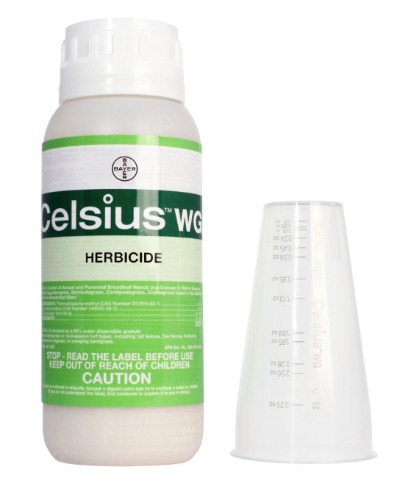
1. Celcius WG Herbicide 6666194
Product Description
Celsius WG is a well-known post-emergent weed killer made for warm-season lawns. It comes as water-dispersible granules. You mix it with water and spray it on weeds.
The formula uses three active ingredients: dicamba, iodosulfuron-methyl-sodium, and thiencarbamazone-methyl. Together, they hit weeds in different ways. That is why the product can handle many weed types in one pass.
This listing, with the product code 6666194, is a standard retail size. Package sizes can vary between sellers, so check the weight on the page before you buy. Match it to your lawn size so you do not overbuy.
Best Use Cases
This product shines when your lawn has a mix of weed types. If you see dollarweed next to clover, crabgrass near dandelions, and a few sedges along the edge, Celsius WG can handle a lot of that in one treatment.
It also works well for:
- Lawns where weeds have already taken hold
- Mixed broadleaf and grassy weed problems
- Warm-season lawns that need a selective weed killer
- Lawn owners who want one product to cover many weeds
It is not the right pick for stopping weeds before they sprout. For that job, use a pre-emergent.
Key Features Explained Simply
Three active ingredients. Think of it like three tools in one. One ingredient handles broadleaf weeds, and the other two help with grassy weeds and some sedges.
Selective for warm-season turf. The label lists centipede grass. That means the grass can tolerate the product when you follow the rates.
Granule form. The granules dissolve in water. You mix a small amount into a tank sprayer, which keeps the cost per treatment low.
Surfactant needed. The label calls for a nonionic surfactant. A surfactant helps the spray stick to waxy weed leaves. Skip it, and the results get weaker.
Visible results. Weeds usually turn yellow or bleached white within several days. They then die back over a couple of weeks.
Real-Life Usage Insight
In typical backyard use, lawn owners mix a small scoop into a sprayer, add the surfactant, and treat the whole yard in one pass. The bleaching effect on weeds is dramatic, which helps beginners see that the product is working.
Some people get nervous when the weeds turn white and the grass looks slightly pale too. Light, temporary yellowing can happen on centipede, especially at higher rates or when the lawn is stressed. In most cases the turf recovers in a short time.
The smart move is to start with the lower label rate for centipede. Then treat a small test patch first and wait a few days. If the grass looks fine, spray the rest.
Pros and Cons
Pros
- Kills a wide range of weeds in one product
- Works on both broadleaf and grassy weeds
- Labeled for centipede grass
- Low cost per treated square foot
- Visible results within days
Cons
- Can cause temporary yellowing on stressed centipede
- Needs a surfactant for best results
- Does not stop weed seeds from sprouting
- Measuring small amounts takes care
- Not a good fit for tiny lawns if you buy a large size
Performance Discussion
Performance is strong when the weeds are young and actively growing. Dollarweed, clover, and crabgrass in early stages tend to fade fast. Larger weeds can need a second pass after a few weeks, and the label allows follow-up treatments within yearly limits.
Weeds that are drought-stressed or dormant respond slowly. If the weather has been dry, water the lawn a day or two before you spray so the weeds are actively taking in the product.
Rain soon after spraying can wash some of it off. Check the label for the dry window it asks for, and pick a calm, dry day.
Ease of Use
This is a medium-ease product. The steps are simple, but the dose is tiny, so you have to measure with care. A small kitchen scale or the measuring tools sold for this kind of product helps.
Beginners can handle it if they follow the label line by line. A pump sprayer is all you need.
Value for Money
The upfront price looks high compared with some weed killers. The cost per treatment is low, though, because you use so little product per 1,000 square feet. For lawns with many weed types, one package can replace several single-purpose products.
Verdict on this product: A strong all-around post-emergent for centipede lawns with mixed weeds, as long as you respect the rate and test first.
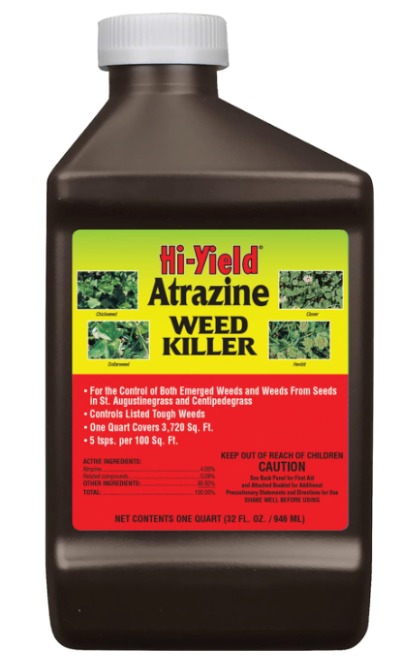
2. Hi-Yield (33430) Atrazine Weed Killer, 32 oz
Product Description
Hi-Yield Atrazine is a liquid concentrate. You mix it with water and spray it over the lawn. Atrazine has been used on warm-season turf for decades, and it is one of the few active ingredients labeled for centipede grass and St. Augustine grass.
What makes atrazine useful is its dual action. It works through the leaves of young weeds and through the soil by roots. That means it can control weeds that are up and also slow new ones from sprouting.
The 32 oz bottle is a small to medium size. It suits homeowners with an average yard, not large properties.
Best Use Cases
This product fits best when you have:
- Broadleaf weeds like clover, chickweed, and henbit
- Winter weeds such as annual bluegrass in cooler weather
- A lawn with only centipede or St. Augustine grass
- A need for a lower-cost option than some newer weed killers
It is also a favorite for cool-weather weed control. Many centipede lawn owners lean on atrazine when winter weeds pop up.
Do not use it on lawns that include other grass types without checking the label. Atrazine can injure Bermuda grass, bahia grass, tall fescue, and ryegrass.
Key Features Explained Simply
Works two ways. It kills small weeds that are already growing and also gives some short-term soil protection.
Liquid concentrate. You measure a set amount per 1,000 square feet and mix it in a sprayer. Liquid mixes evenly and spreads easily.
Labeled for centipede. The label lists the grass types it is safe on. Always confirm centipede is on your bottle before you spray.
Broadleaf focus. It is stronger on broadleaf weeds than on tough grassy ones. Large crabgrass and goosegrass usually need a different product.
Real-Life Usage Insight
Lawn owners who use atrazine often report good results on winter weeds when the grass is dormant or fully active, depending on label timing. Many guides warn against spraying during spring green-up, when the grass is waking up and more sensitive.
Heat is another concern. High temperatures raise the risk of turf injury, so spray on mild days and follow the label temperature limits.
Tree roots matter too. Atrazine can move through soil and get absorbed by roots of trees and shrubs. If your yard has big trees with roots under the lawn, keep the spray away from those zones or pick another product.
Also check local rules. Atrazine is regulated in some areas, and you should never use it near ponds, wells, or drainage ditches.
Pros and Cons
Pros
- Labeled for centipede and St. Augustine lawns
- Works on both emerged weeds and new seedlings
- Strong on broadleaf and winter weeds
- Budget-friendly cost per treatment
- Easy to mix and spray
Cons
- Can harm trees and shrubs with roots under the lawn
- Not safe on all grass types
- Weak on large grassy weeds
- Needs careful timing to avoid turf stress
- Has local limits in some places
Performance Discussion
On young broadleaf weeds, atrazine performs well. You usually see yellowing over a week or two, followed by die-off. On winter annual weeds, results are often solid when you apply at the right time.
Performance drops on mature weeds, tough sedges, and big crabgrass. In those cases, you get better results from a product like Celsius WG.
The soil action is helpful, but it does not replace a true pre-emergent for crabgrass. Think of it as a bonus, not the main plan.
Ease of Use
Atrazine is easy for most beginners. You measure the liquid, mix it with water, and spray evenly. A basic pump sprayer works fine.
The harder part is timing and safety. You need to read the label for temperature limits, grass types, tree warnings, and annual maximum amounts. Rushing that step is where most mistakes happen.
Value for Money
The 32 oz bottle gives a good return for small and medium lawns. It costs less per treatment than many specialty products. For homeowners with a standard yard and mostly broadleaf weeds, it is a smart buy.
Verdict on this product: A dependable, budget-friendly choice for centipede lawns, as long as you watch the timing, the temperature, and nearby tree roots.
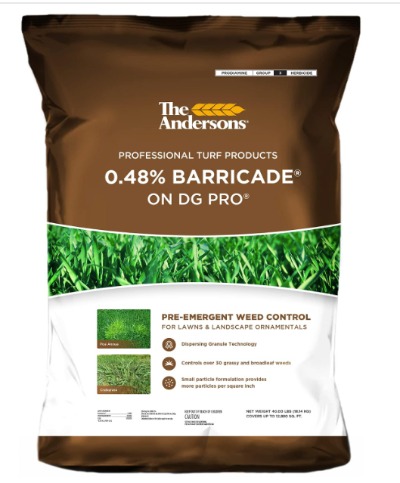
3. The Andersons Barricade Professional-Grade Granular Pre-Emergent Weed Control (40 lb)
Product Description
Barricade is a granular pre-emergent. The active ingredient is prodiamine, a trusted ingredient in professional lawn care. The granules sit on the lawn, get watered in, and form a protective layer in the top of the soil.
When weed seeds try to sprout through this layer, they die before they break the surface. This keeps the lawn clean without spraying young weeds one by one.
The 40 lb bag covers up to 12,880 square feet according to the listing. That makes it a solid fit for large lawns and anyone who wants a full-season plan.
Best Use Cases
This is the product to grab if you want to prevent problems, not fix them. It works best for:
- Crabgrass and goosegrass prevention
- Stopping winter weeds like annual bluegrass
- Large centipede lawns
- Lawn owners who want a twice-a-year plan
- Anyone tired of fighting the same weeds every season
It does not kill weeds that are already up. If your lawn is full of weeds right now, pair this with a post-emergent like Celsius WG.
Key Features Explained Simply
Prodiamine formula. This ingredient is known for long-lasting control. A single application can protect the lawn for months.
Granular form. You spread it with a broadcast or drop spreader. No mixing, no measuring liquid, no sprayer.
Large coverage. The 40 lb bag handles a big yard, so you can treat a full lawn in one go.
Professional-grade. It is the type of product many lawn care crews use, which tells you it holds up in real-world conditions.
Water-in step. The label asks for irrigation or rain after spreading. This moves the product into the soil where it can work.
Real-Life Usage Insight
Timing is everything with a pre-emergent. Many lawn owners watch soil temperature, since crabgrass starts sprouting when the soil warms up to a certain range in spring. The product has to be down before that happens.
A second application in the cooler season helps with winter weeds. Many centipede lawn owners follow this two-pass schedule.
Calibration matters. Spreaders put out different amounts, so check your spreader setting against the product label. Too little leaves gaps. Too much wastes money and can stress turf.
Weeds do show up after treatment in thin spots, bare patches, or areas where the barrier was disturbed. That is normal, not a product failure.
Pros and Cons
Pros
- Strong weed prevention for many months
- Safe for centipede grass when used as directed
- Covers a large area per bag
- No mixing or sprayer needed
- Great value on big lawns
Cons
- Does not kill existing weeds
- Needs a spreader
- Needs water to activate
- Timing mistakes cut results sharply
- The bag is heavy and too big for tiny yards
Performance Discussion
When applied on time, Barricade performs very well on crabgrass and other seed-sprouting weeds. The lawn stays cleaner, and you spend less time spot spraying.
The barrier holds up against rain and normal watering, which is why it lasts so long. Disturbing the soil, such as aerating or raking hard, can break it.
Do not use it when you plan to seed or sprig new grass. The barrier blocks grass seed too.
It also does little against weeds that spread by roots or runners, like sedges and some established perennials.
Ease of Use
Beginners find this product easy once they own a spreader. You fill the hopper, set the dial, walk the lawn in even passes, and water it in.
The learning curve comes from timing and spreader settings. Read the bag chart and take your time.
Value for Money
On a large lawn, the cost per square foot is very low. A single bag can handle one or two treatments depending on your yard size. Compared with spending the season killing weeds one by one, prevention costs less and saves time.
On a tiny lawn, the bag is overkill. You would be storing most of it.
Verdict on this product: The best prevention tool in this roundup, and a smart base layer for any centipede grass weed control plan.
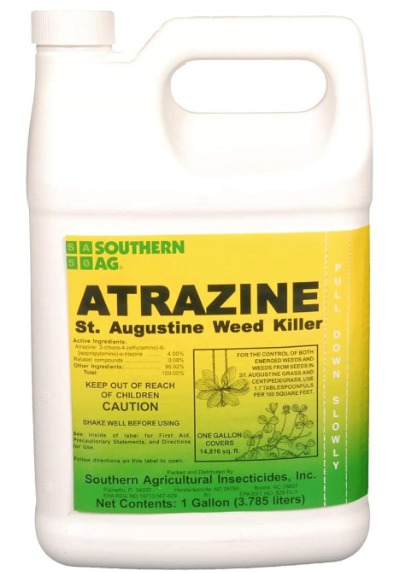
4. Southern Ag Atrazine St. Augustine Grass Weed Killer, 1 Gallon
Product Description
Southern Ag Atrazine is another liquid atrazine concentrate, sold in a 1 gallon jug. The name highlights St. Augustine grass, but the label also covers centipede grass. Always confirm that on your own bottle before use.
Like the Hi-Yield product, it works on emerged weeds and gives some soil action. The main difference is size. A gallon goes much further, so it suits large lawns and repeat users.
Best Use Cases
This product fits well when you have:
- A large centipede or St. Augustine lawn
- Broadleaf weeds such as clover, chickweed, and henbit
- Winter weeds that return every year
- A tight budget and a big area to cover
- Several properties or a family yard plus a neighbor’s
Small-yard owners can use it, but it takes a long time to finish a gallon.
Keep it away from Bermuda grass, bahia grass, and cool-season turf. The same tree-root warning applies here too.
Key Features Explained Simply
Gallon size. One jug covers many treatments. That drops your cost per use.
Atrazine formula. It controls many broadleaf weeds and young grasses through leaf and root uptake.
Labeled for warm-season lawns. The label names the grass types it is safe for. Read it first.
Liquid concentrate. You measure it out and mix with water. It sprays easily through a standard pump sprayer.
Real-Life Usage Insight
The gallon size changes how people use this product. Large-lawn owners often split work into two light passes in the cool season, within the yearly limit on the label. This keeps the dose per pass low and gentler on the turf.
Storage is part of the deal. Keep the jug sealed, upright, and away from kids, pets, and food. Store it in a cool, dry spot out of sunlight.
Mixing area matters too. Rinse the sprayer well after use. Leftover residue can harm plants you spray later.
Many lawn owners also mark the sprayer for herbicide use only. Do not use that same sprayer for fertilizer or garden pesticides.
Pros and Cons
Pros
- Excellent cost per treated square foot
- Labeled for centipede and St. Augustine
- Handles many broadleaf and winter weeds
- Works on emerged weeds and gives light soil action
- Good size for big lawns
Cons
- A gallon is too much for small yards
- Can injure trees and shrubs through root uptake
- Not for use on all grass types
- Weaker on mature grassy weeds
- Needs careful label reading on timing and temperature
Performance Discussion
Performance matches other atrazine products. Young broadleaf weeds fade within a week or two. Winter annuals respond well when treated at the right time.
Heavy infestations of crabgrass, goosegrass, or sedges usually need another product. Atrazine is a good foundation, not a cure for every weed.
Consistency helps. Treating in the right weather window, without stressing the turf, brings the best outcomes.
Ease of Use
Ease of use is about the same as the Hi-Yield product. Mixing and spraying are simple. The extra care goes into reading the label, watching temperatures, and avoiding tree root zones.
Handling a full gallon takes a little more caution. Pour slowly, use gloves and eye protection, and avoid spills.
Value for Money
This is the best value in the roundup for large lawns on a budget. The cost per treatment is low, and one jug can last a long time if stored well.
For a small lawn, a smaller bottle like the Hi-Yield product wastes less.
Verdict on this product: A budget-friendly workhorse for big centipede lawns with broadleaf and winter weed problems.
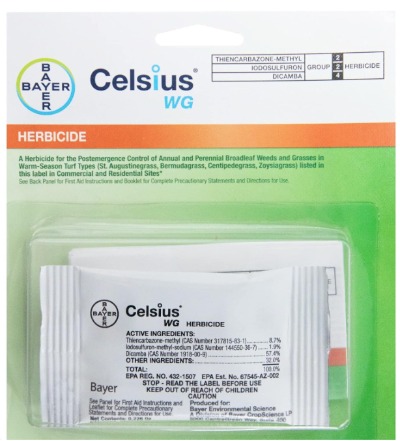
5. Prime Source Celsius WG – 0.226 oz Easy Mix Packet
Product Description
This is the same Celsius WG herbicide formula, packaged in a small 0.226 oz easy mix packet. The packet is pre-measured for a small area, so you do not have to weigh out tiny amounts.
It is a post-emergent weed killer for warm-season lawns, and it uses the same three-ingredient blend as the larger Celsius WG products.
The packet size makes it a good fit for a small yard, a trial run, or spot treatment.
Best Use Cases
This product fits best when you:
- Have a small lawn or a limited weedy area
- Want to test Celsius WG before buying a bigger size
- Need a quick fix for a patch of mixed weeds
- Feel nervous about measuring small amounts
- Do not want leftover product sitting around
It is also handy for people who share the cost of a lawn plan or treat small areas at different times.
Large lawns will burn through packets fast, which gets pricey. In that case, a bigger Celsius WG size makes more sense.
Key Features Explained Simply
Pre-measured packet. You do not need to weigh anything. That cuts the biggest beginner mistake, which is a wrong dose.
Same Celsius formula. You get the same dicamba, iodosulfuron, and thiencarbamazone blend that makes the larger version effective.
Selective on warm-season turf. The label lists centipede grass, so you can treat the lawn without harming it when you follow the directions.
Broad weed control. It handles many broadleaf and grassy weeds, plus some sedges.
Surfactant still needed. The packet does not remove the need for a nonionic surfactant. Check the label for the right amount.
Real-Life Usage Insight
Most people use a packet on one section of the yard, such as the front lawn or a weedy corner. The results are the same as the bigger bag, so a packet works as a low-risk trial.
A common smart move is to treat a small test patch first, even with the pre-measured packet. If the centipede looks fine after a few days, spray the rest.
Keep track of how much area the packet covers. The label gives the coverage at each rate. Dividing the packet across an area bigger than the label allows weakens the dose and wastes your money. Spraying a smaller area than needed raises the risk of turf injury.
Use clean water and a clean sprayer. Mix right before spraying, not hours earlier.
Pros and Cons
Pros
- Pre-measured, so no scales needed
- Low risk for first-time users
- Same strong formula as larger Celsius WG
- Great for small lawns and spot treatment
- No leftover product to store
Cons
- Costs more per square foot than larger sizes
- Not practical for big yards
- Still needs a surfactant
- Can still cause temporary yellowing on stressed centipede
- Does not prevent new weeds
Performance Discussion
Performance is the same as other Celsius WG products when used at the right rate. Young, actively growing weeds fade fast. Bigger weeds can need a follow-up pass later, within label limits.
Results depend on spray coverage. Because the area per packet is small, even coverage is easy to achieve on a small lawn.
Weather rules stay the same. Avoid spraying right before rain, in strong wind, or during heat stress.
Ease of Use
This is the easiest product in the roundup to use. The packet takes out the measuring step. You tear it open, mix it with water in your sprayer, add the surfactant, and spray.
Beginners with a small yard will feel comfortable right away.
Value for Money
For small jobs, the packet is good value. You pay only for what you use. For larger lawns, the cost per square foot rises and a bigger Celsius WG size wins.
It is also a useful way to test the product’s fit for your lawn before you commit to a bigger purchase.
Verdict on this product: The best beginner-friendly option for small centipede lawns and spot treatment.
Comparison Insights: How These Five Products Stack Up
Looking at all five side by side makes the best fit clearer.
By weed type
- Mixed broadleaf and grassy weeds: Celsius WG (both versions)
- Broadleaf and winter weeds: Atrazine (Hi-Yield or Southern Ag)
- Crabgrass and seed-sprouting weeds: Barricade
By lawn size
- Small lawn: Prime Source Celsius WG packet or Hi-Yield Atrazine
- Medium lawn: Celcius WG 6666194 or Hi-Yield Atrazine
- Large lawn: Barricade, Southern Ag Atrazine, or a bigger Celsius WG size
By skill level
- Easiest: Prime Source Celsius WG packet
- Easy with a spreader: Barricade
- Moderate: Atrazine products and the larger Celsius WG, because of label rules and measuring
By budget
- Lowest cost per treatment for big areas: Southern Ag Atrazine and Barricade
- Best value for mixed weeds: Celsius WG
- Best trial option: the packet
By risk to the lawn
All five are labeled for centipede or safe on it when used properly. The biggest risks are:
- Celsius WG: temporary yellowing on stressed turf
- Atrazine: timing, heat, and tree root damage
- Barricade: wrong timing or spreader settings
No product wins every category. The smartest approach for most lawns is to combine a pre-emergent with a post-emergent.
A simple setup looks like this:
- Apply Barricade in the right window to prevent crabgrass and winter weeds.
- Use Celsius WG for any weeds that slip through.
- Use atrazine for winter broadleaf weeds on lawns that fit the label.
You do not have to use all of them. Pick the pieces that match your yard.
Buying Guide: What to Look for in a Centipede Grass Weed Killer
Picking the right product gets easier when you know what to check. Here is a simple guide.
Confirm Centipede Grass Is on the Label
This is the most important step. A product that is great for Bermuda or zoysia can ruin centipede. Look for “centipedegrass” in the list of turf types.
Know Your Weeds First
Take a close look at the weeds in your yard. Are they wide-leaf plants like clover and dandelions? Thin-leaf grassy weeds like crabgrass? Or grass-like sedges with triangle-shaped stems?
Different weeds need different tools. A few quick photos and a check with your local extension office can save you from buying the wrong product.
Decide Between Pre-Emergent and Post-Emergent
If weeds are not up yet, a pre-emergent like Barricade makes sense. If they are already growing, you need a post-emergent such as Celsius WG or atrazine.
Most lawns need both at some point.
Match the Product Size to Your Lawn
Measure your lawn. Multiply length by width for each section and add them up. Then compare the total with the coverage on the label.
Buying too much means wasted money and storage hassle. Buying too little means a second trip and a missed treatment window.
Check Product Form
- Granules like Barricade need a spreader but no mixing.
- Liquids like atrazine need a sprayer and careful measuring.
- Water-dispersible granules like Celsius WG need a sprayer and small, precise measuring.
Pick the form that fits the tools you own or are willing to buy.
Think About Your Skill Level
Beginners do best with pre-measured packets or simple granular products. Experienced lawn owners can handle small-dose products and timing rules with ease.
If a product makes you nervous, start small and test.
Look at Timing and Temperature Limits
Every label gives temperature and season guidance. Centipede is especially sensitive during spring green-up and hot spells. Follow the label, and when in doubt, wait.
Consider Trees, Water, and Pets
Atrazine and some other products need extra care near trees, ponds, wells, and drainage areas. Read the label for pet and kid re-entry times too. Most products ask you to keep pets and kids off the lawn until the spray dries.
Compare Cost Per Treated Area, Not Just Price
A cheap bottle that covers a tiny area is not always a bargain. Divide the price by the square feet covered to compare products fairly.
Check Local Rules
Some areas limit or ban certain herbicides. Check with your local extension office or state agriculture department before you buy.
Who Should Buy These Products?
Each product fits a different type of lawn owner.
Celcius WG Herbicide 6666194 suits homeowners with mixed weed problems who want one product to cover many weed types. It is a good match for medium to large lawns.
Hi-Yield Atrazine (32 oz) fits small and medium lawn owners with broadleaf and winter weeds, especially those who want a budget option for a centipede or St. Augustine lawn with few trees nearby.
The Andersons Barricade (40 lb) is ideal for people with large lawns who want a prevention plan. It also suits anyone tired of fighting crabgrass every year and willing to buy a spreader.
Southern Ag Atrazine (1 gallon) works well for big-lawn owners on a budget, and for those who treat a lot of space each season.
Prime Source Celsius WG packet is great for beginners, small lawns, and anyone who wants to test Celsius WG without a big commitment.
If you have a lot of trees with roots under your lawn, lean away from atrazine and toward Celsius WG and Barricade. If your lawn is mixed with other grass types, check labels very carefully before you buy anything.
Common Mistakes to Avoid
Even the best herbicide for centipede grass can fail if you use it the wrong way. Here are the mistakes that cause the most trouble.
Spraying During Green-Up
Centipede is more delicate when it wakes up from dormancy. Spraying during this window raises the risk of turf injury. Wait until the lawn is fully green, or follow the timing in the label.
Spraying in Hot Weather
High heat adds stress on the grass. Many labels set a temperature limit. Spray on mild days, and skip the afternoon sun.
Guessing the Dose
More is not better. Overdosing is the fastest way to burn centipede grass. Measure carefully, use the lower label rate when it applies, and never mix “a little extra for good measure.”
Skipping the Surfactant
Celsius WG needs a nonionic surfactant. Without it, the spray beads up on waxy leaves and results drop.
Missing the Pre-Emergent Window
Spreading Barricade after weeds have already sprouted wastes the product. Watch the soil temperature and get it down early.
Forgetting to Water It In
Pre-emergents need irrigation or rain to move into the soil. Skipping this step leaves granules sitting on top, where they do little.
Using Pre-Emergent Before Seeding
A pre-emergent blocks grass seed as well as weed seed. If you plan to overseed or sprig new grass, wait until the label says it is safe.
Ignoring Tree Roots
Atrazine can hurt trees and shrubs through root uptake. Keep it away from root zones, and use another product near valuable trees.
Using the Wrong Product for Your Grass Type
A weed killer labeled for St. Augustine only, or for cool-season turf, can ruin centipede. Check the grass list every time.
Skipping the Test Patch
Spray a small area first and wait a few days. If the grass looks healthy, spray the rest. This one step prevents most big mistakes.
Overfeeding the Lawn
Centipede does not like heavy nitrogen. Too much fertilizer makes the grass weak, encourages thatch, and leaves it more open to weeds and stress. A healthy, lightly fed lawn fights weeds better than a pushed one.
Mowing Too Short
Cutting centipede too low thins the turf and lets weeds in. Keep the mower height in the range suggested for centipede and avoid scalping.
Using Dirty Sprayers
Leftover herbicide in a sprayer can harm your flowers and veggies later. Rinse the tank, hose, and nozzle after each use, and keep a sprayer just for herbicides.
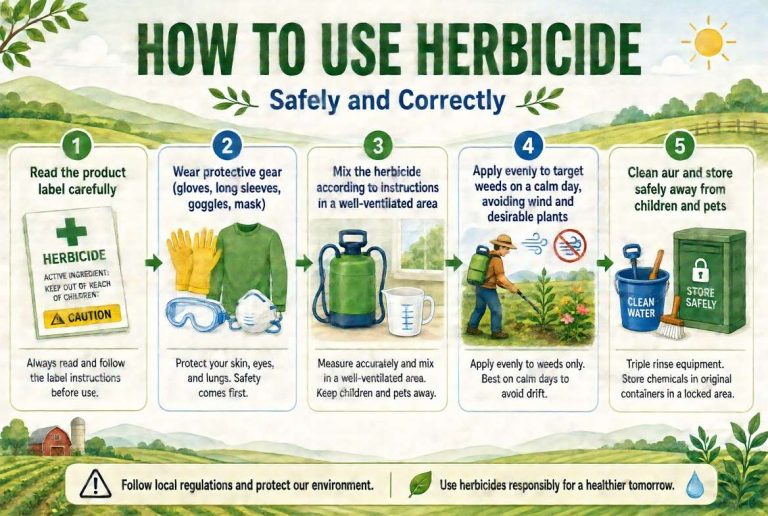
Not Wearing Protection
Gloves, long sleeves, and eye protection are a must. Follow the label for re-entry times for pets and kids.
Extra Tips for a Weed-Free Centipede Lawn
Herbicides work best when the lawn is healthy. A few small habits make a big difference.
- Mow at the right height. Taller turf shades the soil and stops weed seeds.
- Water deeply, not often. Deep watering builds stronger roots and cuts weed growth.
- Feed lightly. Centipede needs little fertilizer. Follow a low-nitrogen plan.
- Test your soil. Centipede likes acidic soil. A simple test helps you avoid problems with pH.
- Fix bare spots. Weeds love empty ground. Patch thin areas early.
- Pull weeds by hand. For a few stray plants, hand pulling is safest for the turf.
A strong lawn does half the weed control job for you.
Frequently Asked Questions
What is the safest herbicide for centipede grass?
A pre-emergent like Barricade is usually the gentlest on established centipede because it does not hit the grass leaves. Among post-emergent products, Celsius WG and atrazine are both labeled for centipede, but both need careful rates and timing.
Can I use Celsius WG on centipede grass?
Yes, the label lists centipede grass. Start with the lower rate, add the surfactant, and test a small patch first.
Does atrazine kill centipede grass?
Atrazine is labeled safe for centipede when used as directed. Problems usually come from heat, bad timing, overdosing, or spraying during green-up.
When should I apply a pre-emergent on centipede grass?
Apply it before weed seeds start sprouting. For crabgrass, that usually means when soil temperatures rise in early spring. For winter weeds, apply it in the cool season before the seeds sprout. Check the label for exact guidance.
Can I use a pre-emergent and a post-emergent together?
Yes. Many lawn owners use a pre-emergent as a base and a post-emergent for weeds that sneak through. Read both labels for timing and overlap rules.
How long until I see results?
Celsius WG shows color changes within several days. Atrazine often takes a week or two. Pre-emergents show results over time, because you are watching for weeds that never appear.
Will these products harm pets?
Most labels say to keep pets and kids off the lawn until the spray dries. Read the re-entry section on each label, and store all products out of reach.
Is one product enough for the whole year?
Rarely. Most lawns do best with a pre-emergent in the right windows and a post-emergent for weeds that break through.
Final Verdict: What Is the Best Herbicide for Centipede Grass?
There is no single product that fits every lawn, but there is a clear best fit for each situation.
Best overall for mixed weeds: Celcius WG Herbicide 6666194. It handles many weed types, works on centipede, and offers low cost per treatment when you follow the label.
Best for prevention: The Andersons Barricade. It gives long-lasting control, protects the lawn without hitting the leaves, and offers great value on large yards.
Best budget option for big lawns: Southern Ag Atrazine. A gallon goes a long way, and it works well on broadleaf and winter weeds when used carefully.
Best for small, simple jobs: Hi-Yield Atrazine in the 32 oz size. It suits small and medium lawns with broadleaf problems and few nearby trees.
Best for beginners and spot treatment: Prime Source Celsius WG packet. The pre-measured design takes out the measuring risk and gives you a low-stress way to try the product.
If you want a simple plan, here it is. Use Barricade to stop weeds before they sprout. Keep Celsius WG on hand for the weeds that get through. Add atrazine for winter broadleaf weeds if your lawn and trees fit the label.
Whatever you pick, the same rules apply. Read the label, confirm centipede grass is listed, measure with care, watch the weather, and test a small patch first. Do those things, and your lawn will stay thick, green, and mostly weed-free with far less stress.
A healthy centipede lawn does not need much. Give it the right product at the right time, keep your mowing and feeding gentle, and it will reward you with a calm, clean look all season.
I can also put this into a markdown file for easy upload to WordPress if you want.

Hi, I’m Mary, the founder of GardenCure.com. I’m passionate about creating healthy, beautiful gardens and well-kept lawns. I share practical experience and trusted advice on garden and lawn gear that truly works. With the support of my dedicated research team, our writers produce honest, in-depth reviews using reliable, authentic sources—helping you choose the right tools with confidence for your outdoor space.



One Comment