5 Best Hand Fertilizer Spreader In 2026
Getting a green, thick lawn starts with one simple thing — spreading fertilizer the right way. And to do that well, you need the best hand fertilizer spreader that fits your yard, your budget, and your comfort level.
In this article
But here’s the thing: not all hand spreaders are built the same. Some are great for small yards. Others handle large areas like a champ. A few work best for pellet fertilizer, while others spread grass seed, ice melt, and salt just as easily.
This guide breaks down five popular hand spreaders in plain, simple language. No fluff. No fake star ratings. Just honest, useful information so you can pick the right tool and get to work.
Let’s dig in.
Why a Hand Fertilizer Spreader Is Worth Having
If you’ve ever tried to spread fertilizer by hand — like literally by hand — you already know the problem. Uneven coverage. Wasted product. Clumps in one spot, bare patches in another. It’s frustrating and ends up costing more money over time.
A handheld lawn spreader solves all of that. It gives you control over how much product goes down and where. You can walk at your own pace, adjust the spread rate, and cover every corner of your lawn without hauling around a big push spreader.
Handheld fertilizer spreaders are perfect for small to medium lawns, tight spaces near flower beds, around trees, along walkways, and any area where a large wheeled spreader just won’t fit. They’re also great for quick jobs — spreading ice melt on a snowy driveway, tossing down some grass seed on a bare patch, or touching up spots you missed during your last fertilizer run.
They’re lightweight, easy to store, and simple enough that anyone can use them — even if you’ve never fertilized a lawn before.
How We Picked These Products
The five hand spreaders in this roundup were selected based on a mix of factors:
- Coverage area — how much ground can the spreader realistically handle?
- Ease of use — can a beginner figure it out without reading a 20-page manual?
- Versatility — does it handle more than just fertilizer?
- Build quality — is it sturdy enough to last more than one season?
- Value for money — does the price match the performance?
We looked at real user feedback, product specs, and practical use cases to give you a rounded picture of each option.
The 5 Best Hand Fertilizer Spreaders Reviewed
1. Scotts Whirl Hand-Powered Spreader
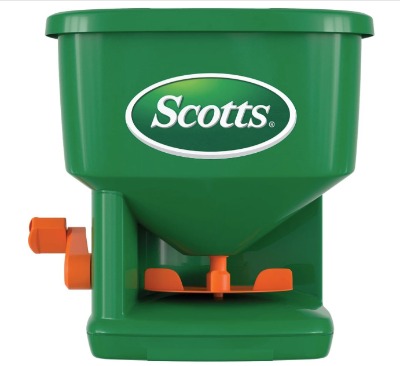
Best For: Beginners and small yard owners who want a simple, no-fuss option
What It Is
The Scotts Whirl is one of the most recognized names in handheld lawn spreaders. It’s a crank-style spreader — you hold it with one hand and spin the crank with the other. Simple as that. No batteries. No charging. Just pure mechanical action.
It holds enough product to cover up to 1,500 square feet, which makes it solid for small to medium-sized lawns. The hopper is roomy enough to reduce how often you need to stop and refill, but small enough to stay lightweight and comfortable.
Key Features
- Manual crank operation — no batteries needed, just your hand power
- 1,500 sq. ft. coverage capacity — handles a decent-sized lawn in one fill
- Works with multiple products — fertilizer, grass seed, salt, ice melt, and more
- Lightweight design — easy to carry for extended use
- Adjustable flow gate — control how much product drops
Real-Life Usage Insight
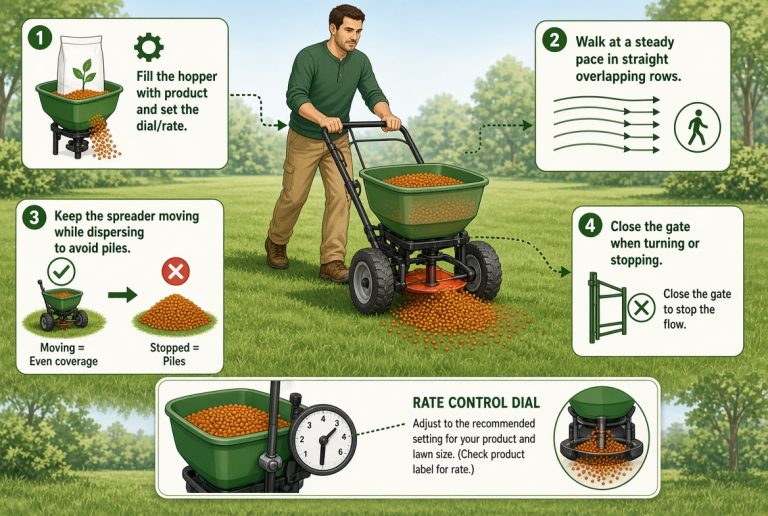
The Scotts Whirl is a straightforward tool. You fill it up, set the flow rate, and walk your lawn in rows while turning the crank. The spreader throws product in a wide arc, so you cover ground quickly.
It works especially well with Scotts brand fertilizers and seeds since the product is designed with that compatibility in mind. That said, it handles other brands and products just fine as long as the pellets or granules aren’t too large or sticky.
One thing to keep in mind: you need both hands to operate it. One hand holds the hopper handle, and the other spins the crank. This isn’t a problem for most people, but if you’re carrying something else or need a free hand, it’s worth noting.
The spreading pattern is decent but not ultra-precise. For general lawn fertilizing, it’s perfect. For tight spaces near garden beds where you don’t want product to drift, you’ll want to be careful.
Pros
- Very affordable — one of the lowest price points in this category
- Easy to learn — you’ll be spreading in under two minutes
- Reliable mechanical action — no worries about dead batteries
- Compact and easy to store in a shed or garage
- Great for quick seasonal tasks like ice melt spreading
Cons
- Requires two hands to operate
- Spreading pattern can be inconsistent if you crank at different speeds
- Not ideal for very fine materials or larger pellets
- Doesn’t have a shoulder strap, so your arm carries all the weight
Performance Discussion
The Scotts Whirl does exactly what it promises — it spreads product evenly across your lawn when you use it consistently. The key to getting even coverage is keeping a steady crank pace while walking at a consistent speed. When you do that, it works really well.
The 1,500 sq. ft. coverage is realistic for lighter application rates. If you’re applying heavy doses of fertilizer, you might run through a full hopper in 1,000 sq. ft. or less. For most homeowners with small to medium lawns, this is a non-issue.
It’s not built for heavy commercial use. But for regular residential lawn care, it holds up season after season.
Ease of Use
High. Very beginner-friendly. You fill it, set the gate, walk, and crank. There’s nothing complicated about it. Clean-up is easy too — just rinse it out with water after use.
Value for Money
Excellent. The Scotts Whirl is one of the best bang-for-buck options on this list. If you have a small yard and just need a reliable spreader for basic tasks, this is hard to beat.
Rating: 4.3/5
2. SOLO Inc. Solo 421 20-Pound Capacity Chest-Mount Spreader
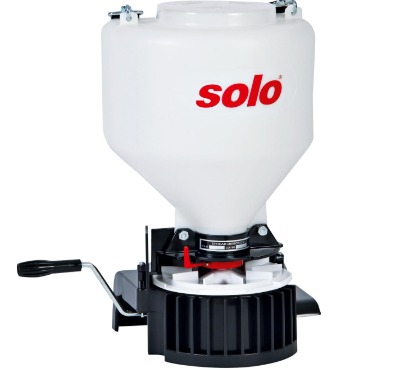
Best For: Larger lawns and users who want a hands-free spreading experience
What It Is
The SOLO 421 takes a different approach to handheld spreading. It sits on your chest using a cross-shoulder strap, which means both your hands are free while you operate the crank. This design is a game-changer for people who need to cover a lot of ground without arm fatigue.
With a 20-pound capacity, it holds significantly more product than most compact handheld spreaders. That means fewer refill stops and more time actually spreading. It’s designed for serious lawn enthusiasts and small-scale property managers who want to work efficiently.
Key Features
- 20-pound capacity hopper — handles large amounts of product in a single load
- Chest-mount design with cross-shoulder strap — both hands are free for the crank
- Adjustable spreading rate — control the output to match your needs
- Works with fertilizer, grass seed, and granular products
- Manual crank operation — no batteries required
- Durable poly construction
Real-Life Usage Insight
The chest-mount design is what sets the SOLO 421 apart. You strap it on like a backpack across your chest, and the weight is distributed across your shoulders instead of held in one arm. This makes a huge difference when you’re covering half an acre or more.
The 20-pound capacity is a real advantage for large lawn jobs. You can load it up with a heavy dose of fertilizer and walk your whole yard without stopping. For smaller yards, this might feel like overkill — but if you have a lot of ground to cover, it’s the smarter choice.
The spreading pattern is wider than compact handheld models, which helps you finish faster. The crank action is smooth, and the flow gate is easy to adjust on the fly.
One small drawback: the chest-mount position takes a little getting used to. The first time you use it, you might need a few minutes to adjust the strap and get comfortable. After that, it becomes natural.
Pros
- Large 20-pound capacity reduces refill trips
- Chest-mount design reduces arm fatigue significantly
- Works great for covering large areas quickly
- Stable spreading pattern with consistent output
- Durable build quality that holds up over many seasons
- Good for a range of granular products
Cons
- Pricier than basic handheld options
- The strap setup takes a few minutes to adjust at first
- Bulkier to store than compact models
- May feel excessive for very small yards
- Requires two hands for operation (one holds the strap, one cranks)
Performance Discussion
The SOLO 421 delivers consistent, even coverage across large lawn areas. The wide spread pattern and large capacity make it one of the most efficient options here for users with bigger properties.
It performs especially well with standard granular fertilizers and grass seeds. The flow rate adjustment works smoothly, and you can dial in the right output pretty easily after a test run.
The build quality feels solid. The poly hopper is tough, the strap is comfortable, and the crank mechanism doesn’t feel cheap or flimsy. This is a tool built to last.
Ease of Use
Moderate. It’s not complicated, but the chest-mount design requires a bit of setup before your first use. Once you get it dialed in, it’s actually easier to use than a standard handheld model because you’re not holding the weight in one arm.
Value for Money
Good. It costs more than the basic options, but the large capacity and ergonomic design justify the price for anyone with a medium to large lawn. If you only have a tiny yard, you’re probably paying for features you don’t need.
Rating: 4.4/5
3. Chapin 8740A 64-Ounce Poly Hand Shaker Spreader
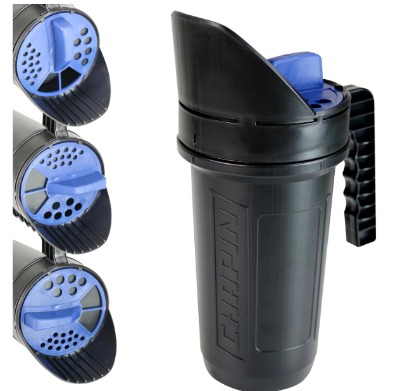
Best For: Quick touch-ups, small patches, and users who want the simplest possible tool
What It Is
The Chapin 8740A is a shake-style spreader — not a crank model. You hold it, tilt it, and shake or wave it to spread product. There’s no crank to turn and no battery to charge. It’s as simple as a tool gets.
It holds 64 ounces of product and features three different opening sizes at the bottom. You choose which opening to use based on the size of your granules — small openings for fine products, larger ones for bigger pellets. This flexibility makes it useful for a range of materials including fertilizer, grass seed, salt, sand, and ice melt.
Key Features
- 64-ounce capacity — enough for small lawns and spot treatments
- 3 opening sizes — matches different granule sizes for better control
- Large grip handle — comfortable to hold and easy to maneuver
- Works with turf fertilizer, grass seed, salt, sand, and ice melt
- Year-round use — designed to handle seasonal tasks beyond just lawn care
- No moving parts — nothing to break, nothing to replace
Real-Life Usage Insight
The Chapin shaker is the simplest spreader on this list. You fill it, choose your opening, and start walking while shaking the tool from side to side. There’s no crank, no battery, no settings to adjust. Just a shake-and-spread motion.
This design is perfect for quick jobs. Bare patch of lawn that needs seed? Fill the Chapin up and walk over it a few times. Icy walkway that needs salt? Same process. It takes less than a minute to get started.
The three opening options are a smart feature. Larger granular fertilizers go through the big holes cleanly, while finer products like grass seed use the smaller openings to avoid clumping or blockage.
The trade-off is that you have less precision control over spread rate compared to crank-style models. You’re relying on your arm motion to control output, which takes a little practice to get consistent. For large lawns, this can be tiring and slow.
Pros
- Extremely simple to use — no learning curve at all
- Versatile with three opening sizes for different materials
- Very affordable price point
- Lightweight and compact — easy to carry and store
- Great for small jobs, spot treatments, and quick seasonal tasks
- Durable black poly construction holds up well
Cons
- Not ideal for covering large lawn areas
- Spread consistency depends entirely on your arm motion
- 64-ounce capacity requires frequent refills for bigger yards
- No adjustable flow gate — you control output by motion only
- Can be tiring on the arm if used for extended periods
Performance Discussion
For small-scale tasks and spot work, the Chapin 8740A performs very well. It’s consistent as long as you maintain an even shaking motion, and the three openings give it more flexibility than you’d expect from such a simple tool.
For covering large lawns, it’s not the right choice. It works best when you need to knock out a small job fast — touching up a bare patch, salting a short walkway, or doing a quick fertilizer pass on a postage-stamp yard.
The build quality is solid. The poly body feels sturdy, the handle is comfortable, and the opening mechanism is reliable. There’s nothing mechanical to break down, which is a big plus.
Ease of Use
Very high. This is the easiest spreader on the list to use. Fill it, choose an opening, start walking and shaking. That’s it. Beginners and kids can use it without any trouble.
Value for Money
Excellent for what it does. It’s one of the least expensive options here, and for small lawns and seasonal tasks, it punches well above its price. If your needs go beyond basic spot work, you’ll want something with more capacity and control.
Rating: 4.0/5
4. Handheld Lawn Spreader — 7.2V Battery-Powered Seed & Fertilizer Spreader
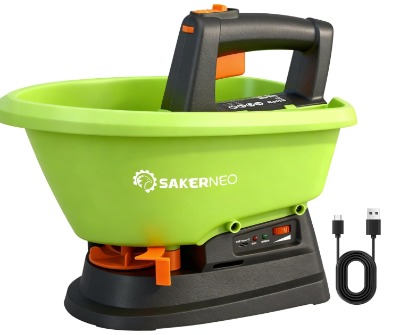
Best For: Tech-forward users and those who want effortless, consistent spreading across larger areas
What It Is
This battery-powered handheld spreader is the most modern option on this list. Powered by a 7.2V rechargeable battery, it does the work for you — no cranking, no shaking, just press a trigger and walk.
It holds 3 liters of product and can cover up to 6,400 square feet on a single fill (depending on application rate). It offers 7 different spread settings and 5 angle adjustments, giving you a level of control that manual spreaders can’t match.
Key Features
- 7.2V rechargeable battery — no hand cranking required
- 3L large capacity hopper — covers up to 6,400 sq. ft. per fill
- 7 spread rate settings — dial in exactly how much product drops
- 5 adjustable angles — change the spread direction to suit your path
- 135° wide spread pattern — covers more ground per pass
- Works with grass seed and granular fertilizer
- Rechargeable via USB or standard charger
Real-Life Usage Insight
Using a battery-powered spreader is genuinely a different experience from manual models. You fill the hopper, select your spread setting, point the spreader, and pull the trigger. The motor takes care of flinging the product across your lawn at a consistent rate.
The 7 settings let you fine-tune the output based on what you’re spreading and how thick you want coverage. Grass seed needs a lighter touch than fertilizer pellets. With 7 options, you can find the right setting quickly.
The 5 angle adjustments are surprisingly useful. You can point the spreader straight ahead, angled left, angled right, or downward — which helps when spreading in tight spots near edges or around garden beds.
The 3-liter capacity sounds modest, but combined with the efficient motorized spreading, it goes a long way. Covering 6,400 square feet per fill is impressive for a handheld unit.
Battery life is adequate for most residential jobs. A full charge handles a complete lawn fertilizing session for average-sized yards without issue.
Pros
- No cranking — effortless operation for all users
- Wide 135° spread pattern covers ground fast
- 7 settings give excellent control over product output
- 5 angle options add serious flexibility for tricky spots
- Rechargeable battery — no need to buy replacement batteries
- Large 3L capacity for extended spreading sessions
- Consistent, motorized spread rate regardless of walking speed
Cons
- Battery needs to be charged before use — requires planning ahead
- Costs more than manual options
- Battery might not last through very large lawns on a single charge
- Some small granular products may not spread as smoothly as others
- More parts than manual models means more potential for wear over time
Performance Discussion
The battery-powered design delivers the most consistent spread pattern of any handheld option on this list. Because the motor maintains a steady rotation speed, you don’t get the uneven coverage that can happen with crank models when your hand speed varies.
The 135° spread arc is wide enough that you cover a broad swath of lawn with each pass. Combined with 7 rate settings, you can spread heavy fertilizer loads or light grass seed applications with equal ease.
The motorized mechanism handles most standard granular fertilizers and grass seeds very well. Very fine powder-style products or extra-large pellets may not feed through as cleanly — so check product compatibility before loading up.
For most homeowners, the battery-powered convenience is a real upgrade from manual cranking. It’s especially good for people with hand or wrist issues who find cranking uncomfortable.
Ease of Use
Very high. Once charged, you just fill it and go. The settings are clearly marked, and the angle adjustment is quick. It’s also one of the lightest options here despite having a motor, which helps.
Value for Money
Good. It costs more than the manual options, but the convenience, consistency, and coverage capacity make it worth the price for regular lawn care users. If you fertilize often and value ease, this is a solid investment.
Rating: 4.5/5
5. Brinly HHS3-5BH 5lb. All-Season Handheld Spreader
Best For: Quick seasonal tasks, small yards, and users who want a compact all-season tool
What It Is
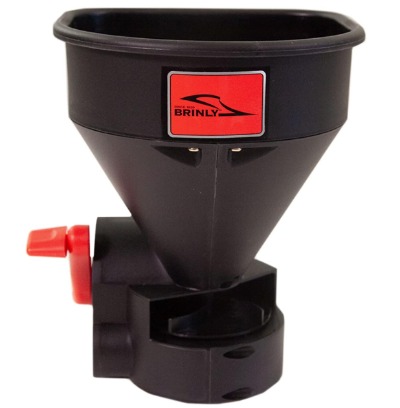
The Brinly HHS3-5BH is a compact handheld spreader designed for year-round use. It holds 5 pounds of product and works with grass seed, fertilizer, and ice melt. The easy-fill design makes loading it up quick and mess-free, which is a small but appreciated detail.
Brinly is a well-known name in lawn equipment, and this spreader reflects that reputation — solid build, reliable performance, and sensible design.
Key Features
- 5-pound capacity — ideal for small lawns and spot work
- Easy-fill design — wide hopper opening makes loading quick
- All-season use — handles fertilizer, seed, and ice melt
- Single-hand crank operation — straightforward spreading action
- Durable construction — built to handle outdoor conditions season after season
- Adjustable flow control — manage output based on product type
Real-Life Usage Insight
The Brinly HHS3-5BH is a compact, no-nonsense spreader. You fill it through the wide top opening, set your flow rate, and start cranking. The wide hopper mouth makes filling from a bag easier than with models that have small, narrow openings — a simple feature that saves you from spilling product on your shoes.
The 5-pound capacity is on the smaller side, which means it works best for small yards, narrow strips of lawn, or spot applications. If you try to use it for a large backyard, you’ll be refilling it constantly, which gets old fast.
The crank action is smooth and consistent. Brinly put some thought into the feel of the tool — it doesn’t feel cheap or hollow. The spreading pattern is reliable when you maintain a steady pace.
For ice melt spreading in winter, it does a great job. The easy-fill top means you can load it up quickly even with gloves on, which matters when it’s cold outside and you just want to get the walkway treated and head back inside.
Pros
- Easy-fill wide opening saves time and reduces mess
- All-season design handles multiple product types
- Durable, quality construction that holds up over time
- Reliable spreading pattern with consistent crank action
- Compact size — easy to carry and store
- Good brand reputation with strong customer support
Cons
- Only 5-pound capacity — not suited for large lawn areas
- No shoulder strap — all weight is on one arm
- Basic feature set — no angle adjustments or multiple settings
- Costs slightly more than some competitors with similar capacity
- Requires two hands if you want steady crank and stable hold
Performance Discussion
The Brinly delivers solid, reliable performance for the tasks it’s designed for. Small yard fertilizing, patch seeding, and ice melt spreading are all within its wheelhouse. The spreading action is even and the flow control is easy to adjust mid-walk.
It’s not trying to compete with the battery-powered model or the large-capacity SOLO. It does exactly what a compact handheld spreader should do — quietly and efficiently.
Build quality is above average for this size category. The materials feel sturdy, and there’s nothing flimsy about the crank mechanism or the hopper construction.
Ease of Use
High. The easy-fill design and simple crank operation make it very accessible for beginners. The wide mouth opening deserves a special mention — it’s one of those quality-of-life features that you appreciate every single time you use the tool.
Value for Money
Fair. It’s priced a little above the most basic options, but the build quality and all-season versatility make it worth the slight premium. For small yard owners who want a dependable compact spreader, it delivers good value.
Rating: 4.2/5
Side-by-Side Comparison
| Feature | Scotts Whirl | SOLO 421 | Chapin 8740A | Battery Spreader | Brinly HHS3 |
|---|---|---|---|---|---|
| Capacity | ~1,500 sq ft | 20 lbs | 64 oz | 3L / 6,400 sq ft | 5 lbs |
| Power Source | Manual crank | Manual crank | Shake/manual | 7.2V battery | Manual crank |
| Mounting | Hand-held | Chest-mount | Hand-held | Hand-held | Hand-held |
| Settings | Adjustable gate | Adjustable gate | 3 openings | 7 settings + 5 angles | Adjustable gate |
| Best For | Small yards | Large lawns | Spot work | Medium-large lawns | Small yards/seasonal |
| Ease of Use | Very Easy | Moderate | Very Easy | Easy | Easy |
| Value Rating | ★★★★★ | ★★★★☆ | ★★★★★ | ★★★★☆ | ★★★★☆ |
Buying Guide: What to Look for in a Hand Fertilizer Spreader
Before you spend money on a spreader, take a minute to think about your actual needs. Here’s what matters most.
1. Your Lawn Size
This is the biggest factor. A 5-pound handheld spreader is perfect for a small front yard or a strip of grass along a sidewalk. For a large backyard or a half-acre lawn, you’ll want the highest capacity you can get — like the SOLO 421 or the battery-powered model.
Think in terms of square footage. If your lawn is under 2,000 sq. ft., almost any spreader on this list works. If it’s over 5,000 sq. ft., you need something with real capacity.
2. What You’re Spreading
Not all spreaders handle all materials equally. Fine grass seed, coarse fertilizer pellets, and chunky ice melt granules all behave differently. Look for a spreader with adjustable openings or settings that match the products you use most often.
The Chapin 8740A’s three-opening design handles this especially well. The battery-powered spreader’s 7 settings also give you flexibility for different product types.
3. Manual vs. Battery-Powered
Manual crank spreaders are simple, affordable, and never run out of power. They work great for most users. But if you have a large lawn, hand or wrist issues, or just prefer the ease of motorized tools, the battery-powered option is worth considering.
Battery-powered spreaders deliver more consistent coverage because the motor maintains a steady rotation speed regardless of how fast you walk. With manual spreaders, coverage evenness depends partly on your cranking rhythm.
4. Ergonomics and Comfort
If you’re covering a large lawn, comfort matters a lot. A heavy spreader with no strap support will tire your arm out quickly. The SOLO 421’s chest-mount design solves this beautifully. For smaller lawns, ergonomics matter less — any comfortable grip works fine.
Look for a large, non-slip handle, a design that balances weight evenly, and if possible, a strap for longer spreading sessions.
5. Ease of Filling
This is a practical detail that gets overlooked. A spreader with a small, narrow opening is annoying to fill — especially from a big 40-pound bag of fertilizer. Wide-mouth openings like the one on the Brinly HHS3 save time and prevent messy spills.
6. Build Quality and Material
Plastic (poly) construction is standard for handheld spreaders, and that’s fine. Look for thick, UV-resistant poly that won’t crack after a season or two in the sun. Metal parts — especially the crank and flow gate — should feel solid, not hollow or loose.
Stainless steel or rust-resistant hardware is a bonus if you’re spreading salt or ice melt regularly, since those products are corrosive.
7. Price vs. Features
More expensive doesn’t always mean better for your specific needs. The Scotts Whirl costs very little and handles small lawns brilliantly. Spending more on the SOLO 421 only makes sense if you have a large lawn to cover.
Match your budget to your actual needs — not to the most impressive-sounding spec sheet.
Who Should Buy Each Spreader
Scotts Whirl — Perfect for first-time lawn care enthusiasts, renters, or anyone with a small yard who needs a simple, affordable spreader that works without any fuss.
SOLO 421 — Great for homeowners with large properties, property managers maintaining multiple lawns, or anyone who wants to minimize arm fatigue and refill trips during long spreading sessions.
Chapin 8740A — Ideal for people who want the simplest possible tool for quick, small jobs. Also excellent as a second spreader for spot work when your main spreader is too bulky for tight corners.
Battery-Powered Spreader — Best for users who want modern convenience and consistent results without the physical effort of cranking. Great for people with wrist or hand discomfort, or those who simply prefer power tools.
Brinly HHS3 — A solid pick for homeowners who want an all-season spreader with good build quality that handles seed, fertilizer, and ice melt equally well in a compact package.
Common Mistakes to Avoid When Using a Hand Spreader
Even the best hand fertilizer spreader gives poor results when used incorrectly. Here are the most common mistakes — and how to avoid them.
1. Overfilling the Hopper
More product in the hopper doesn’t mean faster coverage. Overfilling can cause the spreader to jam, the gate to stick, or product to spill unevenly. Fill to the recommended level and refill as needed.
2. Walking Too Fast
Speed matters. If you rush through your lawn, you’ll end up with thin, patchy coverage. Walk at a steady, comfortable pace — about the same speed you’d walk while window shopping.
3. Not Calibrating the Spread Rate First
Always do a quick test pass before spreading on your actual lawn. Set the flow gate, walk across a driveway or bare patch, and see how much product drops. Adjust until you’re happy with the output before moving to the grass.
4. Spreading in the Wrong Conditions
Don’t spread fertilizer on wet grass — it can cause burning. Avoid spreading seed or fertilizer on a very windy day, as product will drift away from your target zone. Early morning with calm winds and dry grass is usually the best time.
5. Skipping Overlap Between Passes
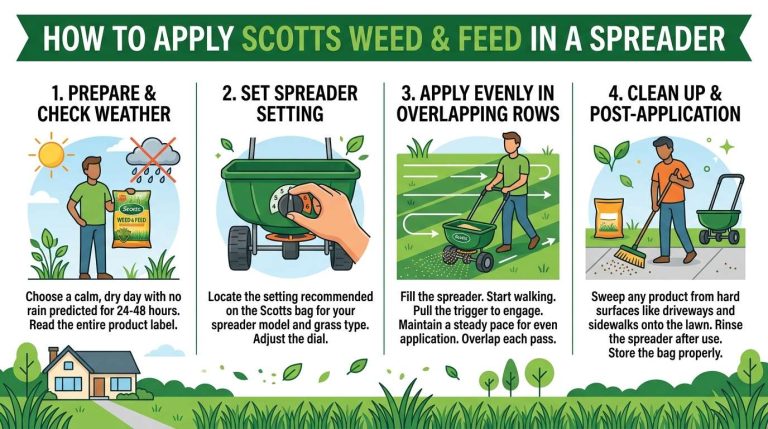
To avoid striped or patchy results, overlap your walking paths slightly on each pass. About 6 to 12 inches of overlap is enough to ensure even coverage without over-applying.
6. Forgetting to Clean the Spreader After Use
Fertilizer and salt are corrosive. Leaving product in the hopper after use will degrade the plastic and rust any metal parts. Rinse your spreader with clean water after every use and let it air dry before storing.
7. Using the Wrong Setting for the Product
Fine products need smaller openings or lower flow settings. Coarse products need larger openings. Using the wrong setting leads to clogs, jams, or uneven distribution. Check the product bag for recommended spreader settings before you start.
Final Verdict: Which Is the Best Hand Fertilizer Spreader?
After reviewing all five options, here’s the bottom line.
If you want the overall best value and simplest experience: The Scotts Whirl is hard to beat. It’s affordable, easy to use, and handles most small lawn tasks reliably. It’s the go-to pick for most beginners.
If you have a large lawn and want efficiency: The SOLO 421 wins. Its chest-mount design, large capacity, and consistent spreading make it the most practical choice for bigger properties.
If you just want the easiest possible experience: The Battery-Powered Spreader is the top pick. Push a button, walk, and get even coverage without cranking. It’s the most modern and user-friendly tool here.
For quick jobs and all-season versatility on a budget: The Chapin 8740A is great. No parts to break, simple to use, and works well for spot treatments and seasonal tasks.
For an all-around compact quality build: The Brinly HHS3 is the most well-built compact option here. Its easy-fill design and reliable all-season performance make it a strong everyday companion for small to medium lawns.
There’s no single “best” for everyone — it depends entirely on your lawn size, your comfort level, and what you’re spreading. But with this guide, you now have everything you need to make the right call.
Grab the one that fits your situation, get outside, and give your lawn the nutrition it deserves.
Frequently Asked Questions
Q: Can I use a hand spreader for ice melt? Yes. Several models on this list — especially the Chapin 8740A, Scotts Whirl, and Brinly HHS3 — are explicitly designed for ice melt and salt spreading. Just be sure to rinse the spreader thoroughly after each use with salt-based products.
Q: How do I know how much fertilizer to spread? Check the fertilizer bag. It will list the recommended application rate and often include suggested spreader settings. Do a test pass first to calibrate before spreading on your full lawn.
Q: Are handheld spreaders accurate? They’re accurate enough for most residential lawn care. Battery-powered models with motor-controlled output are the most consistent. Manual crank models depend more on the user’s technique.
Q: How do I clean my hand spreader? Rinse with clean water after every use, especially after spreading salt or fertilizer. Use a brush to clear any stubborn residue from the openings. Air dry completely before storing.
Q: Is a battery-powered spreader better than a manual one? For ease and consistency, yes. For simplicity and cost, manual wins. It depends on your priorities. Both types deliver good results when used correctly.
Happy spreading — and here’s to a greener, healthier lawn.

Hi, I’m Mary, the founder of GardenCure.com. I’m passionate about creating healthy, beautiful gardens and well-kept lawns. I share practical experience and trusted advice on garden and lawn gear that truly works. With the support of my dedicated research team, our writers produce honest, in-depth reviews using reliable, authentic sources—helping you choose the right tools with confidence for your outdoor space.