5 Best Fertilizer for Pine Trees In 2026
Pine trees are tough. They grow in rocky soil, handle cold winters, and still manage to look stunning year after year. But even the hardiest pine can start looking sad — yellowing needles, slow growth, weak branches — if it’s not getting the nutrients it needs.
In this article
That’s where fertilizer comes in.
Finding the best fertilizer for pine trees isn’t always easy. Walk into any garden center and you’ll see dozens of options. Liquid, granular, spikes, slow-release, fast-release — it can get confusing fast.
So here’s what this article does: it breaks down three solid fertilizer products that actually work for pine trees and other acid-loving evergreens. Each review is detailed, honest, and written in plain language. No fluff, no fake hype.
By the end, you’ll know exactly which fertilizer fits your trees and your situation.
Let’s dig in.
A Quick Word About Pine Tree Nutrition
Before getting to the reviews, it helps to understand what pine trees actually need from a fertilizer.
Pine trees are acid-loving plants. They thrive in soil with a pH between 4.5 and 6.0. When soil pH creeps too high, the tree can’t absorb nutrients properly — even if those nutrients are present in the soil. This is why fertilizers made specifically for pines and evergreens matter so much.
The three main nutrients in any fertilizer are nitrogen (N), phosphorus (P), and potassium (K). For pine trees:
- Nitrogen drives green, leafy (or needle) growth
- Phosphorus supports strong root development
- Potassium builds overall resilience and stress tolerance
Beyond these three, pine trees benefit from micronutrients like iron, manganese, and zinc — especially when soil pH is off and absorption is poor.
Signs your pine tree may need fertilizer:
- Pale or yellowing needles
- Slow or stunted growth
- Sparse foliage
- Drooping or weak branches
- Poor color in spring
Now, let’s look at the three fertilizers being reviewed here.
The 3 Products at a Glance
- Pine Tree Fertilizer – Liquid Plant Food (1 Gallon) — Best for fast results and root-focused feeding
- Jobe’s Slow Release Evergreen Fertilizer Spikes (9 Count) — Best for set-it-and-forget-it convenience
- 32oz Evergreen Fertilizer Concentrate — Makes 32 Gallons — Best for large properties and budget-conscious gardeners
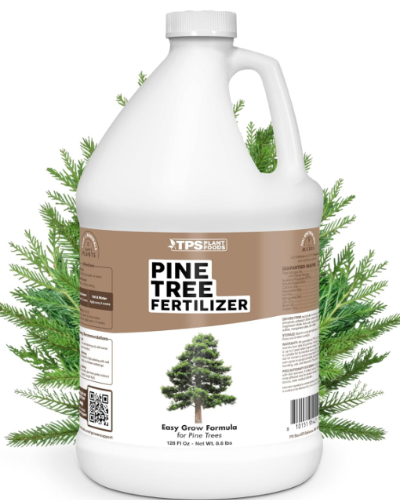
Pine Tree Fertilizer — Liquid Plant Food (1 Gallon)
What Is It?
This is a liquid concentrate designed specifically for pine trees, Leyland cypress, and other evergreens. The formula focuses heavily on root stimulation while also supporting above-ground growth. It comes in a 1-gallon jug and gets diluted with water before application.
The product targets trees that need to establish themselves quickly or recover from stress. It’s built around the idea that strong roots = strong tree. A tree with deep, well-developed roots can better handle wind, drought, and soil instability.
Who Is This Made For?
This fertilizer suits homeowners who have recently planted pine trees or evergreens and want to give them a strong start. It also works well for mature trees that are looking a little rough — sparse needles, slow growth, or general decline.
If you’ve got Leyland cypress lining your driveway or a row of pines acting as a windbreak, this product was practically made for your yard.
Key Features — Explained Simply
Root Growth Focus The formula is designed to push rapid root growth. Healthy roots mean the tree can pull water and nutrients from a larger area of soil. For young trees, this means faster establishment. For older trees, it means better stability and drought tolerance.
Liquid Delivery Liquid fertilizer gets into the soil quickly. Unlike spikes or granules that need time to break down, a liquid product is available to the roots almost right away. This makes it a good pick when you want to see results faster.
Versatile for Evergreens This isn’t just for pines. The label covers Leyland cypress, arborvitae, spruce, fir, and other evergreen varieties. So if your yard has a mix of conifers, one product handles all of them.
1-Gallon Size A gallon of concentrate goes a long way. Depending on your dilution ratio and how many trees you have, this jug can feed multiple trees across several applications.
How to Use It
Mix the concentrate with water according to the label instructions. Then apply it directly to the root zone — the area around the base of the tree extending out to the drip line (the edge of where the branches reach). You can use a watering can or a hose-end sprayer for larger areas.
Avoid getting the concentrate directly on the bark or needles. Dilute it properly. More isn’t better here — over-fertilizing with liquid products can burn roots or cause a nutrient flush that actually weakens the tree.
Apply during the active growing season. For most regions, that’s late spring through early fall.
Real-Life Usage Insight
Liquid fertilizer works best when the soil is already moist. Apply it after a good rain or after watering the area. This helps the nutrients move down into the root zone instead of sitting on the surface.
For newly planted trees, apply every four to six weeks during the growing season. For established trees, two or three applications spread across the season is usually enough.
One thing to note: liquid fertilizers don’t last as long in the soil as granules or spikes. The nutrients are available fast, but they also wash out faster. In areas with heavy rainfall, you may need to reapply more frequently.
Pros
- Fast nutrient delivery to roots
- Great for newly planted or stressed trees
- Works on multiple evergreen species, not just pines
- Liquid form means easy, even distribution
- Root-stimulating formula gives a real developmental advantage
- Straightforward to apply with a watering can or sprayer
Cons
- Needs to be diluted properly — skip this step and you risk root burn
- Doesn’t last as long as slow-release options
- Requires more frequent applications compared to spikes or granules
- Gallon jug can be a bit heavy to move around if you’re working a large yard
Performance Discussion
For trees that need help fast, this liquid fertilizer delivers. The root stimulation focus is a real differentiator. Most general-purpose fertilizers feed what’s above ground first. This one prioritizes the root system, which pays off in the long run with stronger, more resilient trees.
Trees treated with this type of product tend to show improved needle color within a few weeks of application. Root development improvements are harder to see, but the tree’s overall vigor — how straight it stands, how it handles wind, how dense its canopy becomes — reflects what’s happening underground.
It’s not a miracle product. If your soil pH is way off or the tree is in deep decline from disease or pests, fertilizer alone won’t fix it. But as a regular feeding tool or a recovery boost, this liquid formula does the job well.
Ease of Use
Pretty simple once you get the dilution right. Read the label, measure carefully, mix, and apply. The liquid form means no digging, no hammering in spikes, and no spreading granules by hand. Just mix and pour.
If you have a hose-end sprayer attachment, application becomes even easier — especially for multiple trees or larger root zones.
Value for Money
A 1-gallon jug at a reasonable price point that feeds multiple trees across several applications? The value is solid. Liquid concentrates generally offer better cost-per-application than pre-mixed ready-to-use bottles.
Jobe’s Slow Release Evergreen Fertilizer Spikes (9 Count)
What Is It?
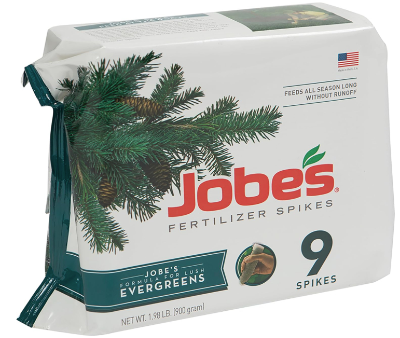
Jobe’s Fertilizer Spikes are pre-measured, solid sticks of fertilizer that you hammer into the ground around your tree. Once in the soil, they release nutrients slowly over time — no mixing, no spraying, no reapplication every few weeks.
This 9-count pack is formulated for acid-loving trees including pine, cypress, arborvitae, cedar, and other conifers. Each spike delivers nutrients directly into the root zone where the tree can access them.
Who Is This Made For?
This product is ideal for anyone who wants low-maintenance tree care. If you don’t want to think about fertilizing your pines every month, spikes are the answer. You put them in once per season, and the slow-release formula does the work for you.
It’s also great for people who are nervous about over-fertilizing. With spikes, there’s no mixing, no guessing on concentration, and no accidental over-application. Each spike delivers a set amount of nutrients at a controlled rate.
Busy homeowners, older gardeners who prefer less physical work, and beginners who aren’t confident about diluting liquid fertilizers will all find spikes comfortable and approachable.
Key Features — Explained Simply
Slow-Release Formula The nutrients in Jobe’s spikes break down gradually. Instead of a big flood of fertilizer all at once, the tree gets a steady, consistent supply over weeks or months. This is actually closer to how trees get nutrients from naturally decomposing organic matter.
Pre-Measured Convenience Every spike is identical. No measuring, no mixing. Just push them into the ground at the recommended spacing and depth. This removes a lot of the guesswork that trips up beginners.
Targets Acid-Loving Trees The formula is calibrated for trees that prefer acidic soil. Pine, cedar, spruce, arborvitae, and cypress are all on the label. The nutrients are balanced in a way that complements the soil and pH preferences of these species.
Root Zone Delivery Because the spikes go directly into the soil near the roots, nutrients don’t sit on the surface where they can wash away or evaporate. The root zone placement makes delivery more efficient.
9-Count Pack Nine spikes handles several trees depending on their size. For smaller trees (under 6 feet), fewer spikes are needed. Larger trees need more. The pack is a good starting supply for a yard with a few evergreens.
How to Use It
Place the spikes in a ring around the tree, about halfway between the trunk and the drip line. Use the plastic cap provided (or a wooden block) and a hammer to drive each spike into the soil. Spacing between spikes depends on tree size — the label gives clear guidelines.
For most trees, you apply spikes once in spring and once in fall. That’s it for the whole growing season.
Real-Life Usage Insight
Spikes work best in moist soil. If the ground is dry or compacted, getting the spikes in can be tricky, and nutrient release slows significantly. Water the area the day before application to soften the soil.
In areas with very heavy clay soil, spikes can sometimes sit in one spot without releasing nutrients evenly across the root zone. This is a known limitation of the spike format. If your soil is particularly dense, pairing spikes with an occasional liquid application can help.
The 9-count pack covers a small to medium-sized yard. If you have a large tree — say, a mature pine with a wide root zone — you’ll use more spikes per tree and burn through the pack faster.
Pros
- Extremely easy to use — no mixing or spraying
- Slow-release means fewer applications per season
- Pre-measured dosing reduces risk of over-fertilizing
- Delivers nutrients directly into the root zone
- Great for beginners or time-crunched homeowners
- Covers multiple acid-loving evergreen species
- Minimal mess or equipment needed
Cons
- In dry or compacted soil, getting spikes in cleanly can be hard
- Nutrient distribution may be uneven in heavy clay soils
- 9-count pack may not be enough for larger trees or multiple trees
- Slow-release means you won’t see quick results — patience required
- Not ideal for trees in acute decline that need fast nutrient delivery
Performance Discussion
Jobe’s spikes have a long track record in the home garden market, and for good reason. They’re reliable, consistent, and low-effort. Trees fertilized with spikes on a regular seasonal schedule tend to maintain healthy needle color, steady growth, and good branch density.
The slow-release aspect is both a strength and a minor limitation. It’s great for ongoing maintenance, but if your pine tree is struggling right now, you may want to start with a quick liquid application first and then switch to spikes for long-term feeding.
Over a full growing season, spikes do a solid job of keeping nutrient levels stable in the root zone. The formula is well-suited to conifers, and the pre-measured format ensures consistent dosing without any fuss.
Ease of Use
This is the easiest product in this roundup to use. If you can swing a hammer, you can use Jobe’s spikes. The instructions are clear, the process is fast, and once they’re in the ground, you’re done for the season.
The only physical challenge is breaking through hard or rocky soil. A hammer or mallet helps, and pre-watering makes a real difference.
Value for Money
A 9-count pack covers multiple trees for two seasons of application (spring and fall). Compared to buying multiple bottles of liquid fertilizer or bags of granules, the cost per application is reasonable. And when you factor in the time savings — no mixing, no spraying, minimal labor — the convenience adds significant value.
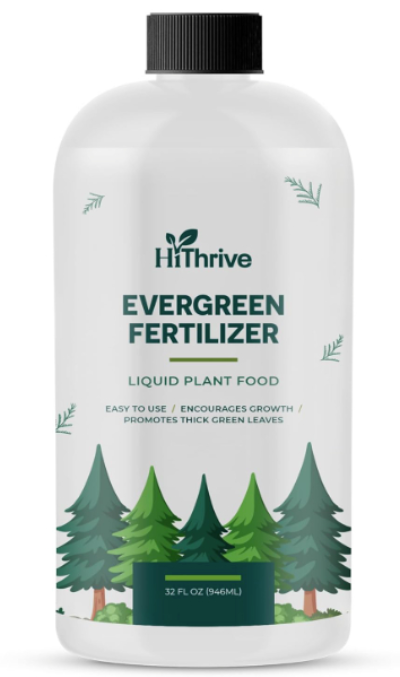
32oz Evergreen Fertilizer Concentrate — Makes 32 Gallons
What Is It?
This 32-ounce bottle of concentrated liquid fertilizer makes up to 32 gallons of ready-to-use tree food when diluted with water. It’s a nutrient-rich formula designed to support lush foliage, strong branches, and deep green color in evergreens throughout the growing season.
The product targets overall tree health — not just roots or just foliage, but the full picture. It’s designed to promote resilience, which means trees that can handle weather stress, recover from minor setbacks, and stay vibrant from spring through fall.
Who Is This Made For?
The 32-gallon yield makes this product an excellent pick for anyone with multiple trees, a large yard, or both. If you’re managing a pine grove, a line of privacy trees, or a property with a dozen evergreens, buying a small product every few weeks gets expensive fast. This concentrate stretches your dollar much further.
It’s also a solid choice for anyone who wants a versatile product that feeds multiple types of evergreen trees without needing a separate product for each species.
Key Features — Explained Simply
High Concentrate Ratio One 32-ounce bottle makes 32 gallons. That’s a 1:16 dilution ratio, which is very efficient. For comparison, some liquid fertilizers only make 4–8 gallons from a similar bottle size. You’re getting a lot more product for your money here.
Full-Spectrum Nutrition The formula is built to support foliage density, branch strength, and overall greenery — not just one aspect of tree growth. Trees treated with a balanced, full-spectrum fertilizer tend to look better overall and hold up better under stress.
Year-Round Vibrancy The label markets this as supporting green color “all year round.” For evergreens, this is relevant — pines and similar trees don’t drop their needles seasonally, but needle color can fade or turn yellow if nutrition is lacking. A consistent feeding schedule with this product helps maintain deep, rich green throughout the year.
Works on Multiple Evergreen Species Like the other products in this roundup, this one covers the full range of acid-loving conifers. Pine, spruce, fir, arborvitae, cypress — all are on the list.
Lush Foliage + Strong Branch Focus Beyond just needle color, the formula supports branch development. Stronger branches mean trees that are less likely to lose limbs in wind or snow load events. For large pines or conifers used as windbreaks, branch integrity is a real practical concern.
How to Use It
Dilute 1 ounce of concentrate per gallon of water. Apply to the root zone using a watering can, hose-end sprayer, or garden sprayer. Water the area after application to help nutrients soak into the soil.
Apply during the active growing season, spacing applications every four to six weeks. For trees with visible nutrient deficiency signs, start with two applications two weeks apart to jumpstart recovery, then drop to the regular schedule.
Real-Life Usage Insight
The concentrate format gives you flexibility. You can make a small amount for a single tree visit or mix up a large batch for a whole property treatment. This is hard to do with spikes or pre-mixed liquids.
Because this formula emphasizes foliage and branch health, it’s especially useful in late spring and early summer when trees are putting energy into new growth. A well-timed application during this period can make a visible difference in how lush and full the canopy looks by midsummer.
For properties with both pines and deciduous acid-loving shrubs — like blueberries, azaleas, or rhododendrons — this product can pull double duty, since the formulation suits a wide range of acid-preferring plants.
Pros
- Exceptional value — 32 gallons from one bottle
- Great for large properties with multiple evergreens
- Balanced formula supports both foliage and branch health
- Flexible concentrate format for variable batch sizes
- Covers a wide variety of evergreen species
- Fast liquid delivery gets nutrients into the soil quickly
- Supports vibrant green color throughout the season
Cons
- Requires accurate measuring to avoid over- or under-application
- Like all liquid fertilizers, nutrients wash out faster than slow-release options
- No root-specific focus — less ideal if root development is the primary goal
- Larger volume means you need appropriate storage space
- More frequent application schedule compared to spike-based products
Performance Discussion
This concentrate earns its place in the lineup through sheer versatility and value. Where the liquid pine fertilizer from Product #1 focuses heavily on roots, this one takes a broader approach — feeding the whole tree with an emphasis on looking good.
For trees that are already established and just need consistent seasonal maintenance, this is an excellent choice. The foliage and branch benefits are real and visible. Trees that receive regular applications tend to show denser needle growth, richer color, and better overall structure.
For large yards, the cost efficiency is hard to beat. You’re not buying new product every month — one bottle lasts a solid portion of the growing season even for a property with many trees.
Ease of Use
Very easy, with one caveat: you need to measure accurately. The 1:16 dilution ratio is simple math, but if you eyeball it, you risk burning roots or under-feeding the tree. Use a measuring cup or a clearly marked mixing container.
Once mixed, application with a hose-end sprayer or watering can is quick and straightforward. Larger batches benefit from a backpack garden sprayer for coverage efficiency.
Value for Money
This is the best value pick of the three. The concentrate ratio means you’re paying for active nutrients, not water. For anyone feeding more than two or three trees regularly, the per-application cost drops significantly compared to the other options.
Side-by-Side Comparison
| Feature | Liquid Pine Fertilizer (1 Gal) | Jobe’s Fertilizer Spikes (9 Ct) | Evergreen Concentrate (32oz) |
|---|---|---|---|
| Form | Liquid concentrate | Solid spikes | Liquid concentrate |
| Release Speed | Fast | Slow | Fast |
| Ease of Use | Easy | Very Easy | Easy |
| Best For | Root development | Low-maintenance care | Large yards, full-tree nutrition |
| Application Frequency | Every 4–6 weeks | Once per season | Every 4–6 weeks |
| Coverage | Multiple trees | Several trees | Up to 32 gallons |
| Value | Good | Good | Excellent |
| Ideal User | New planters, recovery | Beginners, busy owners | Multi-tree properties |
Buying Guide: How to Pick the Right Pine Tree Fertilizer
Picking a fertilizer isn’t just about grabbing whatever’s on the shelf. Here are the factors that actually matter:
Soil pH First
Before buying any fertilizer, do a soil test. Pine trees need acidic soil. If your pH is above 6.5, fertilizer alone won’t help much — you’ll also need to address the pH with sulfur or an acidifying amendment. Soil test kits are inexpensive and available at most garden centers.
Tree Age and Health
Young trees and stressed trees benefit most from fast-acting liquid fertilizers. They need immediate nutritional support to establish or recover. Healthy, mature trees do well with slow-release options that provide steady, consistent feeding.
Your Property Size
One or two trees? Any of these products works. A dozen trees or more? Go with the concentrate. The math is simple: more trees = more fertilizer = concentrate makes more sense.
How Much Time You Want to Spend
Spikes win on convenience. Liquid fertilizers require more frequent application and mixing. Be honest about how much time and attention you can commit, and pick accordingly.
Specific Goals
- Want faster root development? Go liquid with a root-stimulating formula.
- Want the simplest possible routine? Go spikes.
- Want the most bang for your buck across a whole property? Go concentrate.
Reading the Label
Always check the N-P-K ratio on the label. For pines, a higher nitrogen number supports needle growth. A balanced formula with some phosphorus helps roots, and potassium supports stress tolerance. Avoid fertilizers with very high phosphorus if your soil already has adequate phosphorus — it can cause problems for the tree over time.
Common Mistakes to Avoid When Fertilizing Pine Trees
Even with a good product, there are ways to go wrong. Here are the most frequent mistakes and how to dodge them:
Fertilizing in the Wrong Season Fertilizing in late fall or winter, when the tree is dormant, is mostly wasteful. Nutrients wash away before the tree can use them. Stick to the active growing season.
Over-Fertilizing More fertilizer doesn’t mean more growth. Too much nitrogen causes a rapid flush of weak, tender growth that can stress the tree and attract pests. Follow label directions — they’re there for a reason.
Ignoring Soil pH A tree in soil with the wrong pH can’t absorb nutrients properly. If you’re fertilizing regularly but seeing no improvement, test your soil pH before spending more money on product.
Applying to Dry Soil Fertilizer applied to bone-dry soil can sit on the surface, wash off, or burn roots. Water first, then fertilize.
Placing Spikes Too Close to the Trunk Fertilizer spikes belong in the root zone — not right at the base of the tree. The roots that absorb nutrients are mostly at the outer edges of the root zone, not directly under the trunk.
Skipping Young Trees Some people assume young trees don’t need fertilizer because the soil is “fresh.” But young pines actually benefit from supplemental feeding during their first few years to build a strong root system before the tree grows large.
Using the Wrong Product General-purpose fertilizers for lawns or vegetables often have the wrong nutrient ratios for pines. Always use a product designed for acid-loving trees or conifers.
Who Should Buy These Products?
Buy the Liquid Pine Tree Fertilizer (1 Gallon) if:
- You’ve recently planted pine trees or evergreens
- Your trees are showing signs of stress or decline
- You want faster, visible results
- Root development is your main concern
Buy Jobe’s Fertilizer Spikes if:
- You want the least effort possible
- You’re new to tree care and don’t want to deal with mixing
- You have a few trees and a regular seasonal routine
- You’re worried about over-fertilizing
Buy the 32oz Evergreen Concentrate if:
- You have multiple trees or a large property
- You want the best value per gallon of fertilizer
- You’re focused on overall foliage health and branch strength
- You want a product flexible enough to mix in various batch sizes
Final Verdict
All three products reviewed here are legitimate, well-designed fertilizers for pine trees and other acid-loving evergreens. None of them are flashy gimmicks. They each do their job well — just in different ways.
Best for Root Growth and Tree Recovery: The Liquid Pine Tree Fertilizer (1 Gallon) takes this spot. Its focus on root stimulation gives young and stressed trees a real leg up. Fast nutrient delivery and ease of application make it a practical first choice for trees that need immediate support.
Best for Low-Effort Maintenance: Jobe’s Fertilizer Spikes are the clear winner here. For someone who wants to feed their pines twice a year with minimal fuss, spikes are unbeatable. The slow-release formula keeps nutrients coming without any extra work on your part.
Best Value for Large Properties: The 32oz Evergreen Concentrate wins on value and versatility. Making 32 gallons from one bottle is a compelling deal, and the full-spectrum formula that supports both foliage and branch health makes it a well-rounded choice for properties with multiple evergreens.
If you can only pick one, think about your biggest need right now. Young trees or sick trees? Go liquid. Easy routine for healthy trees? Go spikes. Multiple trees on a budget? Go concentrate.
Any of these picks will serve your pines better than leaving them without nutrition. Feed your trees right, and they’ll reward you with years of healthy, green growth that makes your yard look exactly like it should.
Frequently Asked Questions
How often should I fertilize pine trees? For liquid fertilizers, every four to six weeks during the growing season. For slow-release spikes or granules, once in spring and once in early fall is typically enough.
Can I use too much fertilizer on pine trees? Yes. Over-fertilizing causes rapid, weak growth, root burn, and can stress the tree. Always follow the recommended application rates on the label.
Do pine trees need special fertilizer? Pine trees benefit from fertilizers designed for acid-loving plants. General-purpose fertilizers can work in a pinch, but a formula made for conifers or evergreens gives better results because the nutrient ratios are better matched.
When is the best time to fertilize pine trees? Late spring through early summer is the prime window, when trees are actively growing. A second application in late summer supports the tree heading into fall. Avoid fertilizing right before or during dormancy.
What if my pine tree’s needles are still yellow after fertilizing? Check your soil pH. If the pH is too high, the tree can’t absorb nutrients even when they’re present. You may need to add sulfur or another acidifying agent to lower the pH before fertilizing helps.

Hi, I’m Mary, the founder of GardenCure.com. I’m passionate about creating healthy, beautiful gardens and well-kept lawns. I share practical experience and trusted advice on garden and lawn gear that truly works. With the support of my dedicated research team, our writers produce honest, in-depth reviews using reliable, authentic sources—helping you choose the right tools with confidence for your outdoor space.