5 Best Short Impact Sprinklers In 2026
If your lawn has dry patches, brown spots, or corners that never seem to get enough water, a good impact sprinkler can fix that problem fast. These tools have been around for a long time, and there’s a reason lawn care pros still reach for them instead of fancy new gadgets. They’re simple, tough, and they throw water far and evenly.
In this article
In this guide, we’ll walk through five of the top short impact sprinklers on the market right now. We’ll break down what each one does well, where it falls short, and who should actually buy it. By the end, you’ll know exactly which sprinkler fits your yard, your budget, and your watering needs.
Let’s get into it.
What Is an Impact Sprinkler and Why Does It Matter
An impact sprinkler works using a spring-loaded arm that gets knocked back and forth by the water pressure. Every time that arm swings, it makes a “tick tick tick” sound and rotates the sprinkler head a tiny bit further. Over time, this motion covers a full circle, or just part of one if you set it that way.
This design has stuck around for decades because it just works. Impact sprinklers throw water in a strong, steady stream rather than a fine mist, so wind doesn’t blow the water away as easily. That means less waste and more water actually landing where you want it, on your grass and plants instead of your driveway.
They’re also great for large areas. A single impact sprinkler can often cover a space that would need three or four regular spray heads. That saves you money on parts and cuts down on the number of hoses and timers you need to manage.
Quick Comparison Table
| Product | Material | Coverage Range | Best For |
|---|---|---|---|
| Orbit 55015 Zinc Impact Sprinkler | Zinc | Up to 55 feet | Medium to large yards |
| STYDDI Metal Impact Sprinkler Head | Zinc-Alloy | 20 to 43 feet | Gardens and mid-size lawns |
| Orbit 55200 Pulse Pop-Up | Plastic and metal parts | Standard pop-up range | Lawns needing a hidden sprinkler |
| WEMADE Heavy Duty Metal Sprinkler | Metal with metal base | Up to 85 feet diameter | Large open yards and fields |
| Orbit 58308 Brass Impact Sprinkler | Brass | 22 to 48 inch height, long range | Long-term, heavy use setups |
Now let’s look closer at each one.
1. Orbit 55015 Zinc Impact Sprinkler, 1/2-Inch
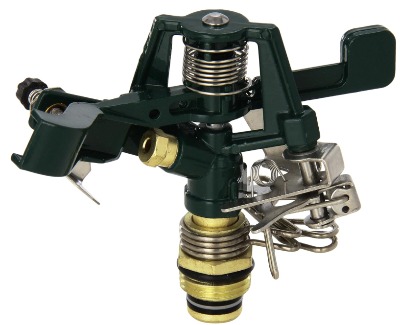
Product Description
The Orbit 55015 is one of the most well-known impact sprinklers out there, and it’s easy to see why. It’s built from zinc, which gives it a good balance between weight and strength. This model attaches to a standard 1/2-inch hose thread, so it’s simple to hook up to almost any garden hose without needing extra fittings.
It has a classic look, the kind you probably picture when someone says “sprinkler.” A metal body, a swinging arm, and a nozzle that throws water in a strong arc across your lawn.
Best Use Cases
This sprinkler works best for medium to large yards where you need even coverage without spending a lot of money. It’s also a solid pick for gardens, since you can adjust the spray pattern to avoid soaking pathways or flower beds you don’t want drenched.
Key Features Explained Simply
- Adjustable spray distance: You can turn a small dial to control how far the water travels, which helps you match the sprinkler to the size of your space.
- Full or partial circle pattern: You’re not stuck watering a complete circle. If your yard is shaped oddly, you can set the sprinkler to cover just part of that circle.
- Zinc body: Zinc resists rust better than basic steel, so this sprinkler can sit outside through different seasons without falling apart quickly.
- Diffuser pin: A small pin near the nozzle breaks up the water stream into a gentler shower, which is nice for young grass or seedlings that can get damaged by a hard water blast.
Real-Life Usage Insight
For a backyard lawn of average size, this sprinkler does the job without any fuss. Setting the spray pattern takes a minute or two once you get used to the adjustment screws. The ticking sound as it swings back and forth is part of the charm, and most people find it more relaxing than annoying once they’re used to it.
One thing worth noting is that water pressure really affects how well this sprinkler performs. On low pressure, the arm might swing slower and the coverage circle shrinks. On strong pressure, it throws water impressively far and rotates at a steady pace.
Pros
- Affordable price point
- Adjustable pattern and distance
- Zinc build holds up well outdoors
- Easy to connect to any standard hose
- Works well on medium and large lawns
Cons
- Plastic parts inside can wear out faster than the metal body
- Performance drops noticeably with low water pressure
- The ticking sound might bother some people at night
Performance Discussion
In terms of raw watering power, this sprinkler holds its own against pricier options. It covers a wide area evenly, and the water pattern stays fairly consistent across the whole arc. Where it can struggle a bit is with really uneven or low pressure setups, since the swinging arm relies on a strong, steady flow to work smoothly.
Ease of Use
Setup takes just a couple of minutes. Screw it onto your hose, plant it in the ground using a spike (sold separately, or bring your own), and adjust the dials. No tools needed, no manual required beyond common sense.
Value for Money
Given the price and the coverage area, this sprinkler offers strong value. It’s not the toughest or longest-lasting option on this list, but for casual to regular home use, it hits a nice sweet spot between cost and performance.
2. STYDDI Metal Impact Sprinkler Head
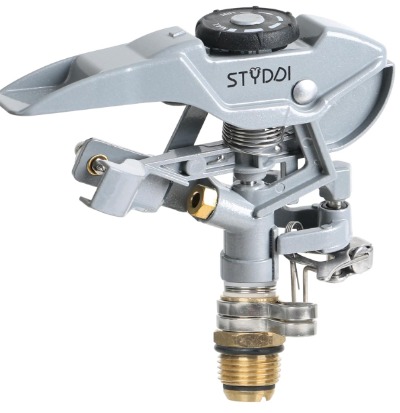
Product Description
The STYDDI impact sprinkler head is made from zinc-alloy and threads onto a standard 1/2-inch NPT fitting. It’s designed to cover anywhere from 20 to 43 feet depending on your water pressure and how you set the nozzle. This one leans more toward garden and mid-size lawn use rather than massive open fields.
Best Use Cases
If you’ve got a garden with mixed plants, a side yard, or a lawn that isn’t huge but still needs solid coverage, this sprinkler fits well. It’s also a nice option if you want something that feels sturdy without paying for a heavy-duty industrial model.
Key Features Explained Simply
- Full metal build: Unlike sprinklers that mix in a lot of plastic, this one is mostly metal, which usually means better durability over the years.
- Adjustable circle pattern: You can dial in a partial or full circle, giving you control over exactly where the water lands.
- Wide spray radius range: The 20 to 43 foot range gives you flexibility for different sized spaces without needing to buy multiple sprinklers.
- Standard thread size: The 1/2-inch NPT thread means it fits typical hose setups and risers without hunting for special adapters.
Real-Life Usage Insight
This sprinkler feels solid in the hand right out of the box, and that sturdiness carries over once it’s running. The spray pattern is easy to adjust, and the range does shift noticeably based on your home’s water pressure, so it helps to test it out in different spots in your yard before locking in a permanent setup.
Gardeners who grow rows of vegetables or flower beds tend to like this one because the adjustable radius lets them water tighter or wider zones as their plants grow throughout the season.
Pros
- Strong metal construction throughout
- Good range flexibility for different yard sizes
- Fits standard threads without extra parts
- Reasonable price for the build quality
Cons
- On the higher end of its range, water pressure needs to be fairly strong
- Not ideal for extremely large open fields
- The nozzle can need occasional cleaning if your water has sediment
Performance Discussion
Performance-wise, this sprinkler does well in small to mid-size spaces. The water distribution stays fairly even, and adjusting the spray radius is straightforward. It doesn’t quite match the sheer distance of the heavy-duty options on this list, but for its intended use, it performs reliably.
Ease of Use
Screwing it onto a riser or hose fitting takes seconds. The adjustment dial for radius and pattern is simple enough that even first-time sprinkler users won’t need instructions to figure it out.
Value for Money
For the price, you’re getting a mostly metal build with decent range and solid adjustability. It’s a smart pick if you want something better than the cheapest plastic sprinklers without jumping straight to premium brass models.
3. Orbit 55200 Pulse Pop-Up Impact Sprinkler Head, Black
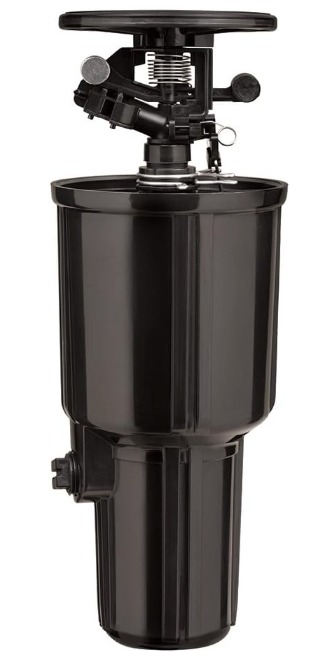
Product Description
This one’s a bit different from the rest. The Orbit 55200 is a pop-up impact sprinkler, meaning it sits flush with the ground when it’s not running and pops up when water pressure hits it. Once it’s done watering, it drops back down out of sight. This makes it a favorite for people who care about how their lawn looks when the sprinklers aren’t in use.
Best Use Cases
This sprinkler is built for lawns where looks matter, like front yards, HOA-controlled properties, or anywhere you’d rather not have a sprinkler head sticking up all the time. It’s also a good match for underground irrigation systems since it’s designed to work with that kind of setup.
Key Features Explained Simply
- Pop-up design: The head rises out of the ground only when it’s watering, then retracts when it’s done.
- Impact rotation mechanism: Even though it’s a pop-up style, it still uses that same reliable swinging-arm impact motion for even coverage.
- In-ground installation: Designed to connect into an underground sprinkler system rather than a garden hose.
- Durable pop-up stem: Built to handle repeated rising and lowering without getting stuck or jamming over time.
Real-Life Usage Insight
For anyone with an existing underground irrigation system, swapping in this pop-up head is a nice upgrade from a basic spray head, especially for lawns that need a stronger, farther-reaching stream instead of a soft mist. The pop-up action is smooth in most cases, though it does depend on having enough water pressure to push the head up fully.
People who mow their lawns often really appreciate this style since there’s no sprinkler head to dodge or accidentally clip with the mower blade.
Pros
- Nearly invisible when not in use
- Keeps your lawn looking clean and tidy
- Impact motion gives strong, even coverage
- Great match for existing sprinkler systems
- Mower-friendly design
Cons
- Requires an underground irrigation setup, not just a hose
- Installation is more involved than surface sprinklers
- Weak water pressure can cause the head to pop up only partway
Performance Discussion
Once it’s popped up and running, this sprinkler performs just like a standard impact model, throwing water in that classic strong, even arc. The tricky part is making sure your system has enough pressure to lift the head fully out of the ground every time. When that’s dialed in correctly, performance is impressive.
Ease of Use
This is the most involved option on the list to set up, since it requires connecting into an underground system rather than just screwing onto a hose. Once installed, though, day-to-day use is completely hands-off, since it works automatically with your existing sprinkler timer or valve.
Value for Money
If you already have an in-ground system, this pop-up head is a smart upgrade that adds impact-style coverage without ruining your lawn’s appearance. For someone starting from scratch with no underground plumbing, it’s a bigger investment of time and money to get running.
4. WEMADE Heavy Duty Metal Pulsating Sprinkler for Yard
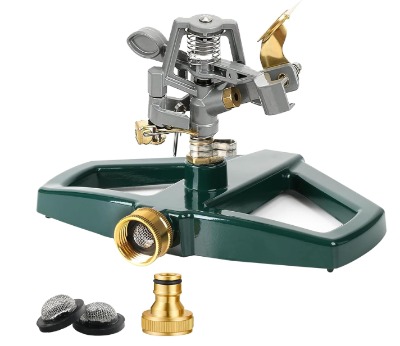
Product Description
The WEMADE sprinkler is built for people with a lot of ground to cover. With a metal base and a claimed reach of up to 85 feet in diameter, this is one of the biggest coverage options on this list. It rotates a full 360 degrees automatically, making it a strong pick for open lawns, farms, or large garden plots.
Best Use Cases
This sprinkler shines in big open spaces, think large backyards, small farms, or fields where you’d otherwise need multiple smaller sprinklers working together. It’s also handy for people who want to water a big area without constantly moving the sprinkler around.
Key Features Explained Simply
- Heavy metal base: This weighted base keeps the sprinkler steady even when water pressure is strong, so it doesn’t tip over or wobble around.
- 360 degree rotation: Unlike some impact sprinklers that only do partial circles, this one is built to rotate the full way around automatically.
- Long reach: With coverage up to 85 feet across, it can water a large area from one single spot.
- All-metal build: Metal parts throughout mean better resistance to cracking or breaking compared to plastic-heavy sprinklers.
Real-Life Usage Insight
For bigger properties, this sprinkler cuts down on the hassle of moving equipment around the yard every twenty minutes. Set it in the middle of a large space, connect your hose, and let it run. The heavy base really does help keep things stable, especially compared to lightweight sprinklers that tend to walk or tip over on their spike.
Farmers and homeowners with big lots tend to like this one the most out of the group, simply because fewer sprinklers means less time spent managing hoses and timers.
Pros
- Covers a huge area from one spot
- Heavy base adds stability during use
- Full metal construction for durability
- Great for farms, fields, and oversized lawns
- Cuts down on the number of sprinklers you need
Cons
- Overkill for small or average-sized yards
- Heavier and bulkier to move around than smaller models
- Needs strong water pressure to hit its maximum reach
Performance Discussion
When paired with good water pressure, this sprinkler delivers on its promise of wide coverage. The rotation stays smooth, and the stability from the metal base keeps the spray pattern consistent instead of drifting off in one direction. On weaker pressure systems, the reach shrinks quite a bit, so it’s worth checking your home’s water flow before expecting the full 85 foot spread.
Ease of Use
Setup is simple, connect the hose, place the sprinkler, and turn on the water. There’s very little adjustment needed since it’s designed to rotate fully on its own. The only real effort involved is moving it since it’s heavier than the average sprinkler.
Value for Money
For large properties, this sprinkler can replace two or three smaller units, which actually makes it a smart financial choice despite the higher upfront price. For small yards, though, you’d be paying for coverage you don’t need.
5. Orbit 1/2 Inch Brass Impact Sprinkler with Adjustable Tripod
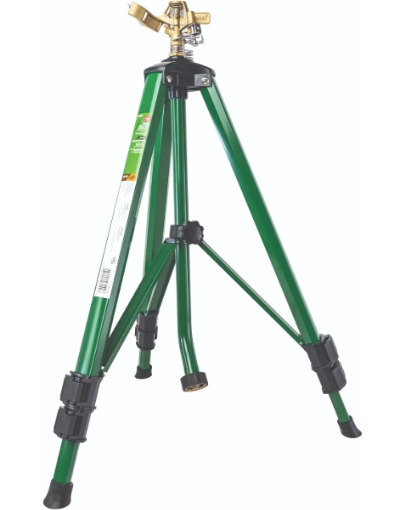
Product Description
This Orbit model steps things up with a brass build instead of zinc or plastic-heavy parts, plus it comes mounted on an adjustable metal tripod. The tripod height ranges from 22 to 48 inches, letting you raise the sprinkler up above tall grass, garden beds, or crops so the water isn’t blocked before it can spread out.
Best Use Cases
This is a great match for gardens with tall plants, vegetable patches, or any spot where a ground-level sprinkler would get its spray blocked by leaves and stems. It’s also a solid long-term option for anyone who wants a sprinkler built to last through heavy, repeated use.
Key Features Explained Simply
- Brass construction: Brass is known for holding up extremely well against rust and general wear, often outlasting zinc or plastic parts by a wide margin.
- Adjustable tripod stand: You can raise or lower the sprinkler between 22 and 48 inches, which is great for clearing tall plants or crops.
- 360 degree rotation with adjustable pattern: Like the other Orbit models here, you can set a full circle or dial in a partial pattern.
- Sturdy tripod legs: The tripod base spreads out on the ground for extra stability, which matters a lot once the sprinkler is raised up high.
Real-Life Usage Insight
Gardeners with taller crops, like corn, tomatoes on stakes, or tall flowers, tend to run into a common problem: ground-level sprinklers get blocked and can’t spread water evenly. Raising this sprinkler up on its tripod solves that problem directly, letting the water arc clear over the plants and land where it’s needed.
The brass build also means this sprinkler tends to age well, resisting the kind of corrosion that can eventually clog or jam cheaper metal or plastic sprinklers after long-term outdoor exposure.
Pros
- Brass material resists corrosion very well
- Tripod height adjustment solves the “blocked by tall plants” problem
- Sturdy and stable even when raised high
- Long-lasting build quality
- Adjustable spray pattern like the other Orbit models
Cons
- Higher price tag than the zinc or plastic options
- Tripod takes up more storage space when not in use
- Slightly more setup involved compared to a simple spike sprinkler
Performance Discussion
This sprinkler performs consistently well, and the tripod really does make a noticeable difference in gardens with taller plants. The brass parts also seem to keep the internal mechanism running smoothly over long stretches of use, without the sticking or jamming that can sometimes happen with lower-grade metals.
Ease of Use
Setting up the tripod legs and adjusting the height takes a bit more time than a basic spike sprinkler, but it’s still simple enough for anyone to figure out without instructions. Once it’s set at the right height, you likely won’t need to touch it again for the rest of the growing season.
Value for Money
Yes, it costs more than the basic models on this list, but the brass build and tripod design genuinely solve problems that cheaper sprinklers can’t. For serious gardeners or anyone watering tall crops, this one earns its higher price tag.
Comparison Insights
Looking at all five sprinklers side by side, a few clear patterns show up.
For sheer coverage area, the WEMADE heavy duty sprinkler wins by a wide margin, reaching up to 85 feet across. That makes it the go-to for large yards, fields, or farms.
For durability over the long haul, the Orbit brass tripod model stands out, since brass resists corrosion better than zinc or plastic parts. If you’re planning to use a sprinkler for many seasons without replacing it, brass is the safer bet.
For looks and lawn appearance, the Orbit pop-up model is the clear winner, since it disappears into the ground when not in use. Nothing else on this list offers that.
For budget-friendly, general-purpose watering, the Orbit 55015 zinc sprinkler and the STYDDI metal head both offer strong value, covering medium to large areas without a steep price tag.
For gardens with tall plants or crops, the tripod-mounted brass sprinkler solves a problem that ground-level models simply can’t handle.
Buying Guide: What to Look for in a Short Impact Sprinkler
Water Pressure Compatibility
Every impact sprinkler needs decent water pressure to work at its best. Before buying, it helps to know your home’s average water pressure, since low pressure can shrink both the coverage radius and how well the arm swings. If your pressure is on the weaker side, look for a model known to perform well even without strong flow.
Material Matters
Zinc, brass, and plastic all behave differently outdoors. Plastic parts tend to crack over time with sun exposure, zinc holds up decently but can wear faster than metal alternatives, and brass tends to outlast both, resisting rust and corrosion the longest. If you’re watering often or leaving your sprinkler outside year-round, lean toward metal-heavy builds.
Coverage Area
Match the sprinkler’s stated range to your actual yard size. Buying a sprinkler rated for 85 feet when your yard is only 20 feet across means you’re paying for coverage you’ll never use, and you might even end up watering your neighbor’s driveway by accident.
Adjustability
Look for models that let you set a partial circle instead of just a full 360 degree spray. This matters a lot if your yard has odd corners, paths, or garden beds you’d rather not soak every time you water.
Mounting Style
Spike-mounted sprinklers are the simplest and cheapest to set up. Tripod models raise the water above tall plants. Pop-up styles hide below ground when not running. Pick based on your yard’s shape and how much you care about visible equipment sitting on your lawn.
Build Quality and Warranty
Check what the sprinkler’s housing is made of and whether the brand backs it with any kind of warranty. A sprinkler that’s mostly plastic inside, even with a metal shell, may not last as long as one built with metal gears and moving parts throughout.
Who Should Buy These Sprinklers
Homeowners with medium to large lawns will likely be happiest with the Orbit 55015 zinc model or the STYDDI metal head, since both cover solid ground without costing too much.
People with underground irrigation systems already installed should look at the Orbit pop-up model, since it fits right into that kind of setup and keeps the lawn looking neat.
Farmers, or anyone with a large open property, will get the most value out of the WEMADE heavy duty sprinkler, thanks to its huge coverage range and sturdy base.
Serious gardeners growing tall crops like corn, staked tomatoes, or tall flowers should go with the brass tripod model, since raising the sprinkler above the plant line solves a real, common watering problem.
Anyone wanting long-term durability over the cheapest upfront price should also lean toward the brass option, since it tends to outlast zinc and plastic builds by a good stretch.
Common Mistakes to Avoid
Ignoring water pressure before buying. A sprinkler rated for 80 feet of coverage won’t hit that number on a weak water system. Test your pressure or at least ask your water provider for typical numbers in your area before buying a sprinkler based purely on its advertised range.
Buying based on coverage number alone. Bigger isn’t always better. A sprinkler built for huge open fields can actually waste water and money in a small backyard, since you’re paying for reach you’ll never use.
Skipping the adjustment settings. Many people run their sprinkler on the default full-circle setting without ever checking if a partial pattern would actually work better for their yard’s shape. Take a few minutes to test different settings before locking in a permanent watering schedule.
Placing the sprinkler too low near tall plants. If your garden has tall crops or bushes, a ground-level sprinkler might get blocked, leading to uneven watering. A tripod or raised mount solves this instantly.
Forgetting to clean the nozzle. Sediment and mineral buildup from tap water can clog the nozzle over time, leading to a weaker or uneven spray. A quick rinse or clean every so often keeps performance steady.
Leaving cheaper plastic models out in harsh weather year-round. Even sprinklers with metal housing sometimes have plastic internal gears that degrade faster under constant sun and temperature swings. Bringing sprinklers indoors during off-seasons can add years to their lifespan.
Not checking the thread size before buying. Most of these sprinklers use a standard 1/2-inch thread, but it’s still worth double-checking your hose or riser fitting before ordering, especially if you’re replacing an older or non-standard sprinkler head.
How These Sprinklers Compare to Other Watering Options
It’s worth mentioning briefly how impact sprinklers stack up against other common watering tools, since that context helps explain why so many people still choose them.
Compared to oscillating sprinklers, impact models tend to throw water farther and handle wind better, since the stream is stronger and more focused rather than a wide, gentle fan. Oscillating types work great for smaller, rectangular lawns but often struggle with larger or irregularly shaped spaces.
Compared to drip irrigation, impact sprinklers cover ground much faster and work better for open lawns rather than garden beds with individual plants. Drip systems shine for precise, low-waste watering of specific plants, but they’re not practical for covering a whole lawn.
Compared to basic spray heads, impact sprinklers usually last longer and cover more ground per unit, though spray heads can offer gentler, more even coverage for smaller, more delicate areas like flower beds or newly seeded patches.
None of these options is universally “better.” It really comes down to your yard’s size, shape, and what you’re trying to grow.
Tips for Getting the Most Out of Your Impact Sprinkler
Run your sprinkler early in the morning or later in the evening rather than during the hottest part of the day. Less water evaporates that way, so more of it actually soaks into the soil where your grass and plants need it.
Move the sprinkler around occasionally if you’re using a spike-mounted model, especially in larger yards, so no single area gets overwatered while another stays dry.
Check the spray pattern every few weeks, since ground settling, growing plants, or accidental bumps can shift the direction over time without you noticing right away.
Store your sprinkler somewhere dry during long stretches when you’re not watering, especially in colder months, since leftover water inside the mechanism can freeze and damage internal parts.
Pair your sprinkler with a simple timer if you tend to forget to turn the water off. This small addition can save a surprising amount of water and money over a full season.
Final Verdict
All five of these short impact sprinklers do their job well, but they’re built for slightly different situations.
If you want an affordable, reliable option for a typical home lawn, the Orbit 55015 zinc sprinkler is hard to beat. It covers a wide area, adjusts easily, and won’t break the bank.
If your yard sits somewhere between a small garden and a mid-size lawn, the STYDDI metal impact sprinkler head offers a nice, sturdy middle ground with flexible range settings.
If keeping your lawn looking neat matters to you, and you already have an underground system, the Orbit 55200 pop-up model is the clear pick, since it stays hidden until it’s needed.
If you’re dealing with a large yard, a small farm, or any wide open space, the WEMADE heavy duty sprinkler covers ground that the others simply can’t match.
And if you’re growing tall plants or just want something built to last for many seasons without corroding, the Orbit brass tripod sprinkler earns its higher price with genuinely useful features.
There’s no single “best” pick here, since so much depends on your yard’s size, shape, and what you’re growing. But based on the features, build quality, and real-world performance covered in this guide, you should now have a clear sense of which sprinkler actually fits your space. Match the sprinkler to your yard rather than just grabbing the one with the biggest coverage number, and you’ll end up with healthier grass, happier plants, and a lot less wasted water along the way.

Hi, I’m Mary, the founder of GardenCure.com. I’m passionate about creating healthy, beautiful gardens and well-kept lawns. I share practical experience and trusted advice on garden and lawn gear that truly works. With the support of my dedicated research team, our writers produce honest, in-depth reviews using reliable, authentic sources—helping you choose the right tools with confidence for your outdoor space.