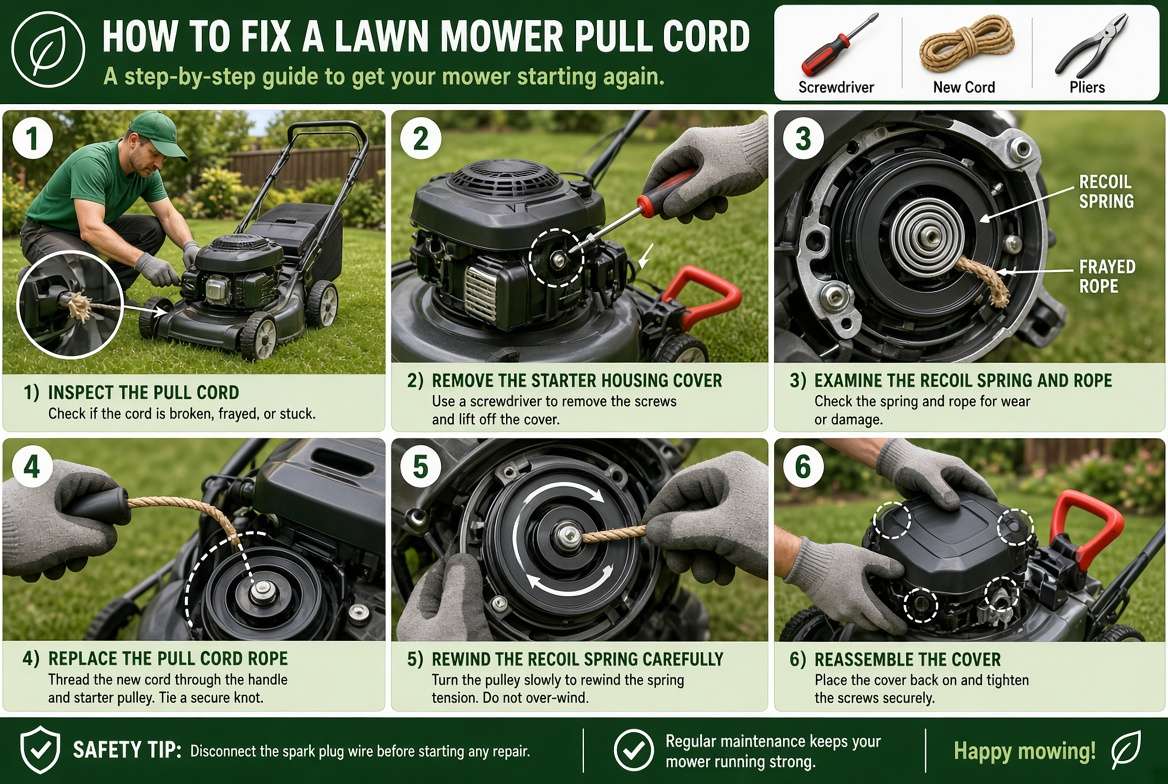
How to Fix a Lawn Mower Pull Cord?
Meta description: Lawn mower pull cord stuck, snapped, or won’t go back in? Follow this simple guide to fix your recoil starter, replace the rope, and get your mower running again.
In this article
You walk out to the yard, grab the handle, and give it a big pull. Nothing happens. Or the cord snaps in your hand. Or it comes out and never goes back in.
Annoying, right? The good news is that a broken pull cord is one of the easiest mower problems to fix at home. You don’t need fancy tools. You don’t need a mechanic. You just need a little patience and this guide.
In this post, I’ll show you how to find the problem, fix it, and keep it from happening again. I’ll keep it simple and skip the confusing talk.
What Is a Lawn Mower Pull Cord, Anyway?
The pull cord is the rope you yank to start your mower. People also call it a starter rope, recoil cord, or rip cord. It connects to a part called the recoil starter (also called the recoil assembly).
Here is how it all works, in plain words:
- You pull the handle.
- The rope unwinds from a round spool, called a pulley.
- The spool spins and grabs a part on the engine called the flywheel.
- The flywheel turns the engine over, and the engine starts.
- A rewind spring pulls the rope back onto the spool when you let go.
So when something goes wrong, the problem usually sits in one of these places: the rope, the handle, the spring, the spool, or the little metal grabbers inside called pawls.
Signs Your Pull Cord Needs Fixing
Not every starting problem comes from the cord. Still, these signs point right at it:
- The cord feels stuck. You can’t pull it at all, or it only moves a tiny bit.
- The cord pulls out but won’t retract. It just hangs there, limp.
- The rope snapped. You’re holding a handle with a short piece of string.
- The rope is frayed. It looks fuzzy, thin, or worn out near the handle.
- The cord pulls easily, but the engine does nothing. It feels loose, with no resistance.
- The handle broke or cracked. The rope slips right out.
Let’s fix each one.
Safety First (Please Don’t Skip This)
A lawn mower can hurt you if you rush. Take two minutes to stay safe:
- Pull the spark plug wire off the spark plug. This stops the engine from starting by accident. It’s the most important step.
- Work on a flat, solid surface. A garage floor or driveway works great.
- Let the engine cool down if you used the mower recently.
- Wear gloves and safety glasses. The rewind spring packs a lot of energy. If it snaps loose, it can fly out fast.
- Tip the mower the right way. Turn off the fuel and keep the air filter side facing up. This keeps oil and gas from leaking into the wrong places.
Now you’re ready.
Tools and Parts You Will Need
You probably own most of this already:
- Socket wrench set or a screwdriver (depends on your mower)
- Pliers (needle-nose pliers are best)
- Scissors or a sharp knife
- A lighter (to seal the rope end)
- New starter rope (check your manual for the right thickness and length)
- A new handle (only if yours is cracked)
- Replacement rewind spring or full recoil starter (only if needed)
- Work gloves and safety glasses
- A small tray or cup to hold screws
Pro tip: Take a photo of the recoil assembly before you take it apart. That photo will save you later.
Fix #1: The Pull Cord Is Stuck and Won’t Move
A stuck cord scares people the most. They think the engine is dead. Often, it isn’t. Here is what to check, from easiest to hardest.
Check the mower blade first
A stuck blade can lock the whole engine. Grass, sticks, or a rock can jam it.
- Pull the spark plug wire off.
- Tip the mower on its side (air filter up).
- Look under the deck. Clear out any packed grass or debris.
- Try to turn the blade by hand.
If the blade turns freely, put the mower back down and try the cord again. Many stuck cords come from a clogged deck, and this simple cleanup solves the problem.
Check for a blocked recoil starter
Sometimes dirt, grass, or a bent part jams the starter itself. Take off the starter cover and look inside. We’ll cover how to do that in a moment. If you see gunk, clean it out and test the spool. It should spin smoothly.
Rule out a seized engine
If the cord stays locked even after you clear the deck and remove the recoil starter, the engine itself might be stuck. This can happen from:
- Low or no oil. The engine overheated and locked up.
- Hydro-lock. Too much oil or gas got into the cylinder.
To test it, remove the spark plug and pull the starter again. If the cord suddenly moves, extra fluid was trapped inside. Let the cylinder air out, wipe the plug, and try again.
If the engine still won’t turn with the plug out, you likely have a serious internal problem. At that point, a small engine repair shop is your best bet.
Fix #2: The Cord Pulls Out but Won’t Go Back In
This one is super common. It almost always means the rewind spring came loose, lost tension, or broke.
Here’s how to fix it.
Step 1: Remove the recoil starter
- Pull the spark plug wire off.
- Find the starter housing. It’s the plastic or metal cover on top of the engine, with the rope coming out of it.
- Unscrew the bolts that hold it to the engine. Most mowers have three or four.
- Lift the whole assembly off and set it on your workbench.
Step 2: Open the starter housing
Look at the back of the housing. You’ll see a round spool (the pulley) held in by a center bolt or clip. Remove it carefully.
Warning: The spring sits under the spool. Hold the spool down with one hand while you remove the bolt. If the spring jumps out, it can uncoil like a snake. Wear your gloves and glasses here.
Step 3: Check the spring
Lift the spool gently. Now look at the spring:
- If the spring popped out of place, you can wind it back into the housing in a circle, following the same direction it came out.
- If the spring is bent, rusty, or broken, you need a new one. Springs are cheap, and many shops sell them alone.
- If the spring looks fine, but the rope still won’t retract, the spring probably lost its tension. You can add tension (we’ll do this in the rewind steps below).
Step 4: Put it back together
Place the spring in its slot. Set the spool on top, hook the rope back in, and put the center bolt or clip back on. Then move on to the tension steps further down.
Fix #3: The Rope Snapped or Looks Frayed
A snapped rope is the easiest fix on this list. You just replace it. Do it even if the old rope still works but looks fuzzy. A weak rope will snap at the worst moment.
How to replace a lawn mower starter rope
Step 1: Remove the recoil starter.
Follow the same steps from Fix #2. Take out the bolts and lift the assembly off the engine.
Step 2: Remove the old rope.
Pull the old rope out of the spool. You will see a knot inside the spool or the handle. Cut it off or untie it. Pull out the leftover pieces. Remove the old handle too.
Step 3: Measure your new rope.
Match the thickness of the old rope or check your manual. A rope that’s too thick won’t wrap well. A rope that’s too thin will snap. Most mower ropes run a few feet long, so measure the old one if you still have it. If not, your owner’s manual will list the exact size.
Step 4: Thread the rope through the housing.
Push the new rope through the small hole in the starter housing. Leave some extra length on the outside so you can tie the handle on.
Step 5: Feed the rope into the spool.
Run the rope through the small hole in the spool. Tie a strong knot (a double overhand knot or a figure-eight knot works well) so it can’t slip through. Pull it tight.
Step 6: Seal the rope end.
Use a lighter to melt the cut end for a second. This stops the fibers from fraying. Let it cool before you touch it.
Step 7: Add the handle.
Slide the handle onto the free end of the rope. Tie a tight knot at the end so the handle stays put. Pull hard to test it. Then tuck the knot into the handle.
Step 8: Wind the rope onto the spool.
Here comes the part most beginners miss. You need to add tension first, then wind. Jump to the next section.
How to Rewind the Spring and Add Tension
Without tension, your cord will hang loose. With too much, it can snap or jam. You want a nice, firm, medium pull.
- Wind the rope around the spool by turning the spool in the same direction the rope unwinds. Most spools have an arrow or a groove.
- Keep the rope wrapped tight. Hold the spool so it doesn’t spin back.
- Lock the rope in the notch. Many spools have a small notch on the edge. Hold the rope in it.
- Turn the spool two or three more times against the spring. This adds the pull-back force.
- Release the rope from the notch while holding the handle. The rope should zip back in on its own.
- Test it. Pull the cord out slowly. Then let it go. It should retract smoothly and fully.
If the cord pulls back hard and fast, you added too many turns. Take one off. If it moves slowly or stays out, add one more turn.
Fix #4: The Cord Pulls Fine but the Engine Won’t Start
You pull, the rope zips out easily, and the engine just sits there. It feels like pulling a loose string.
This usually points to worn or broken pawls. Pawls are small metal or plastic clips inside the starter. They stick out and grab the flywheel when you pull. When they break, they can’t grab anything.
How to check the pawls
- Remove the recoil starter (same steps as before).
- Look at the spool and the small clips attached to it.
- Check if they move freely and spring back out.
- Look for cracks, rust, or missing pieces.
How to fix them
- If they’re dirty, clean them with a rag and a little light oil.
- If they’re bent or broken, replace them. Many parts stores sell pawl kits.
- If the little spring on the pawl is gone, replace that too.
Also look at the flywheel on the engine. If its edge is chipped or damaged, the starter can’t grab it. In that case, the repair gets bigger, so a shop may help.
Fix #5: The Handle Broke or Slipped Off
A cracked handle is a quick job. You don’t even need to remove the whole starter.
- Cut the old knot or untie it.
- Slide a new handle onto the rope.
- Tie a strong knot at the end.
- Burn the tip a little to seal it.
- Tuck the knot inside the handle.
Keep a hold of the rope while you work. If you let go, the spring will pull it right back inside the housing, and you’ll need to open it up again.
When You Should Replace the Whole Recoil Starter
Sometimes fixing each part costs more time than it’s worth. A full replacement makes sense when:
- The plastic housing is cracked or melted.
- The spool is warped or broken.
- The spring keeps failing.
- Several parts look worn out at once.
- The new assembly costs about the same as the small parts.
A new recoil starter assembly is simple to install. You just bolt it onto the engine in the same place as the old one. Make sure you buy the one made for your exact mower model. Look for the model and engine number on the engine label. Then match it with the part number.
How Much Does It Cost to Fix a Pull Cord?
Here’s a rough idea, so you can plan:
- New starter rope: very cheap
- New handle: cheap
- Rewind spring: cheap to moderate
- Pawl kit: cheap
- Full recoil starter assembly: moderate
- Repair shop labor: can cost more than the parts
Most people fix it for the price of a rope and an hour of their time. That’s a pretty good deal compared with buying a new mower.
Simple Tips to Make Your Pull Cord Last Longer
You can avoid most pull cord trouble with a few good habits:
- Pull straight. Don’t yank the rope at a sharp angle. A side pull rubs the rope against the housing and wears it out fast.
- Don’t pull the rope all the way out. Stop before the end. Overstretching can damage the spring.
- Hold the handle when it goes back. Don’t let it snap into the housing. That can crack the handle and the cover.
- Keep it clean. Wipe off dirt and grass bits around the starter.
- Store the mower in a dry spot. Moisture rusts the spring and pawls.
- Check the rope often. Look for fuzz or thin spots at the start of each mowing season.
- Keep up with basic maintenance. Change the oil, clean the air filter, and replace the spark plug on time. A healthy engine starts easier, so you pull less and wear the cord less.
Common Mistakes Beginners Make
Learn from other people’s trouble:
- Forgetting to pull the spark plug wire. Always do this first.
- Using the wrong rope size. It might fit, but it won’t last.
- Skipping the knot test. Always tug hard on your knots.
- Adding too much spring tension. Too many turns can snap the spring.
- Losing small parts. Keep screws and clips in a cup.
- Forcing a stuck cord. If it won’t move, find out why. Yanking harder can break things.
Quick Troubleshooting Table
| Problem | Likely Cause | Easy Fix |
|---|---|---|
| Cord won’t pull | Jammed blade or seized engine | Clear the deck, check oil, remove spark plug |
| Cord won’t retract | Loose or broken rewind spring | Reset spring or replace it |
| Cord snapped | Old, worn rope | Install a new starter rope |
| Cord pulls but no start | Broken pawls | Clean or replace pawls |
| Handle fell off | Cracked handle or bad knot | Replace the handle and re-tie |
| Cord feels rough | Dirt in the housing | Clean and lightly oil the parts |
Frequently Asked Questions
Why won’t my lawn mower pull cord go back in?
The rewind spring most likely lost tension or slipped out of place. Open the housing, check the spring, and rewind the spool with a few extra turns.
How do I fix a lawn mower pull cord that is stuck?
Pull the spark plug wire first. Then clear any grass under the deck, check the oil level, and test the blade. If the cord stays stuck, remove the starter and see if the engine turns by hand.
Can I replace a pull cord without taking the starter off?
Sometimes you can, if the rope only snapped near the handle and still has some length inside. Most of the time, though, you need to remove the starter to feed the rope correctly.
What kind of rope should I use?
Use a rope made for small engine starters. It should match the thickness and length in your owner’s manual. Regular string or clothesline won’t hold up.
How long does it take to fix a pull cord?
Most beginners finish in about 30 to 60 minutes. After your first time, you can do it even faster.
Is it worth fixing or should I buy a new mower?
Fix it. A pull cord repair costs a tiny fraction of a new mower. Only think about replacing the mower if the engine itself is badly damaged.
Final Thoughts
A broken lawn mower pull cord looks scary, but it’s really a simple job. Most of the time, you only need a new rope, a quick spring reset, or a small cleaning. You can do it in one afternoon with basic tools.
Start by staying safe. Pull the spark plug wire. Then work your way through the steps, one at a time. Find the problem, fix it, add the right tension, and test it a few times.
Once you finish, you’ll feel proud. You’ll also save money and know your mower better. Next time that cord acts up, you won’t panic. You’ll just grab your tools and fix it.
Now go cut that grass.

Hi, I’m Mary, the founder of GardenCure.com. I’m passionate about creating healthy, beautiful gardens and well-kept lawns. I share practical experience and trusted advice on garden and lawn gear that truly works. With the support of my dedicated research team, our writers produce honest, in-depth reviews using reliable, authentic sources—helping you choose the right tools with confidence for your outdoor space.