How to Change a Spark Plug on a Lawn Mower?
Your lawn mower won’t start. It sputters and coughs but won’t turn over. You feel frustrated. Before you spend money at a repair shop, try this: the spark plug might be the culprit. The good news? Changing a spark plug is one of the easiest lawn mower repairs you can do yourself. You don’t need special skills or expensive tools. In fact, you probably have everything you need in your garage right now.
In this article
This guide walks you through every step. You’ll learn what a spark plug does, how to find it, how to remove the old one, and how to install a new one. By the end, you’ll feel confident tackling this task on your own.
What Does a Spark Plug Do?
Let’s start with the basics. A spark plug sits inside your lawn mower’s engine. Its job is simple but critical: it creates a spark that ignites the fuel and air mixture inside the engine. This spark happens thousands of times per minute when your mower runs. That spark is what makes your engine turn.
Over time, spark plugs wear out. They get dirty. They get fouled with carbon buildup. The gap between the spark plug’s electrodes widens. When this happens, the spark becomes weak or stops happening altogether. Your engine won’t run right. It might not run at all.
That’s why changing your spark plug matters. A fresh spark plug means a strong spark. A strong spark means your engine starts easier and runs better.
Why Your Spark Plug Might Need Replacing
Several things cause spark plug problems. Maybe your lawn mower sits in the garage for months during winter. Old fuel in the tank leaves residue on the spark plug. That residue stops the spark from forming.
Perhaps you’ve been mowing very dusty yards. Dirt gets into everything, including your spark plug area. Oil buildup happens too. If your mower burns oil, the spark plug gets covered in that burnt oil. All of this stops your mower from starting.
Sometimes you just need a new spark plug because it’s old. Most spark plugs last a full season or two, but they don’t last forever. Regular maintenance of your lawn mower, including spark plug replacement, keeps your mower running strong year after year.
Tools and Materials You’ll Need
Here’s what you need before you start. The good news is that this is a short list.
Tools:
- A spark plug socket (this is the most important tool—it fits perfectly over your spark plug)
- A ratchet wrench that fits your spark plug socket
- A gap tool or small ruler (to check the spark plug gap)
- A shallow tray or container (to hold small parts so you don’t lose them)
Materials:
- A new spark plug (the right type for your mower)
- Optional: a small amount of dielectric grease (helps prevent corrosion)
That’s it. You don’t need much.
Finding the Right Spark Plug for Your Mower
Before you buy a new spark plug, you need to know what type your mower uses. You have two options to find this out.
Option one: Check your mower’s manual. Open that manual and look for the spark plug specification. It will tell you the exact brand and model number you need.
Option two: If you’ve lost your manual, look at your current spark plug. Take off the old one and read what’s stamped on it. Write down the numbers and letters. Take that information to your local hardware store or garden supply shop. Show the worker the old spark plug, and they’ll find you a new one that matches.
Most lawn mowers use common spark plugs like Champion or Briggs & Stratton brands. These are easy to find at any store that sells mower parts.
Safety First: Prepare Your Mower
Before you touch anything on your lawn mower, you need to prepare it. This keeps you safe.
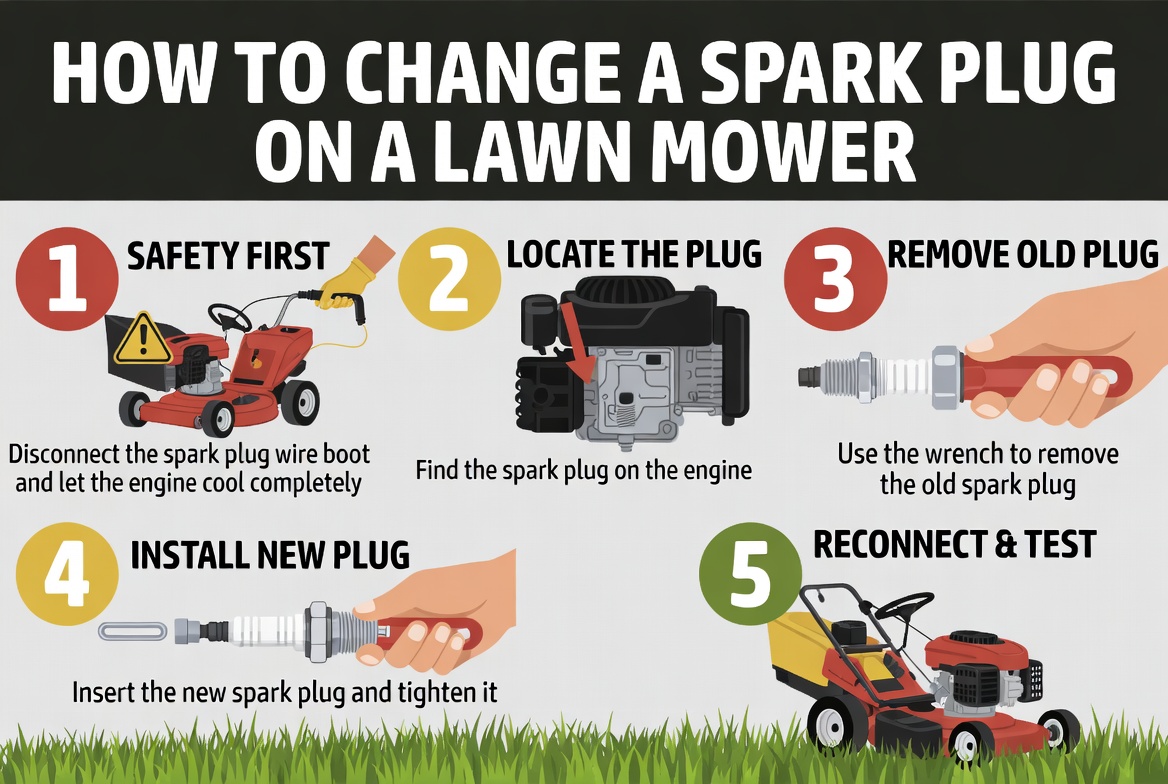
Step one: Turn off your mower. Let it sit. This sounds obvious, but make sure your engine is completely stopped and cool. Don’t work on a hot engine. The metal gets very hot and can burn your hands.
Step two: Empty the fuel tank or at least drain enough fuel that you can work safely. You don’t want gasoline spilling everywhere or getting on you while you work. Turn off the fuel valve if your mower has one.
Step three: Disconnect the spark plug wire. This is the thick black rubber wire that connects to your spark plug. Pull it straight off. This step is crucial for safety. It keeps your mower from accidentally starting while you work.
Step four: Make sure your lawn mower sits on flat, level ground. You don’t want it rocking back and forth while you’re working on it.
Take your time with these prep steps. They’re not exciting, but they keep you safe. A safe job is a successful job.
Locating Your Spark Plug
Now let’s find where your spark plug lives. On most push mowers and small riding mowers, the spark plug is easy to find.
Look at your mower’s engine. It’s usually on top or to the side. You’ll see a thick black rubber wire sticking out of a metal cylinder. That wire is your spark plug wire, also called the spark plug cap or spark plug connector. At the end of that wire, stuck in the metal cylinder, is your spark plug.
For some mower models, the spark plug sits under a cowl or cover. If you can’t find it, check your manual for help. But honestly, on most lawn mowers, it’s pretty obvious once you know what you’re looking for.
Don’t confuse it with other engine parts. Your spark plug sits in a thick metal tube that sticks out of the engine block. It’s usually about the size of your pinky finger, maybe a bit smaller. It has a wire sticking out of it.
Removing the Spark Plug Wire
This step is simple. Grab the thick rubber boot of the spark plug wire. Yes, grab the boot—that’s the thick rubber part that slides over the spark plug. Don’t pull on the thin wire itself because you might damage it.
Twist the boot slightly while pulling. A gentle twist and pull loosens it from the spark plug. It should come off with a soft popping sound. That’s normal.
Now you can see the spark plug. Take a moment and look at it. This metal piece is what makes your engine run. Pretty cool.
Set the spark plug wire aside somewhere safe. You don’t want it getting dirty or bent while you work. Lay it on a clean cloth.
Getting the Spark Plug Out
This is where your spark plug socket comes in. A regular socket won’t work because your spark plug needs special handling. The spark plug socket has a rubber insert inside. That insert protects the spark plug from getting cracked.
Slide your spark plug socket over the spark plug. Push it down gently until you feel it settle over the plug. Now attach your ratchet wrench to the socket.
Turn the ratchet counter-clockwise. You’re unscrewing the spark plug from the engine. It takes several turns. Keep turning until the spark plug spins freely in the socket. Once it’s loose enough, you can finish removing it by hand. Be gentle. Spark plugs can break if you’re rough with them.
When the spark plug comes out, look at it. Is it dirty and covered in black soot? That’s probably why your mower wasn’t starting. Admire it for a moment—you’re about to replace this little thing that made all the difference.
Checking the Spark Plug Gap
Before you install your new spark plug, you need to check something called the spark plug gap. This is the distance between the two metal parts at the end of the spark plug. This gap is crucial.
Look at the end of your new spark plug. You’ll see two small metal pieces sticking out. The gap is the space between them. This space needs to be exactly right. Too wide, and the spark won’t reach across. Too narrow, and the spark won’t form correctly.
Here’s how to check it: Use a spark plug gap tool. This little tool has notches for different sizes. Slide the gap tool into the gap of your spark plug. The tool should slide in with just a tiny bit of resistance. If it’s too tight or too loose, you need to adjust the gap.
If the gap is too wide, use the rounded part of your gap tool to gently bend the side electrode closer to the center electrode. If it’s too narrow, use the flat part to gently bend the side electrode away.
This might seem fussy, but it’s important. The right gap gives you a strong spark. A strong spark means your mower will start and run smoothly.
Installing Your New Spark Plug
You’ve checked the gap. Now you’re ready to install the new spark plug. This is the moment where you fix your lawn mower problem.
Take your new spark plug and lower it into the spark plug hole. Line it up straight. This is important. Don’t angle it. Insert it straight into the hole.
Once the spark plug is in the hole, thread it by hand. Turn it clockwise gently. Your fingers can do this at first. You’re threading the spark plug into its hole, just like screwing a bolt. Be gentle and don’t force it. If you feel resistance, you might have the angle wrong. Pull it out and try again.
Once you’ve threaded the spark plug a few turns by hand, you can switch to your socket and ratchet. Attach your spark plug socket to the spark plug, then attach your ratchet. Turn clockwise. The spark plug goes deeper into the engine.
Don’t tighten it too much. Spark plugs don’t need a lot of force. You want it snug, but not cranked down hard. Think of it like tightening a jar lid. You twist until it’s snug, then stop. You don’t twist with all your strength.
Once the spark plug feels snug, remove your ratchet and socket.
Reconnecting the Spark Plug Wire
Your new spark plug is installed. Now you need to reconnect the wire so your mower will actually run.
Take the spark plug wire and boot that you set aside earlier. Push it straight down over the spark plug. You’ll feel it slide down until it seats completely. You might hear a small click or feel it pop into place. That’s what you want to hear.
The boot should sit firmly on the spark plug. If it feels loose, pull it off and push it back down again until it seats completely.
The wire should have no slack between the engine and the spark plug. Pull gently on the boot to make sure it won’t come loose.
Getting Ready to Start Your Mower
You’ve finished the hard work. Now it’s time to test whether your new spark plug fixed the problem.
Step one: Fill your fuel tank if you emptied it. Use fresh gasoline. Old fuel sitting in your tank might have been part of the problem.
Step two: Place your hand on the mower to steady it. Make sure the mower is on level ground.
Step three: Follow your mower’s starting procedure. Most push mowers require you to prime the engine. Check your manual for the specific steps. Usually, you press a primer bulb a few times to get fuel flowing to the carburetor.
Step four: Pull the starter rope firmly. If your mower has an electric starter, press the start button.
This is the moment of truth. Will your mower start?
Your Mower Should Start Now
If everything went well, your mower should turn over and run. You’ll hear that familiar engine sound. Your lawn mower is alive again.
Let it run for a few minutes. Listen to the engine. Does it sound smooth? Does it stay running? Great. Your new spark plug did the job.
If your mower doesn’t start, don’t panic. Let’s troubleshoot.
Troubleshooting: What If Your Mower Still Won’t Start?
Sometimes a new spark plug isn’t enough. Your mower might have another problem.
Check your spark plug wire: Did you reconnect it firmly? Try removing it and pushing it back on again. Make sure you hear that satisfying click or feel it seat completely.
Check your fuel: Is your fuel tank full? Sometimes people forget to fill it up. Add fresh gasoline and try again.
Check for leaks: Did you accidentally loosen any fuel lines while working? Look for gasoline dripping. If you see leaking fuel, tighten the connections.
Check the spark plug gap: Maybe you didn’t set the gap correctly on your new spark plug. Remove the wire and spark plug. Check the gap again. If it’s wrong, adjust it and reinstall.
Consider other problems: If none of these things fix it, your mower might have a different issue. Perhaps your carburetor needs cleaning. Maybe your fuel filter is clogged. These are more advanced repairs that might require professional help.
Regular Maintenance Keeps Your Mower Running
Now that you’ve successfully changed your spark plug, let’s talk about keeping your mower running strong.
Change your spark plug regularly. Most experts recommend changing your spark plug every season or at least every other season. If you mow heavily, more often is better.
Keep your air filter clean. A dirty air filter makes your engine work harder. Check it regularly and replace it when it looks clogged.
Change your oil regularly. Just like your car, your lawn mower needs fresh oil. Check your manual for how often to change it.
Use fresh fuel. Don’t let old gasoline sit in your mower all winter. Either drain the tank completely before storing your mower, or use fuel stabilizer to keep the gas fresh.
Keep your mower clean. Dirt and grass clippings build up under the deck. This buildup makes your engine run hotter. After mowing, tip your mower on its side and clean out the debris. This takes just a few minutes but makes a big difference.
Why Doing This Yourself Saves Money
You might be thinking, “Why did I do this instead of taking my mower to a shop?” Good question. Here’s why doing it yourself matters.
A professional repair shop might charge you $75 to $150 just to replace a spark plug. That’s their labor cost. You bought a new spark plug for maybe $5 to $10. You spent 15 minutes doing it yourself. You saved $60 to $140.
More than just money, you learned something. You know how your mower works now. Next time you have a problem, you won’t feel helpless. You’ll have confidence that you can fix it.
As a lawn mower owner, it’s smart to learn basic maintenance. It saves you money. It keeps your mower running better. It gives you peace of mind.
Signs Your Spark Plug Needs Replacement
Let’s talk about recognizing when your spark plug is the problem. Your lawn mower gives you hints.
Your mower won’t start: This is the most obvious sign. If your mower turns over but won’t fire up, a bad spark plug is often the culprit.
Your mower starts then dies: If your mower fires up for a second then quits, your spark plug might be failing. It creates a spark occasionally but not consistently.
Your mower runs rough: Does your mower sound like it’s choking? Does the engine vibrate badly? A weak spark plug can cause a rough-running engine.
Your mower loses power: If your mower slows down when you’re cutting thick grass, a bad spark plug might be to blame.
Your mower hesitates: Does your mower pause or stumble when you push the throttle? Sometimes this points to a spark plug problem.
Your mower produces excess smoke: If your mower’s exhaust smells weird or produces lots of smoke, your spark plug might be fouled.
Notice any of these signs? It’s time to change your spark plug.
Different Mower Types and Their Spark Plugs
We’ve talked mostly about push mowers, but other mower types need spark plug changes too.
Riding mowers: The process is basically the same, but your spark plug might be harder to reach. You might need to remove a cover or panel. Follow your manual’s instructions. The actual removal and installation steps are identical to what we covered.
Walk-behind mowers: These are what we’ve discussed. The spark plug is usually easy to find and access.
Zero-turn mowers: These larger mowers have more complex engines, sometimes with multiple spark plugs. Check your manual to see how many spark plugs your specific mower has and where they’re located.
Cordless and electric mowers: Don’t have spark plugs. They use batteries instead. No spark plug maintenance needed.
Gas-powered weed whackers and leaf blowers: These small engines also use spark plugs. The process is similar, though the spark plug might be in an odd location. Check your tool’s manual.
Prevention: Stop Problems Before They Start
The best way to handle spark plug problems is to prevent them.
Store your mower properly: At the end of mowing season, prepare your mower for storage. Empty the fuel tank or add fuel stabilizer. Change the oil. Clean out any debris. Store it in a dry place away from moisture.
Use quality fuel: Buy gasoline from busy gas stations. The fuel is fresher. Avoid fuel from stations that don’t move much product. Old fuel causes spark plug problems.
Run your mower regularly: Don’t leave your mower sitting idle for months. Run it occasionally, even if just for a few minutes. This keeps fuel flowing and prevents buildup.
Keep your engine clean: Remove grass clippings and dirt. These materials trap heat and moisture around your spark plug area.
Follow the maintenance schedule: Your mower’s manual has a maintenance schedule. Follow it. Change oil, air filters, and spark plugs on time. This prevents emergency repairs.
Questions You Might Have
Let’s answer some common questions about spark plug replacement.
Q: Can I just clean my old spark plug instead of replacing it? A: You can try, but it’s usually not worth it. A new spark plug costs $5 to $10. Your time is worth more than that. Plus, a new plug works better than a cleaned-up old one.
Q: How do I know what size ratchet to use? A: Your spark plug socket comes with a specific ratchet size. Usually, it’s 3/8 inch. Buy your socket and ratchet as a set, and they’ll fit together perfectly.
Q: Can I hurt myself changing a spark plug? A: It’s very safe if you prepare properly. The biggest risks are burns from a hot engine or getting gasoline on your skin. That’s why we emphasized cooling the engine and disconnecting the fuel. Follow those steps and you’re safe.
Q: How long does this take? A: For a beginner, maybe 15 to 20 minutes. Once you’ve done it before, it takes five minutes. It’s one of the fastest repairs you can do on a lawn mower.
Q: Do I need to gap my spark plug, or does it come gapped? A: Most new spark plugs come pre-gapped correctly. But it’s always smart to double-check. Takes 30 seconds and ensures perfect performance.
Q: What if I over-tighten my spark plug? A: You could crack the ceramic part inside the plug. This ruins it. That’s why we said to tighten it snug but not hard. Hand-tight with the socket is perfect.
Q: Can I use any spark plug or do I need the exact type? A: You need the type specified for your mower. Using the wrong spark plug can cause poor performance or damage your engine. Stick with the type your manual specifies or the type already in your mower.
Final Thoughts
Changing a spark plug on your lawn mower is simple. You’ve learned what spark plugs do, why they matter, and how to replace one. You’ve learned the tools you need, the steps to follow, and how to troubleshoot problems.
You now have a skill that saves you money and keeps your lawn mower running strong. More than that, you have the confidence to tackle other simple lawn mower repairs. Each repair you do yourself makes the next one easier.
Your lawn mower is a machine that works hard for you every week during mowing season. Show it some care. Keep it maintained. Replace that spark plug when it needs it. In return, your mower will start reliably, run smoothly, and keep your yard looking great.
Take pride in this skill. You’ve learned something practical that helps you, saves you money, and makes you more self-sufficient. That’s pretty cool.
Now get out there and change that spark plug. Your lawn mower will thank you.

Hi, I’m Mary, the founder of GardenCure.com. I’m passionate about creating healthy, beautiful gardens and well-kept lawns. I share practical experience and trusted advice on garden and lawn gear that truly works. With the support of my dedicated research team, our writers produce honest, in-depth reviews using reliable, authentic sources—helping you choose the right tools with confidence for your outdoor space.