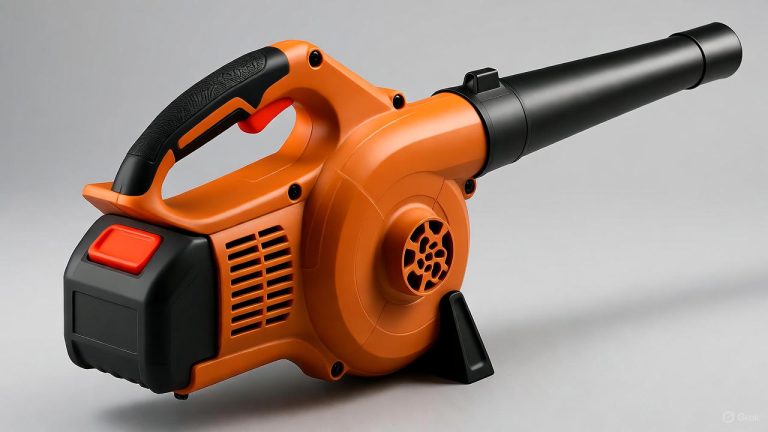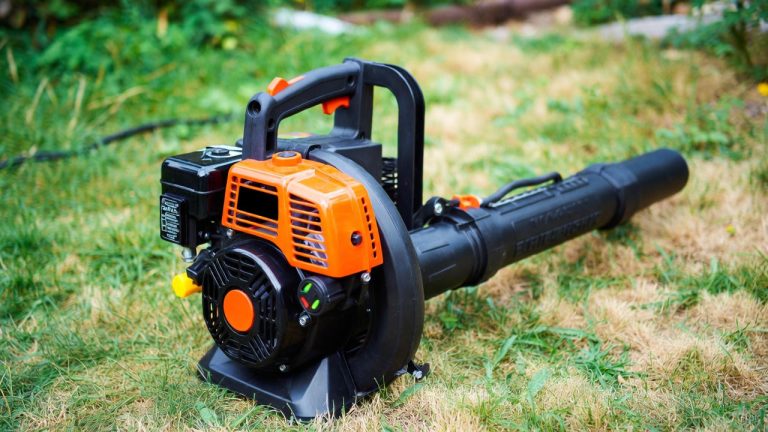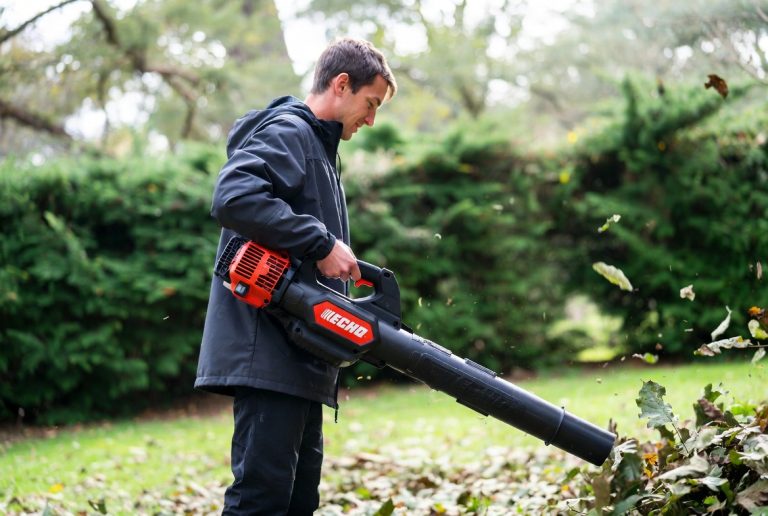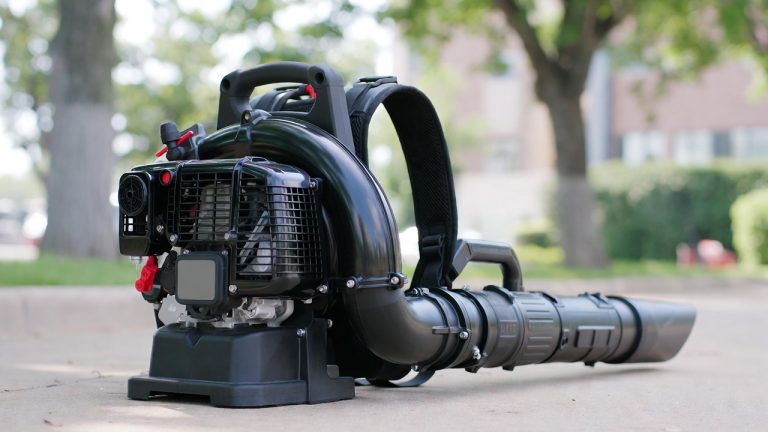
5 Best Handheld Leaf Blower In 2026
If you’ve ever spent a weekend raking leaves by hand, you already know how exhausting it is. Your back hurts. Your arms are sore. And the pile never seems to shrink fast enough. That’s exactly why a good handheld leaf blower can change your entire outdoor routine.
In this article
But here’s the thing — not every leaf blower does the job well. Some are heavy. Some run out of battery too fast. And some just don’t push enough air to matter.
So we put together this detailed roundup of the best handheld leaf blower options available right now. These five cordless blowers cover a range of needs, from light patio cleanup to heavy leaf clearing. We’ve broken down every product honestly — what works, what doesn’t, and who it’s actually best for.
Let’s get right into it.
Why Go Cordless with a Handheld Leaf Blower?
Gas-powered blowers have their fans, but cordless handheld models have taken over for most home users — and for good reason.
You don’t deal with fuel mixing, engine priming, or pull-cord frustration. You just press a button and start working. Cordless electric blowers are also much quieter, which matters a lot if you live in a neighborhood with noise rules or if you want to use one early in the morning without waking everyone up.
The best cordless handheld leaf blowers today rival older gas models in raw airflow. Battery technology has come a long way. With a 4.0Ah battery and a strong motor, you can clear a full driveway and patio area on a single charge.
They’re also lighter. Most handheld cordless models weigh between 2 and 4 pounds, which means less fatigue even after extended use.
Now let’s look at each product in this roundup closely.
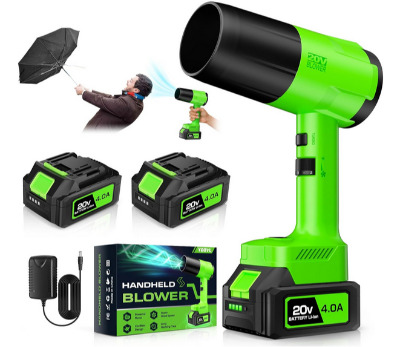
1: Leaf Blower Cordless with 2 x 4.0Ah Battery and Charger — 6 Speed Modes
What Is It?
This is a full-featured cordless handheld leaf blower that comes bundled with two 4.0Ah batteries and a charger. The standout feature is its 6 adjustable speed modes, which gives you more control over airflow than most competitors at this price point.
It’s designed for general outdoor use — lawns, patios, yards, driveways, and even light snow removal. The dual-battery setup means you spend more time working and less time waiting for a charge.
Best Use Cases
This blower works great for homeowners who have medium-sized yards. It handles fallen leaves on grass, debris in corners, wet leaves on pavement, and dust on decks with ease. The lower speed settings also make it good for blowing dust off garage floors or workshop areas without sending everything flying everywhere.
Key Features Explained Simply
6 speed modes — Most blowers have 2 or 3 speeds. Having 6 lets you dial in exactly the right airflow. Use low speed for light debris on a patio. Ramp up to full power for wet, heavy leaves on the lawn.
2 x 4.0Ah batteries — Two batteries means double the run time. When one dies, you swap it out and keep going. No waiting around.
Lightweight body — The compact design keeps fatigue low. You can use it for 30 to 45 minutes without your arm getting tired.
Ergonomic grip — The handle is shaped to fit comfortably in your hand during extended sessions.
Real-Life Usage Insight
In a typical fall cleanup scenario, you’d start on the driveway with a medium speed setting, sweeping leaves to one side. Then move to the lawn edges and corners, bumping up the speed slightly. The 6 speed settings mean you’re not stuck at either “too weak” or “too strong” — you can adjust as the job changes.
The dual batteries really shine for larger properties. One battery handles the front yard, the second handles the backyard. No breaks needed.
Pros
- Six speed settings give precise airflow control
- Two batteries included — great value right out of the box
- Light enough for extended one-handed use
- Versatile for leaves, dust, and light snow
- Easy to operate with a basic trigger and speed dial
Cons
- The 6-speed dial can feel like a small learning curve at first
- Not ideal for very heavy or soaking wet leaf piles
- Battery charge time could be faster
Performance
Airflow performance is solid across all six modes. The highest setting pushes enough air to move damp leaves off a concrete surface. The lowest setting is gentle enough for blowing sawdust off a workbench. Speed transitions are smooth without big jumps in noise or power.
Ease of Use
Very beginner-friendly. The trigger is intuitive and the speed selector is simple to understand after one or two uses. The balance point feels natural in the hand.
Value for Money
Including two batteries and a charger at this price is genuinely hard to beat. You’re essentially getting a complete outdoor tool system rather than just a blower. Strong value.
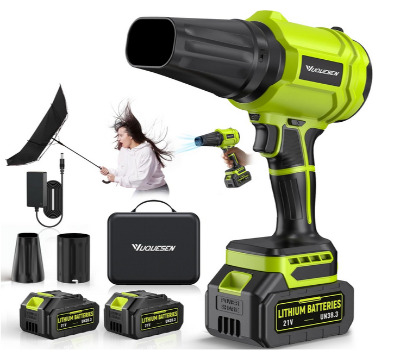
2: Cordless Leaf Blower 980,000 RPM with 2 x 4.0Ah Batteries — Light Green
What Is It?
This is a high-RPM cordless leaf blower that pushes serious air movement. The headline spec is 980,000 RPM, which sounds extreme — and it delivers. This green-colored model comes with two 4.0Ah batteries and a charger, making it a ready-to-use package right out of the box.
It’s aimed at homeowners who want raw power in a portable handheld package, without going up to a larger backpack-style unit.
Best Use Cases
Ideal for clearing driveways, walkways, patios, and decks. The high RPM output is particularly effective on larger debris like bark chips, pine needles, wet leaves, and even gravel that’s drifted onto concrete. This blower also handles lawn cleanup well, especially on flat or gently sloped yards.
Key Features Explained Simply
980,000 RPM motor — This is the engine behind the airflow. Higher RPM means more air moves faster. You’ll feel the difference right away when you compare it to lower-spec blowers.
2 x 4.0Ah batteries — Same dual-battery advantage as the previous model. Swap and go.
Compact handheld design — Despite the power, it stays lightweight. Portability isn’t sacrificed for performance.
Durable build — The green finish isn’t just cosmetic. The housing is built to handle regular outdoor use without cracking or warping.
Real-Life Usage Insight
Point this blower at a pile of wet leaves on your driveway and they move — fast. It’s not a struggle. That’s what the high RPM motor does. Even damp, heavy autumn leaves that stick to concrete get lifted and pushed with the right angle and distance.
The dual batteries make it practical for a full yard cleanup session. You’re looking at roughly 30-40 minutes per battery depending on the speed setting you use most.
Pros
- Very high RPM for strong airflow output
- Dual 4.0Ah batteries and charger included
- Lightweight relative to its power level
- Good for wet leaves and heavier debris
- Simple and clean design
Cons
- High RPM at max setting creates more noise
- May be overkill for very small patios or balconies
- Light green color is polarizing (minor point)
Performance
This is where it really delivers. The 980,000 RPM output translates to noticeably stronger air velocity than budget-tier blowers. Leaves move quickly and cleanly. You spend less time going over the same area twice. On maximum output, this blower handles heavier jobs that would stall weaker models.
Ease of Use
The trigger operation is straightforward. Start at a lower speed and increase from there. The grip is comfortable and the unit balances well. Beginners can pick this up and use it effectively within a few minutes.
Value for Money
Two batteries plus a charger at this power level is excellent value. You’re getting professional-grade airflow in a consumer-priced package.
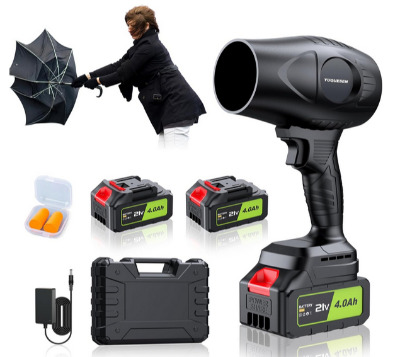
3: 980,000 RPM Cordless Leaf Blower — 21V Electric Handheld, Light Black
What Is It?
Essentially a close sibling to Product #2 in terms of core specs, this 21V electric handheld blower in light black also hits 980,000 RPM. It comes with 2 x 4.0Ah batteries and a fast charger. The fast charger is a notable upgrade — it significantly cuts down on downtime between charges.
If you work on larger properties or need back-to-back sessions without long waits, this model’s fast-charging capability makes a real difference.
Best Use Cases
This one is a great pick for homeowners who use their leaf blower frequently — multiple times a week during fall, spring cleanup, or after storms. The fast charger means you can recharge between morning and afternoon sessions without delay. It handles patios, lawns, yards, and decks well.
Key Features Explained Simply
21V battery system — 21V gives a stable power output that maintains consistent airflow rather than tapering off as the battery drains.
Fast charger included — This is the real differentiator. Shorter charge times mean less downtime.
980,000 RPM motor — Same high-performance motor as Product #2, matched with the 21V system for sustained output.
Lightweight design — The black body keeps it looking clean and stays comfortable to carry for extended use.
Real-Life Usage Insight
The fast charger matters most when you have a large job that stretches across a full day. Imagine clearing the front, charging during lunch, and continuing on the back half of the property in the afternoon. That’s a realistic use case here, and the fast charger makes it seamless.
The 21V system also helps maintain steady power. You don’t feel a big slowdown when the battery hits 50%. Output stays consistent until it’s nearly depleted.
Pros
- Fast charger cuts recharge time significantly
- 21V system for stable, consistent power output
- High 980,000 RPM for strong airflow
- Dual batteries included
- Sleek light black design looks professional
Cons
- Similar performance to Product #2, so the only major differentiator is the fast charger
- Max noise level is high like other high-RPM models
- Slightly higher price point for the fast-charge benefit
Performance
Performance is neck-and-neck with Product #2. Both push the same RPM rating. The real performance advantage here is consistency — the 21V battery system keeps output steady longer. Over a 45-minute session, you notice less tapering compared to some lower-voltage models.
Ease of Use
Clean trigger, comfortable grip, simple speed control. No learning curve. Even someone who’s never used a leaf blower before can figure this out in under two minutes.
Value for Money
If you use your blower heavily and the fast charger saves you even 30 minutes of waiting per session, it’s absolutely worth the price difference. For occasional users, Product #2 might be the better pick. For frequent users, this one earns its cost.
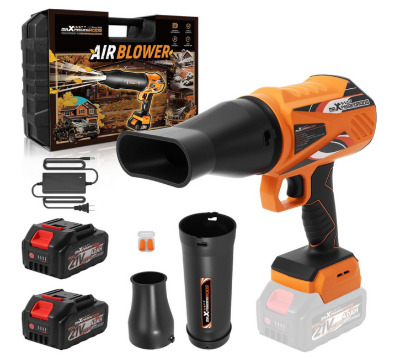
4: maXpeedingrods Cordless Leaf Blower — 550 CFM, Infinitely Variable Speed
What Is It?
The maXpeedingrods blower brings a different approach to the table. Instead of fixed speed modes, it offers infinitely variable speed control — meaning you can set airflow to any level between the minimum and maximum, not just preset notches. The other headline spec is its 550 CFM (cubic feet per minute) rating, which measures actual air volume rather than RPM.
It also includes a charger and focuses specifically on clean, controlled airflow for varied tasks.
Best Use Cases
This one is ideal for people who value precision. If you’re blowing debris near flower beds, you don’t want to accidentally blast mulch everywhere. The infinitely variable speed dial lets you set just enough power for the task. It’s also marketed specifically for car detailing and water blowing — clearing standing water off car surfaces after a wash.
Other uses include patio cleaning, lawn maintenance, leaf clearing, and dust management in garages.
Key Features Explained Simply
550 CFM — CFM measures how much air moves through the tube per minute. Higher CFM means more volume, which is great for covering large areas quickly.
Infinitely variable speed — Not 3 modes. Not 6 modes. A smooth dial that goes from low to high continuously. You’re in full control.
Lightweight handheld form — Compact and easy to carry. Great for users who want mobility over raw power.
Multi-purpose design — Built for leaves, dust, car detailing, and water removal. A genuine all-around tool.
Real-Life Usage Insight
Imagine blowing water off the hood and trunk of your car after washing it. You don’t want a fire-hose blast — you want controlled, even airflow to push the water sheets toward the edges. That’s exactly what the variable speed dial enables. You dial in the right level and move the blower slowly across the surface.
The same precision applies to patio use. Near potted plants or delicate areas, you can dial down. On an open driveway, crank it up. That kind of flexibility is genuinely useful day to day.
Pros
- 550 CFM delivers strong actual air volume
- Infinitely variable speed — unmatched control vs. fixed-mode competitors
- Multi-purpose: leaves, dust, car drying, water blowing
- Lightweight and easy to maneuver
- Clean and durable design
Cons
- No second battery included — check what’s bundled in your specific listing
- Variable dial takes a moment to learn if you’re used to preset modes
- May not match the peak RPM of Products #2 and #3
Performance
The 550 CFM rating is impressive for clearing large areas fast. While the peak RPM may be lower than the 980,000 RPM competitors, the CFM measurement tells a different story — you move a lot of air per second. For leaf clearing, dust removal, and drying tasks, the airflow feels strong and efficient.
Ease of Use
The variable speed dial is intuitive once you spend a few minutes with it. Turn it up, turn it down. There’s nothing complicated about it. The lightweight body keeps fatigue low even during longer sessions.
Value for Money
Good value for what it offers. The variable speed control and multi-task capability set it apart from single-use leaf blowers. If you want one tool that handles leaves AND car drying AND dust, this is worth the investment.
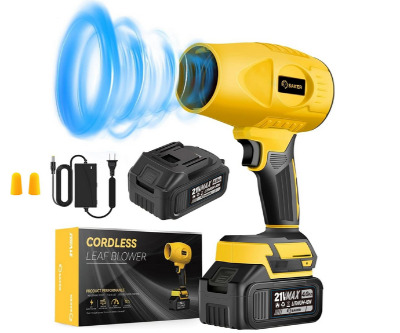
5: Saker Handheld Cordless Leaf Blower — 180,000 RPM Compressed Air Duster
What Is It?
The Saker is a different beast entirely. At 180,000 RPM, it’s not trying to compete with the high-power blowers in this list. Instead, it’s designed as a precision compressed air duster with leaf-blowing capability. Think of it as a hybrid between a traditional air duster and a handheld leaf blower.
It comes in a striking yellow design, includes 2 x 4.0Ah batteries, and features adjustable speed control. It’s specifically marketed for drying, patio cleaning, and camping use — scenarios where portability and precision matter more than raw power.
Best Use Cases
The Saker shines in situations where you need targeted airflow rather than broad blasting power. Cleaning electronics and keyboards, clearing dust from tight spaces, drying gear after camping in rain, blowing debris off a small patio or deck, and spot-cleaning car interiors. It’s also a solid companion for campers who want a lightweight multi-use tool that doesn’t weigh down their pack.
For leaf blowing specifically, it works well in small, defined areas — balconies, small patios, and pathways.
Key Features Explained Simply
180,000 RPM — Lower than the big blowers in this list, but still far more powerful than a canned air duster. Useful for precision tasks.
Compressed air duster function — The nozzle design focuses airflow into a tighter stream, making it effective for cleaning electronics, vents, and small crevices.
Adjustable speed — Dial the power up or down based on the task.
2 x 4.0Ah batteries included — Great for extended use at camping sites or away from power outlets.
Compact and portable — Very lightweight. Fits easily in a bag or backpack.
Real-Life Usage Insight
Picture yourself at a campsite after a rainy day. Your tent got wet, your gear is damp, and you want to speed up the drying process before packing up. The Saker blows out warm air at controlled speed, helping to dry surfaces and push water away from gear seams. No power outlet needed.
Back home, it handles a small apartment balcony in minutes. Or you use it to blow dust out of your laptop vents. It’s that kind of versatile, go-anywhere tool.
Pros
- Lightweight and highly portable
- Works as both a leaf blower and air duster
- Two batteries included for extended untethered use
- Adjustable speed for precise control
- Great for camping, electronics cleaning, and small spaces
- Yellow design is easy to spot in a cluttered garage
Cons
- Not powerful enough for large yards or heavy leaf piles
- 180,000 RPM is significantly lower than the big blowers here
- Not the right tool for heavy-duty fall cleanups
- Limited range on open lawn areas
Performance
Don’t judge this one against the 980,000 RPM models — that’s not what it’s for. For its intended uses (dusting, small patio clearing, drying, camping), performance is excellent. Airflow is strong and focused. The adjustable speed makes it precise. It just isn’t a lawn-clearing powerhouse, and it doesn’t claim to be.
Ease of Use
Very easy. Lightweight, simple controls, intuitive speed dial. The dual batteries are a nice touch since you can use it anywhere, at any time, without worrying about a wall outlet.
Value for Money
The value depends entirely on how you plan to use it. For someone who mostly does electronics cleaning and small-area maintenance with occasional outdoor use, it’s excellent value. For someone expecting it to tackle a quarter-acre of leaves in fall — it’s the wrong tool.
Side-by-Side Comparison: Which One Is Best for You?
Here’s a quick honest breakdown of how these five products stack up against each other on key factors:
Raw Power: Products #2 and #3 lead with 980,000 RPM. Product #4 has strong 550 CFM volume. Products #1 and #5 are more moderate.
Versatility: Product #4 (maXpeedingrods) wins for multi-task use — leaves, dust, and car drying. Product #5 (Saker) wins for electronics cleaning and camping.
Battery Value: Products #1, #2, #3, and #5 all include two 4.0Ah batteries. That’s genuinely good for the money. Product #4 — check the specific listing for battery inclusions.
Speed Control: Product #1 offers 6 discrete speed modes. Product #4 offers infinite variable control. Others offer basic high/low or trigger-based control.
Fast Charging: Product #3 is the only one with a fast charger included, making it ideal for heavy users.
Portability: Product #5 (Saker) is the lightest and most portable. Great for camping and travel.
Best for Beginners: Product #1 or Product #2 — simple to use, great power, and excellent value with dual batteries.
Buying Guide: What to Look for in the Best Handheld Leaf Blower
Before you pull the trigger on any leaf blower, it helps to know what the specs actually mean in real life.
CFM vs. MPH vs. RPM — What Actually Matters?
You’ll see three numbers thrown around with leaf blowers. Here’s what each one means.
CFM (Cubic Feet per Minute) measures how much air volume moves through the nozzle each minute. Higher CFM means more debris gets moved at once. It’s best for wide open areas and large coverage.
MPH (Miles Per Hour) measures how fast the air moves. Higher MPH blows debris farther with each pass. Good for precise directional clearing.
RPM (Revolutions Per Minute) measures how fast the motor spins. It’s an internal spec that indirectly relates to airflow. Higher RPM usually means more power, but the actual CFM and MPH numbers tell you more about practical performance.
For most home users, a blower with 400-600 CFM and 90+ MPH handles typical yard cleanups well. The 980,000 RPM models in this list translate those motor speeds into strong CFM and MPH outputs.
Battery Voltage and Capacity
Voltage (V) affects how consistently the blower maintains power as the battery drains. 21V systems hold output longer than lower-voltage setups.
Capacity (Ah) affects how long the battery lasts. A 4.0Ah battery gives noticeably longer run time than a 2.0Ah battery.
Always check if the listing includes batteries or sells them separately. All five products in this roundup include at least one battery, and most include two — which is a big deal.
Weight and Ergonomics
For handheld blowers, weight matters a lot. A 5-pound unit doesn’t sound heavy until you’ve held it at arm’s length for 30 minutes. Look for models under 4 pounds for comfortable extended use.
Also look at how the handle is shaped. A straight-through design is easy to hold for short bursts. A pistol-grip handle reduces wrist strain for longer sessions.
Noise Level
Cordless electric blowers are much quieter than gas models. Still, high-RPM models make more noise than lower-RPM ones. Check your local noise ordinance if you plan to use a blower early in the morning or late in the evening.
Nozzle Design
A flat nozzle concentrates airflow for getting into corners and tight spaces. A round nozzle spreads air over a wider surface area. Some models include both types. If you do detailed work — like cleaning under furniture or along fence lines — having nozzle options is genuinely useful.
Who Should Buy These Products?
Homeowners with medium to large yards — Go with Products #2 or #3. High RPM, dual batteries, and consistent power output handle fall cleanups without breaking a sweat.
People who want maximum flexibility — Product #4 (maXpeedingrods) is your pick. Variable speed and multi-task capability make it useful year-round, not just in leaf season.
Occasional users with smaller spaces — Product #1 is a great starter choice. The 6 speed settings help you learn the right power level for different jobs. Dual batteries mean you won’t run dry on your first big cleanup.
Campers, travelers, and people with small apartments — Product #5 (Saker) is ideal. Lightweight, portable, does double duty as an air duster, and the two included batteries keep you going off-grid.
Heavy users who clean multiple times per week — Product #3 with its fast charger is built for you. You can recharge and get back to work fast, which matters more than you’d think once you’re in a routine.
Common Mistakes to Avoid When Using a Handheld Leaf Blower
Even simple tools get misused. Here are the most common mistakes people make with handheld leaf blowers — and how to avoid them.
Using full power all the time. This wastes battery and often sends debris flying in directions you don’t want. Start at a lower setting and increase only when needed.
Blowing into the wind. Always work with the wind, not against it. If leaves keep blowing back at you, turn around and work from a different angle.
Not clearing hard surfaces before grass. Leaves on concrete are easier to move first. Then sweep remaining debris off the lawn edges inward.
Ignoring eye and ear protection. Even cordless blowers stir up dust, sand, and small debris. A pair of safety glasses and basic ear protection makes a real difference.
Running the battery completely dead every time. Lithium-ion batteries last longer when you recharge them before they reach 0%. Try to recharge when the battery indicator shows roughly 20% remaining.
Standing too close to the debris. You lose control of where the debris goes when you’re too close. Step back and let the airflow do the work from a slight distance.
Not storing the battery properly. Don’t leave a fully charged battery in extreme heat or cold for extended periods. Store batteries at around 40-60% charge if you won’t use the tool for a few weeks.
Frequently Asked Questions
How long does a 4.0Ah battery last in a leaf blower? On moderate speed settings, a 4.0Ah battery typically lasts 25 to 45 minutes. On maximum speed, expect closer to 15 to 20 minutes. The exact run time depends on the motor’s power draw and the speed setting you use most.
Are handheld leaf blowers strong enough for a large yard? Yes — if you pick the right model. The 980,000 RPM and 550 CFM models in this roundup are well-suited for medium to large residential yards. For very large properties, consider pairing two batteries with a higher-powered cordless model or working in sections.
Can I use a leaf blower to clear snow? Yes, light and fluffy snow responds well to leaf blowers. Heavy, wet snow is harder to move with airflow alone. Products #1 and #3 in this list are specifically mentioned as suitable for snow clearing in light conditions.
What’s the difference between a cordless blower and a corded electric blower? Cordless blowers run on rechargeable batteries. You can use them anywhere without extension cords. Corded electric blowers plug into a wall outlet, giving unlimited run time but restricting your movement to cord length. For most homeowners, cordless is far more practical.
Is higher RPM always better? Not always. Higher RPM generally means more airflow, but the actual CFM and MPH numbers are better performance indicators. A blower with 550 CFM may outperform a higher-RPM model in practical leaf clearing because it moves more air volume per second.
Final Verdict: The Best Handheld Leaf Blower for Most People
After breaking down all five products, here’s the honest conclusion:
For the best all-around pick, the 980,000 RPM model with 2 x 4.0Ah batteries and fast charger (Product #3) is the top choice. It combines the highest motor performance with consistent 21V power output and includes a fast charger — a detail that pays dividends over months and years of regular use. The light black design looks clean and professional. It handles everything from dry autumn leaves to damp debris on patios with ease.
For the best value, Product #1 (the 6 speed mode cordless blower) is hard to beat. Two batteries and a charger come in the box, the six speed modes give you impressive control, and the lightweight design works for extended sessions. It’s an excellent starting point for homeowners who are new to cordless blowers.
For the most versatile tool, Product #4 (maXpeedingrods 550 CFM) earns that title. The infinitely variable speed control and multi-task design — leaves, dust, car drying, water blowing — make it useful all year, not just in fall. If you want one tool that handles multiple outdoor jobs, this is it.
For portability and precision, the Saker (Product #5) is uniquely positioned. If you camp, travel, or mostly do detail cleaning with occasional light outdoor use, the Saker gives you a reliable, lightweight companion that does more than any single-purpose blower could.
Every product in this list earns its place for the right user. The key is matching the tool to your actual needs — yard size, frequency of use, and what else you’d use the blower for beyond leaves.
Pick the one that fits your life, and you’ll wonder how you ever managed with a rake alone.

Hi, I’m Mary, the founder of GardenCure.com. I’m passionate about creating healthy, beautiful gardens and well-kept lawns. I share practical experience and trusted advice on garden and lawn gear that truly works. With the support of my dedicated research team, our writers produce honest, in-depth reviews using reliable, authentic sources—helping you choose the right tools with confidence for your outdoor space.