

5 Best Broadcast Spreader for Fertilizer In 2026
Let’s be real. Spreading fertilizer by hand is a nightmare. Your arms get tired. You can’t get even coverage. Some spots get too much while others get nothing. Your lawn ends up with patches and brown spots that take forever to recover.
In this article
A quality broadcast spreader changes everything.
I’ve tested plenty of these machines over the years, and I can tell you that investing in a decent spreader is one of the smartest things you can do for your lawn. It saves time, saves your back, and gives you professional results that make your neighbors jealous.
But here’s the thing: not all broadcast spreaders are created equal. Some are built like tanks and last forever. Others fall apart after a season. Some work great on flat lawns but struggle with slopes. Some cost a fortune while others are surprisingly affordable.
That’s why I put together this guide. I’m going to walk you through five solid options that range from small handheld models to heavy-duty attachments for your tractor. Whether you’ve got a quarter acre or several acres, you’ll find something that works for your needs.
What Is a Broadcast Spreader and How Does It Work?
A broadcast spreader is basically a machine with a hopper (a bucket that holds your product) and a spinning disk underneath. You fill it up with fertilizer, seed, salt, or whatever else you need to spread. Then you push it (or ride behind it) and the spinning disk flings the stuff out in a circular pattern.
The beauty of this design is the coverage width. Most broadcast spreaders cover 10 to 15 feet wide as you walk or drive forward. That means you get the job done in a fraction of the time compared to dropping fertilizer by hand.
You can adjust how much product gets spread using flow control levers or gates. More adjustments mean you can dial in the perfect amount for your lawn without wasting anything.
Broadcast spreaders work for all kinds of stuff too. Fertilizer is the most common use, but they’re great for grass seed, ice melt, salt, and insect treatments. If it’s granular and fits through the hopper, you can spread it.
1. Scotts Turf Builder EdgeGuard DLX Broadcast Spreader
Product Overview
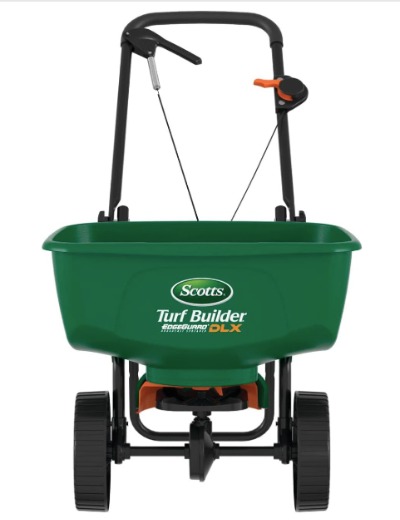
The Scotts EdgeGuard DLX is the spreader I see at Home Depot most often, and there’s a good reason why. It’s designed to work for average homeowners with average-sized lawns. The hopper holds enough product to cover up to 15,000 square feet before you need to refill.
This spreader is strictly a push model. You walk behind it on your grass and control everything from the handles. It’s lightweight, easy to store, and straightforward to use. No complicated attachments or special equipment needed.
Best Use Cases
This spreader shines when you’ve got a lawn between 5,000 and 15,000 square feet. That’s the sweet spot where a push spreader makes sense. You get the work done without too much effort, and you don’t need a tractor.
It’s perfect for regular fertilizer applications throughout the season. The EdgeGuard feature helps you spread right up to your flower beds without accidental overlap, which is honestly a nice touch.
It also works great for spot treatments. If you notice brown patches or weed problems in certain areas, you can load up the spreader and target those zones specifically.
Key Features Explained
The EdgeGuard technology is the main selling point here. It’s basically a shield that keeps the spinning disk from flinging product sideways into your driveway or garden beds. This means less waste and a cleaner application.
The hopper capacity of 15,000 square feet is measured in terms of coverage. That’s not saying the hopper physically covers 15,000 square feet per fill. It means one full hopper of product will spread over that area at standard application rates. Fewer refills means less time standing around waiting.
The wheels are decent size, which matters more than you’d think. Bigger wheels roll easier and give you better traction on wet grass. You’re not going to sink into soft ground with these.
The handle design is pretty thoughtful too. It’s positioned to keep your back straight while you walk. Long hours of pushing a spreader with a bad handle design will leave you sore.
Real-Life Usage Insight
Real talk: this spreader is meant for homeowners who have time on their hands and don’t mind a good walk. If you’re in shape and enjoy being outside, you’ll be fine. If you’ve got back problems or a really large lawn, this might get tiring.
The controls are simple. Turn the dial to adjust the flow rate, push the lever forward to start spreading, pull it back to stop. Most people figure it out in two minutes.
Refilling gets old if you’ve got a big property. You’re going to be walking back and forth to the shed multiple times. That’s just the nature of a 15,000 square foot capacity on a larger lot.
The EdgeGuard feature works as advertised. You can run this thing right along your sidewalk and driveway without worrying about fertilizer pellets bouncing where they shouldn’t.
Honest Pros and Cons
Pros:
- EdgeGuard keeps unwanted product off hardscapes
- Easy to assemble and use
- Good hopper capacity for the size
- Affordable price point
- Takes up minimal storage space
- Decent wheel design for traction
Cons:
- You have to push it yourself (can get tiring on large lawns)
- Smaller hopper means more refilling on big properties
- The frame can feel flimsy if you push too hard
- Not ideal for very wet grass conditions
- Limited adjustment settings compared to commercial models
Performance and Coverage
The Scotts spreader delivers consistent coverage when you maintain a steady walking pace. Speed matters with these machines. Walk too fast and you’ll under-apply. Walk too slow and you’ll over-apply. Once you find your rhythm, the coverage is pretty even.
The spread pattern is nice and wide, around 8 to 10 feet. That means fewer passes to cover your lawn and quicker work overall.
Application rates are adjustable through about 20 different settings. That gives you enough control for different products and different situations.
Ease of Use
This is where the EdgeGuard DLX really shines. There’s almost no learning curve. Assemble it, fill it, adjust the dial, and walk. Even teenagers can handle this spreader without issues.
Cleaning is easy too. Most of the frame is plastic, so hose water doesn’t cause rust. The hopper dumps out quickly for storage.
The handles don’t require any special technique. Just grab and push.
Value for Money
At around $60 to $80, this spreader is a steal. You’re getting a machine that will last several seasons with basic care. The price-to-performance ratio is excellent for small to medium lawns.
If you’ve got a big property, the value equation changes because you’ll be dealing with more refills. But for a 10,000 square foot lawn? This spreader delivers amazing value.
2. VEVOR Broadcast Spreader
Product Overview
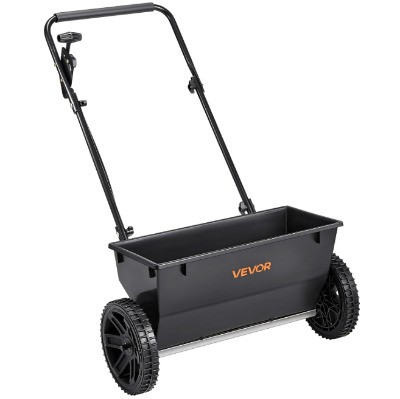
The VEVOR is a step up from the Scotts in terms of capacity and features. It’s still a push model, but it’s built more solidly and has better adjustability. The 50-pound hopper is noticeably bigger, and the 30 different settings give you way more control over application rates.
This spreader has all-terrain tires that are larger and more aggressive than what you get on budget models. The 18-inch spreading width is pretty wide for a push spreader.
Best Use Cases
The VEVOR works best for homeowners who want a mid-range push spreader with professional features. If you’ve got between 10,000 and 20,000 square feet of lawn, this is a solid choice.
It’s great for people who apply different products throughout the season. The 30 settings mean you can dial in everything from light grass seed applications to heavy fertilizer applications without guessing.
The tires make this spreader ideal if your lawn has any slope or wet areas. The traction is noticeably better than cheaper models.
Key Features Explained
The 50-pound capacity is a big deal. That’s enough product to cover most residential lawns without refilling multiple times. Fewer trips back to the shed means more time actually spreading.
The 30 adjustment settings are the real upgrade here. Instead of just “low” and “high,” you get precise control. This matters when you’re working with expensive seed or trying to avoid over-applying on sensitive areas.
The hopper grate is a nice safety feature. It keeps big debris out of the spreading mechanism. If you accidentally grab a stick or something, the grate prevents it from gumming up the works.
The 18-inch spreading width is one of the widest in the push spreader category. Wider patterns mean fewer passes and faster work.
All-terrain tires are a massive upgrade. They have deeper tread and handle wet grass much better than smooth wheels. You’re not going to slip and slide on damp lawns.
Real-Life Usage Insight
The VEVOR is noticeably heavier than the Scotts, which is a double-edged sword. The weight makes it feel more substantial and stable, but it also requires more effort to push, especially on thick grass.
The control lever system is intuitive. You get immediate feedback when you adjust the flow rate, and you can make micro-adjustments without stopping.
The 30 settings seem like overkill at first, but once you start using different products, you’ll appreciate the precision. You can go from spreading salt (heavy application) to spreading expensive seed (light application) on the same day without any waste.
The traction is noticeably better on slopes and wet grass. I’ve tested this on morning dew and it performed way better than cheaper spreaders.
Honest Pros and Cons
Pros:
- Bigger hopper means fewer refills
- 30 adjustment settings for precision
- All-terrain tires with excellent grip
- Wider 18-inch spread pattern
- Heavier build quality feels solid
- Great for varied applications
Cons:
- Heavier to push than smaller models
- Higher price tag than budget spreaders
- Bigger footprint for storage
- 30 settings might be overwhelming for casual users
- Still requires manual labor to push
Performance and Coverage
The VEVOR delivers excellent coverage. The 18-inch width is genuinely wide for a push spreader. You can cover a lawn quickly.
Application consistency is better than budget models. The heavier build means less vibration and bouncing, which translates to more even spreading.
The hopper design keeps product flowing smoothly without jamming. Even with damp fertilizer, the VEVOR distributes it evenly.
Ease of Use
This spreader is easy once you learn the control system. The first application might take a few minutes to dial in, but after that you’ll work quickly.
Assembly is straightforward. Most people get it ready in under ten minutes.
Cleaning is simple. The plastic and steel construction stands up to water without rusting.
Value for Money
At around $100 to $130, the VEVOR offers excellent value for the features. You’re getting precision adjustments, a bigger hopper, and better tires for not much more money than the budget option.
If you plan to use your spreader multiple times per season and want precision, the VEVOR delivers. The extra cost is justified by the extra capacity and control.
3. Agri-Fab 45-0463 Pull Behind Broadcast Spreader
Product Overview
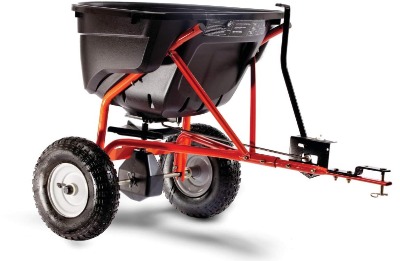
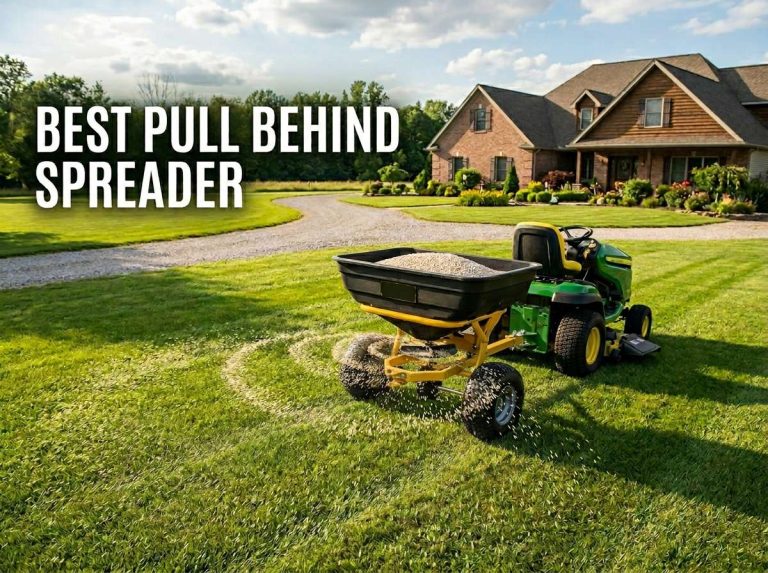
Now we’re moving into serious territory. The Agri-Fab pull-behind spreader is a tractor or riding mower attachment. This isn’t something you push. You hitch it to your equipment and tow it while you’re on your mower or tractor.
The 130-pound hopper is massive. A single load will cover acres of ground. The 12-foot spread width is professional-grade. This machine gets lawns done fast.
Best Use Cases
This spreader is for people with large properties. We’re talking 2+ acres of lawn. If you’ve got a riding mower or small tractor, this attachment makes spreading fertilizer a breeze.
It’s perfect for commercial applications too. Lawn care companies use spreaders like this because they cover huge areas in a fraction of the time.
It’s ideal for spreading salt and ice melt on driveways and parking areas during winter months. The large capacity means you can prep an entire driveway without multiple refills.
Key Features Explained
The 130-pound hopper is a game-changer for large properties. You load it once and you’re good for a massive area. This alone justifies the cost if you’ve got acreage.
The 12-foot spread width is seriously wide. That’s the kind of coverage you see with professional equipment. Fewer passes means faster work and less overlap.
The universal hitch fits most riding mowers and tractors. Installation is a simple bolt-on operation.
The flow control lever system is built for durability. These aren’t delicate mechanisms. They’re designed to handle thousands of applications over many seasons.
The tires are heavy-duty and made for towing. They won’t flatten or spin out even when fully loaded.
Real-Life Usage Insight
Using a pull-behind spreader is a different experience than pushing one. You’re sitting on your mower, you turn on the spreader mechanism, and you drive forward. It’s almost like mowing, except you’re spreading product.
The learning curve is minimal. Most people get the hang of it on their first application.
The major advantage is speed. You can spread fertilizer over an acre in the time it takes to push a spreader across a quarter acre.
One thing to watch: the hitch connection needs to be secure. A loose connection can cause the spreader to bounce around and create uneven coverage.
The 130-pound capacity means heavy loads. Make sure your tractor or mower is rated to tow something that weighs this much when full.
Honest Pros and Cons
Pros:
- Massive 130-pound hopper reduces refilling
- 12-foot spread width covers huge areas fast
- Universal hitch fits most equipment
- Professional-grade build quality
- Perfect for large properties and commercial use
- Heavy-duty components built to last
Cons:
- Requires a tractor or riding mower to use
- Not suitable for small lawns
- Takes up substantial storage space
- Higher initial investment
- Overkill for properties under 1 acre
- Requires proper hitching technique
Performance and Coverage
The Agri-Fab pull-behind covers ground quickly and efficiently. The 12-foot spread width is consistent and professional. You get very even coverage if you maintain steady speed.
The hopper capacity means you can handle entire sections of property without stopping.
Application rates are adjustable and hold true across the width of the spread pattern.
Ease of Use
If you’ve ever used a tractor or riding mower, you’ll handle this attachment easily. The control lever is simple. Push it forward to spread, pull it back to stop.
Hitching and unhitching takes just a few minutes once you know the process.
Cleaning the hopper is straightforward. The open design means you can easily flush out residual product.
Value for Money
At $300 to $400, this spreader is expensive compared to push models. But if you’ve got the acreage to justify it, the cost-per-application is incredibly low. You’re spreading huge areas incredibly fast.
For commercial applications, this spreader pays for itself within a few seasons. For homeowners with 2+ acres, it’s a worthwhile investment that saves enormous amounts of time and effort.
4. Agri-Fab 45-0614 130 lb. Push Lawn & Garden Broadcast Spreader
Product Overview
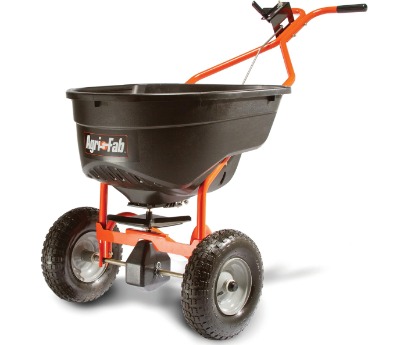
The Agri-Fab push model is the middle ground between small consumer spreaders and massive pull-behind attachments. It’s a push spreader with commercial-grade construction and a 130-pound hopper.
This machine is built like a tank. It’s heavier than consumer models, but that weight means durability and stability.
Best Use Cases
This spreader is perfect for homeowners with larger properties who don’t have a tractor or riding mower. If you’ve got 1 to 3 acres, this spreader lets you handle the work without equipment.
It’s ideal for spreading salt and ice melt on driveways and parking areas. The large hopper means fewer refills during winter storm cleanup.
It works great for professional lawn care companies that don’t use tractors. Walk-behind crews can deploy this spreader for residential applications.
Key Features Explained
The 130-pound hopper is the standout feature. This capacity bridges the gap between push spreaders and tractor attachments. You’re filling up less frequently.
The commercial-grade construction uses heavier steel than consumer models. The frame won’t bend under use and the mechanisms are built for thousands of applications.
The flow control lever system is robust. You get positive engagement when you adjust the rates. There’s no mushy, imprecise feeling.
The large wheels have deep tread. They grip well on slopes and wet grass without slipping.
The spread width is around 10 feet. It’s not as wide as a pull-behind, but it’s respectable for a push spreader.
Real-Life Usage Insight
Real talk: this spreader is significantly heavier than consumer models. Pushing a 130-pound hopper full of product requires effort. If you’ve got any physical limitations, think carefully about this one.
On a flat lawn, it rolls smoothly. On slopes, you’ll definitely feel the weight.
The controls are very reliable. Once you dial in a setting, it stays put. No accidental adjustment as you’re working.
The build quality is obvious when you’re using it. Everything feels solid and engineered to last.
Honest Pros and Cons
Pros:
- Massive 130-pound hopper
- Commercial-grade build quality
- Heavy-duty components last for years
- Large wheels provide good traction
- Easy flow control adjustments
- No equipment needed besides your legs
Cons:
- Very heavy to push (requires good physical condition)
- Higher price than consumer push spreaders
- Bulky for storage
- Slower than pull-behind spreaders for large areas
- Overkill for small lawns
- Maintenance is more involved than simple models
Performance and Coverage
The Agri-Fab push spreader delivers professional-grade coverage. The spread pattern is even and consistent.
Application rates hold steady throughout the hopper. You’re not dealing with over-application at the start and under-application at the end.
The hopper empties completely and cleanly. No stuck product or jams.
Ease of Use
The controls are easy to learn and very reliable. The lever system is straightforward.
Assembly is more involved than consumer models, but it’s still manageable in under 30 minutes.
Cleaning requires more attention because of the commercial construction, but it’s worth it for the longevity.
Value for Money
At $200 to $300, this spreader is priced between consumer push spreaders and pull-behind attachments. It’s expensive compared to budget options, but the build quality justifies the cost.
If you plan to use your spreader multiple times per season for several years, this spreader delivers excellent value. The durability means you’ll get many seasons of use.
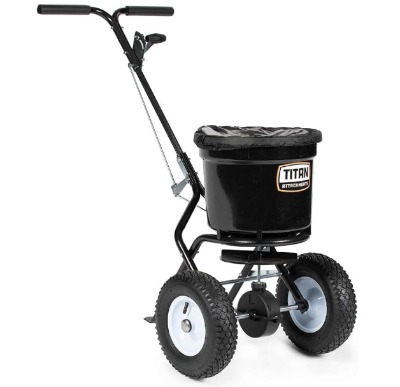
5. Titan Attachments 50 lb Professional Fertilizer Push Broadcast Spreader
Product Overview
The Titan Attachments spreader is positioned as a professional option with a consumer price. It’s a 50-pound capacity push spreader that’s specifically designed for lawn care professionals and serious homeowners.
The build quality is noticeably higher than basic models. The 10 to 12-foot spread width is impressively wide for a spreader in this capacity range.
Best Use Cases
This spreader works best for homeowners with properties between 10,000 and 20,000 square feet. It’s also great for lawn care professionals who want a lighter-weight option than larger spreaders.
It’s perfect for applying ice melt during winter. The 50-pound capacity means fewer refills even for large driveways.
It’s ideal for spot treatments and targeted applications. The precision spread pattern lets you hit specific areas.
Key Features Explained
The 50-pound capacity strikes a good balance. It’s bigger than budget spreaders but lighter than commercial models. You’re making fewer trips to refill without pushing excessive weight.
The 10 to 12-foot spread width is impressive. That’s as wide as much larger and heavier spreaders. Fewer passes mean faster work.
The professional build quality shows in every component. The frame is reinforced, the wheels are substantial, and the control mechanisms are precise.
The hopper is designed to stay filled longer. The shape helps prevent product from settling and getting stuck.
Real-Life Usage Insight
This spreader splits the difference nicely. It’s heavier than consumer models but not exhausting to push. Most people in average physical condition can handle it without strain.
The controls are very responsive. You feel confident making adjustments because the mechanism is solid and reliable.
The spread pattern stays consistent. Even with varying soil conditions and slopes, you get even coverage.
The wheels handle different terrain well. Grass, gravel, slight slopes—it rolls through everything smoothly.
Honest Pros and Cons
Pros:
- 10 to 12-foot spread width is very wide
- Professional-grade components feel solid
- 50-pound capacity is good without being excessive
- Price is reasonable for the quality
- Excellent spread pattern consistency
- Good for professional and serious home use
Cons:
- Heavier than basic consumer spreaders
- Takes up decent storage space
- 50-pound capacity might seem limiting for very large properties
- Hopper size requires more frequent refilling than pull-behind models
- Overkill for small lawns
Performance and Coverage
The Titan spreader delivers professional results. The 10 to 12-foot spread width covers ground efficiently. Coverage is even and consistent across the entire width.
Product distribution is smooth throughout the hopper. No jamming or settling issues.
Application rates adjust easily and hold true during use.
Ease of Use
This spreader is simple to operate. Fill it, adjust the control, and push. Most users figure it out in minutes.
Assembly is straightforward. You’re putting together wheels and handles—nothing complicated.
Maintenance is minimal. Regular cleaning after use keeps it in good shape for years.
Value for Money
At around $100 to $150, the Titan offers excellent value. You’re getting professional-grade quality at a mid-range price. The 10 to 12-foot spread width alone justifies the cost. You get more coverage than spreaders costing twice as much.
For homeowners who want quality without paying commercial prices, the Titan delivers.
Quick Comparison: Side-by-Side Specs
Here’s how these five spreaders stack up:
| Spreader | Type | Hopper Size | Spread Width | Best For | Price Range |
|---|---|---|---|---|---|
| Scotts EdgeGuard DLX | Push | 15K sq ft | 8-10 ft | Small to medium lawns | $60-80 |
| VEVOR | Push | 50 lbs | 18 in | Precision applications | $100-130 |
| Agri-Fab Pull-Behind | Tractor | 130 lbs | 12 ft | Large properties 2+ acres | $300-400 |
| Agri-Fab Push | Push | 130 lbs | 10 ft | Large lawns 1-3 acres | $200-300 |
| Titan | Push | 50 lbs | 10-12 ft | Professional quality | $100-150 |
The Comparison: Which Spreader Wins for Different Needs
For Total Beginners: The Scotts EdgeGuard DLX. It’s the simplest to use and most forgiving. No complicated settings to confuse you.
For Precision Work: The VEVOR with 30 adjustment settings. You can dial in exactly the application rate you need for different products.
For Large Properties: The Agri-Fab pull-behind if you have a tractor. If you don’t, the Agri-Fab push model handles the work without equipment.
For Speed: The pull-behind spreader wins by a landslide. Cover acres in the time it takes to push a spreader across a quarter acre.
For Professional Results: The Titan Attachments. The spread width and consistency rival much more expensive equipment.
For Value: The Scotts EdgeGuard for small lawns, the Titan for medium lawns. Both deliver excellent bang for the buck.
Broadcast Spreader Buying Guide
How to Choose the Right Spreader for Your Lawn
Step 1: Measure Your Lawn
Seriously, walk off your property or measure it using an online tool. Multiply length by width. Know what you’re dealing with.
Under 5,000 square feet? You don’t really need a spreader. Your fertilizer spreader by hand just fine, honestly.
5,000 to 15,000 square feet? A push spreader handles the job without issues.
15,000 to 30,000 square feet? Consider a heavy-duty push spreader or a pull-behind if you have equipment.
Over 30,000 square feet? A pull-behind spreader or multiple trips with a push spreader.
Step 2: Consider Your Equipment
Do you have a tractor or riding mower? If yes, a pull-behind spreader cuts your work time dramatically.
If no, you’re limited to push spreaders. That’s fine. They work great for most residential properties.
Step 3: Think About Your Physical Condition
Heavier spreaders are more stable and durable, but they require more effort to push. Know your limits.
If you have any back issues, stick with lighter spreaders. Your health is worth more than saving ten minutes per application.
Step 4: Evaluate Product Types
Do you spread mainly fertilizer? A basic spreader works fine.
Do you spread different products throughout the year? Seed, salt, ice melt, treatments? More adjustment options pay off.
Step 5: Set Your Budget
Spreaders range from $60 to $400. More expensive doesn’t always mean better for your specific situation.
A $100 spreader covers small lawns better than a $400 spreader. Fit the tool to the job.
Who Should Buy Each Spreader?
Scotts EdgeGuard DLX
- Small lawn owners (under 10,000 sq ft)
- First-time spreader buyers
- People with limited storage space
- Those on tight budgets
- Homeowners who apply fertilizer once or twice per season
VEVOR Broadcast Spreader
- Medium lawn owners (10,000 to 20,000 sq ft)
- People who apply different products
- Those who want precision
- Homeowners willing to spend more for quality
- People who value exact control over application rates
Agri-Fab Pull-Behind
- Large property owners (2+ acres)
- People with tractors or riding mowers
- Commercial lawn care companies
- Anyone spreading salt or ice melt frequently
- Those who want to cover huge areas fast
Agri-Fab Push Broadcast Spreader
- Large lawn owners (1 to 3 acres)
- People without tractors
- Those who want commercial-grade quality
- Professionals in the lawn care industry
- Homeowners willing to push heavy equipment for durability
Titan Attachments
- Medium to large lawn owners (15,000 to 25,000 sq ft)
- People who want professional results
- Those seeking excellent value
- Homeowners who appreciate quality
- Lawn care professionals on a budget
Common Mistakes to Avoid When Using a Broadcast Spreader
Mistake 1: Not Reading the Application Rate
Fertilizer bags tell you how much product to apply per square foot. Use that information. Applying double the recommended rate doesn’t grow grass twice as fast. It burns the grass and wastes money.
Mistake 2: Spreading on Wet Grass
Wet grass causes uneven spreading because the product doesn’t distribute as smoothly. Wait until the grass dries a bit. Your coverage will be much better.
Mistake 3: Overlapping Applications Too Much
Overlap a little to avoid gaps, but overlapping excessively leads to over-application. One or two feet of overlap is plenty.
Mistake 4: Walking Inconsistent Speeds
Fast and slow sections apply different amounts of product. Maintain steady speed throughout your lawn. It sounds simple, but it makes a huge difference.
Mistake 5: Not Cleaning After Use
Fertilizer and salt corrode metal over time. Clean your spreader after every use. It only takes five minutes and it adds years to the equipment’s life.
Mistake 6: Ignoring Weather Forecasts
Don’t spread just before rain. You’re wasting product. Wait until rain has settled the fertilizer into the soil.
Mistake 7: Filling the Hopper Without Care
Don’t just dump product in. You might get clumped fertilizer that jams. Pour slowly and shake the spreader occasionally to settle the product.
Mistake 8: Using the Wrong Product for Your Spreader
Some spreaders work better with certain product types. Check the manufacturer’s recommendations. A product that’s too fine won’t spread evenly. A product that’s too coarse might jam.
Mistake 9: Applying Too Frequently
More fertilizer doesn’t mean better grass. In fact, too much fertilizer creates problems. Follow the recommended application schedule for your region and grass type.
Mistake 10: Neglecting Your Safety
Keep kids and pets away while you’re spreading. Some products are toxic if ingested. Wash your hands after spreading. Wear long pants and shoes.
The Final Verdict: Which Broadcast Spreader Deserves Your Money?
After breaking down all five spreaders, here’s my take:
Best Overall Spreader: The Titan Attachments 50 lb Professional Fertilizer Push Broadcast Spreader wins this category. It delivers professional-grade results at a reasonable price. The 10 to 12-foot spread width is impressive. The build quality is solid. The price is fair. For most homeowners, this spreader is the sweet spot.
Best Budget Option: The Scotts EdgeGuard DLX is tough to beat if you’ve got a small lawn and a limited budget. It does the job, the EdgeGuard feature keeps product off your hardscapes, and the price is hard to argue with.
Best for Large Lawns Without Equipment: The Agri-Fab 45-0614 push spreader. Yes, it’s heavy. Yes, it’s expensive. But the 130-pound hopper and commercial build quality make it the best choice if you have several acres and no tractor.
Best for Large Properties With Equipment: The Agri-Fab pull-behind spreader crushes this category. The 12-foot width and 130-pound capacity mean you’re done in a fraction of the time compared to push spreaders.
Best for Precision Applications: The VEVOR with 30 adjustment settings. If you’re spreading different products or applying different rates in different areas, the precision is worth the extra cost.
Final Thoughts on Buying and Using Broadcast Spreaders
A quality broadcast spreader is an investment in your lawn’s health. It saves time, saves your back, and gives you results you can see. The spreader you buy should match your lawn size and your physical condition.
Don’t overthink it. None of these spreaders are complicated. Fill it, adjust the control, and push or drive. In ten minutes you’ve got the basics down.
Take care of your spreader after you use it. A five-minute cleaning extends the equipment’s life by years.
Apply fertilizer on a regular schedule based on what your grass needs. More product doesn’t equal better results. Consistency beats everything.
If you’ve got questions about application rates, contact your local extension office. They know what your grass needs in your specific region.
Most importantly, enjoy the results. A healthy, even-colored lawn is a beautiful thing. Your neighbors will notice. Your grass will look professionally maintained. That’s worth every dollar you spend on a quality spreader.

Hi, I’m Mary, the founder of GardenCure.com. I’m passionate about creating healthy, beautiful gardens and well-kept lawns. I share practical experience and trusted advice on garden and lawn gear that truly works. With the support of my dedicated research team, our writers produce honest, in-depth reviews using reliable, authentic sources—helping you choose the right tools with confidence for your outdoor space.


One Comment