5 Best Garden Soaker Hose In 2026
If you’ve got a garden, you know watering is one of those never-ending tasks. It’s hot, it’s tedious, and honestly, it feels like you’re pouring money down the drain every time you turn on your hose. Here’s the thing though—there’s a smarter way to handle garden irrigation.
In this article
A soaker hose changes everything. This simple tool lets water drip right where your plants need it most, at ground level, without spraying all over the place. You save water, your plants get healthier, and you get back some of your free time. That’s a win-win situation right there.
But not all soaker hoses are equal. Some fall apart after a few weeks. Others clog up or don’t cover enough ground. That’s why I put together this guide to help you find the right soaker hose for your space.
I’ve broken down five solid options that are actually worth considering. Each one brings something different to the table. Whether you’re running a small flower garden or trying to keep a massive vegetable patch alive, there’s something here for you.
Let’s dive in and find your perfect match.
What Makes a Good Soaker Hose?
Before we talk about specific products, you should know what actually matters when picking a soaker hose. This helps you make smart choices, whether you go with one of these models or hunt down something else.
Water Delivery
The whole point of a soaker hose is that it delivers water slowly and evenly along its entire length. Look for consistent drip spacing. If the holes are too far apart, you’ll have dry spots in your garden. Too close together, and you’re wasting water. You want something that gives your plants exactly what they need, no more, no less.
Durability
A soaker hose that lasts through two seasons is useless. You need something tough enough to handle sun exposure, temperature changes, and general garden work. Dual-layer designs hold up way better than thin, flimsy hoses. They resist UV damage and handle pressure without falling apart.
Flexibility and Length
You need something easy to work with. A hose that’s too stiff becomes a wrestling match every time you try to arrange it. On the flip side, you also need enough length to actually cover your beds. Most gardens need at least 50 feet to be useful. Some people find having multiple 50-foot sections beats trying to manage one giant hose.
Linkability
Can you connect multiple hoses together? This matters because one 50-foot section might not reach your whole garden. A good linkable system means you can snap together sections as needed and adjust your setup when things change.
Water Pressure Handling
Some soaker hoses are picky about water pressure. Too much pressure and they burst. Too little and water barely trickles out. You want something that works in a normal range without special equipment.
Leak Resistance
Leaks waste water and money. A hose with weak seams or poor construction will develop pinhole leaks pretty quickly. This is where paying a bit more up front actually saves you headaches later.
Now that you know what to look for, let’s check out these five models.
Product Reviews
1. Flat Soaker Hose 100 FT for Garden (100′ / 50FT x 2)
Product Overview
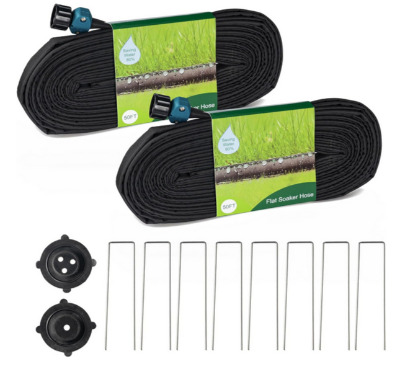
This model comes as two 50-foot sections that link together to give you 100 feet of total coverage. The flat design is probably the first thing you’ll notice—it looks almost like a ribbon when it’s not filled with water. This design packs down smaller than round hoses, which is nice if you’re tight on storage space.
The main selling point here is the water savings. The manufacturer claims it saves about 80% of the water you’d use with a sprinkler setup. That’s pretty significant if you’re in an area where water costs money or you just want to be environmentally conscious.
Best Use Cases
This hose works great for vegetable gardens, flower beds, and landscaped areas where you’ve got plants arranged in rows or neat sections. The two-section design means you can cover 100 feet of garden, or use just one section for smaller spaces and keep the other stored away.
It’s perfect if you’re new to soaker hoses and want something straightforward that doesn’t require any fancy equipment or tons of technical knowledge.
Key Features Explained
The dual-layer construction is what sets this apart. The inner layer handles the water delivery, while the outer layer protects against UV damage and general wear. This means your hose won’t crack and fall apart after a few weeks in the sun.
The linkable design is simple—you just connect one hose to another using standard connectors. No special adapters needed. If your garden grows or you want to expand coverage, you can just grab another pack.
The drip holes release water steadily along the entire length. No big gushes, no dry spots. Water comes out at a rate that’s actually useful for plants, not so fast that it runs off before the soil can absorb it.
Real-Life Usage Insight
In a typical garden setup, you’d lay this out at the base of your plants, run it through your flower beds, or snake it through your vegetable rows. Turn on the water, set it to a low flow, and then basically ignore it for an hour or two. Your plants get a deep, slow drink while you do something else.
The flat profile means it sits nicely on the ground without creating tripping hazards. It also means you can tuck it under mulch if you want a cleaner look. Just make sure the water’s actually flowing through before you cover it up, or you might forget where it is.
Honest Pros
- Covers a decent amount of space with two linked sections
- The flat design is easy to store and move around
- Dual-layer construction holds up to sun and regular garden work
- Easy to understand and use—no complicated setups required
- Linkable system lets you expand when needed
- Real water savings compared to sprinkler systems
Honest Cons
- The connectors sometimes get tight and can be annoying to disconnect
- Very long runs might develop slight pressure drops at the far end
- Not the best choice if you have a lot of curves and complex garden layouts
- Flat design can occasionally kink if bent too sharply
Performance Discussion
This hose performs exactly as advertised. Water comes out of the holes at a steady, plant-friendly rate. We’re talking about a nice, slow drip that soaks the soil without creating runoff. The dual-layer design actually works—these hoses don’t get brittle in the sun like cheaper alternatives do.
The water savings claim holds up pretty well. If you’re coming from a sprinkler or hand-watering setup, the difference is obvious. Less water runs off, more gets to your plants’ roots, and you can literally see your water bill go down.
Ease of Use
Setup takes about five minutes. Lay out the hose where you want water, connect the sections if you’re using both, attach it to your main water line, and turn it on. Adjusting your layout is easy—just move the hose around until you’ve got coverage where you need it.
The only minor complaint is that the connectors can get stuck if you leave them connected for a long time. Disconnecting at the end of the season might take a little patience and maybe a wrench.
Value for Money
For what you’re getting, the price is fair. You’ve got 100 feet of decent-quality soaker hose with proven water-saving benefits. It’s not the cheapest option out there, but it’s also not a premium price point. The dual-layer construction means it’ll probably last several seasons, which actually makes it cheaper per year than buying flimsy hoses that fail every summer.
2. Heavy Duty Flat Garden Soaker Hose 100FT
Product Overview
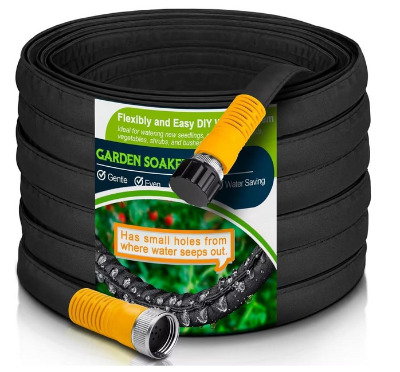
This model emphasizes durability right in the name. It’s another 100-foot setup split into two 50-foot sections. The “heavy duty” part means they’ve used thicker materials and more robust construction throughout the hose.
If the first option is the daily driver, this one is built like a truck. It’s designed for people who want something that’ll last through years of hard use without needing replacement.
Best Use Cases
This hose shines if you’re dealing with rough terrain, hot climates, or you just want something that won’t quit on you. It’s great for larger gardens where you need reliability above all else.
It also works well if you’re the type of person who leaves your hose out year-round or deals with temperature swings. The heavy-duty construction handles these conditions way better than thinner alternatives.
Key Features Explained
The thicker material is the main story here. While regular soaker hoses are, well, regular thickness, this one uses materials that can handle more wear and tear.
The leakproof design is taken seriously here. The seams are reinforced, and the construction eliminates the weak points where water likes to escape.
The flat design still applies, so you get that easy storage and flat profile on the ground. But this version won’t collapse or crack as easily if you accidentally drive over it or drop something on it.
Real-Life Usage Insight
Imagine laying this out through a busy garden where you’re constantly moving plants around, replanting beds, or maybe even walking over the hose. This model laughs at that treatment. It stays functional through the kind of garden activity that would destroy a cheaper hose.
It’s also great if you’re using the hose in a vegetable garden where you might be using stakes, tillers, or other equipment near it. The heavy-duty construction shrugs off minor impacts.
Honest Pros
- Built tough enough for years of hard use
- Reinforced seams mean real leak protection
- Handles temperature extremes without getting brittle or failing
- Still gets the water savings of a drip system
- Linkable design for expanding coverage
- Flat profile remains for easy storage
Honest Cons
- Heavier and stiffer than thinner alternatives, making it less flexible for complex layouts
- Takes slightly more effort to bend and position
- The durability premium means a higher price than basic models
- Not really necessary if you only have a small, simple garden
Performance Discussion
Performance is rock solid. Water delivery is consistent, and the hose actually lives up to its claims about not leaking. Pressure handling is excellent—you can turn the water up to normal household levels without worry.
The durability is real. These hoses genuinely last longer than cheaper alternatives. Three to five seasons isn’t unreasonable if you take basic care of it.
Ease of Use
Setup is identical to the first model—lay it out, link the sections if needed, connect to your water source, and go. The added weight and stiffness mean it takes slightly more effort to position, but this isn’t complicated work.
Value for Money
The higher price is justified if you plan to keep using this hose for multiple seasons. It’s like buying a quality tool instead of a cheap one—you spend more at first but save money long-term because you’re not replacing it every year.
3. Gilmour 50′ Black Flat Weeper Soaker Hose
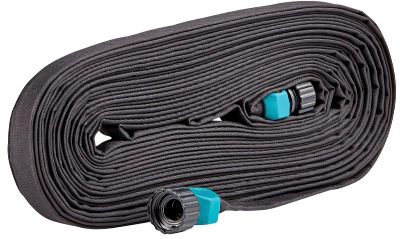
Product Overview
Here’s something different—this one comes as a single 50-foot section instead of two 50-foot pieces. Gilmour is an established brand with a pretty solid reputation in the garden tool space. They’ve been making watering equipment for decades.
This hose uses what they call a “weeper” design, which means the water comes out through tiny openings along the entire length. It’s almost like the hose sweats water instead of dripping it.
Best Use Cases
This model is perfect for smaller gardens or someone who just wants to water one or two specific areas. If your vegetable patch is only 50 feet long, this gives you exactly what you need.
It’s also a great choice if you’re looking for a well-established brand with proven reliability. Gilmour hoses have been around for a long time, and people generally trust them.
Key Features Explained
The weeper design is actually pretty clever. Instead of holes that create distinct drips, the water seeps through the hose material itself. This creates an incredibly uniform water distribution. Every inch of your plants gets the same amount of water.
The black color is practical—it absorbs heat from the sun, which can actually improve water delivery in cooler climates. It also makes the hose less visible in your garden if you care about aesthetics.
The single-section design means fewer connections to worry about. Everything is self-contained and straightforward.
Real-Life Usage Insight
When you run this hose, you get this subtle, uniform watering effect. It’s not dramatic drips—it’s more like the ground is just getting consistently moist. For vegetables and flowers that prefer steady moisture rather than deep soaking, this is pretty much ideal.
The weeper design also means less pressure buildup in the hose. It distributes water so evenly that you don’t get areas where pressure builds up or where dry spots develop.
Honest Pros
- Gilmour is a trusted, established brand
- Weeper design creates perfectly uniform water distribution
- Single 50-foot section is simple and straightforward
- Black color is practical and less visible in gardens
- Consistent performance across the entire length
- Quiet operation—no dramatic dripping sounds
Honest Cons
- Only comes in 50-foot length, so you need to buy multiple for larger gardens
- The weeper design can be slightly more sensitive to water quality—sediment might clog it more easily than direct holes
- Not linkable like other options, so expanding coverage requires buying completely separate hoses
- 50 feet might not be enough for many typical gardens
Performance Discussion
This hose performs really well for what it’s designed to do. The water distribution is excellent—you won’t see dramatic differences between the first foot and the last foot of the hose.
Water pressure tolerance is good. It works fine with standard household pressure and doesn’t require special regulators.
Ease of Use
Setup is dead simple. You connect it to your water line and you’re done. No linking sections, no complicated arrangements. Just run it where you need water and turn it on.
Value for Money
The price is reasonable for a Gilmour product. You’re paying for the brand reputation and proven reliability. Since it’s only 50 feet, you might need to buy multiple units for larger gardens, which changes the math on overall cost.
4. 2026 Flat Soaker Hose 100 ft with Stakes
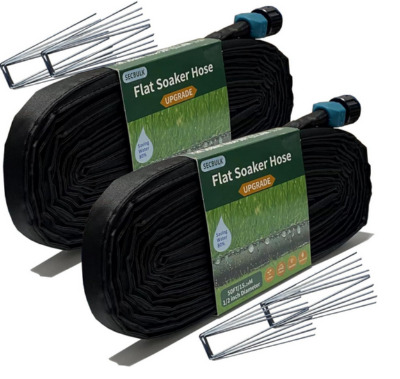
Product Overview
This model comes with a bonus—stakes. That’s right, the package includes little anchors that help keep the hose in place. No more fighting with your hose trying to move around or getting kicked out of position by accident.
It’s another 100-foot setup (two 50-foot sections) with the flat, linkable design. The addition of stakes shows that the manufacturer was thinking about actual garden use, not just specs on a page.
The water savings claim here is again about 80%—consistent with similar flat hose designs.
Best Use Cases
This is excellent for anyone with a garden that’s a bit wild or has uneven ground. The stakes keep the hose exactly where you put it, which means no readjusting every time the wind blows or you water near it.
It’s also great if you want a complete system right out of the box. Other options require you to hunt down stakes separately, but this one has them ready to go.
Key Features Explained
The stakes are simple plastic anchors that slide over the hose and push into the ground. They’re not fancy, but they do the job. Your hose stays put, and you don’t have to think about it.
The dual-layer construction is the same as the first model—it protects against UV damage and keeps the hose flexible without cracking.
The flat design remains, so you get all the benefits of easy storage and a low profile in your garden.
Real-Life Usage Insight
The stakes are honestly a quality-of-life feature. Set up your hose, plant the stakes every few feet, and forget about it. Your hose won’t wander off. You won’t accidentally drag it while working nearby. It just stays exactly where you positioned it.
This is especially useful if you’ve got younger plants that are still tender, or if you’ve got pets or kids who might disturb your setup.
Honest Pros
- Includes stakes, which solves the “hose keeps moving” problem
- 100-foot coverage is practical for medium-sized gardens
- Dual-layer construction is proven and reliable
- Linkable system if you want to expand
- Water savings are real
- Stakes keep everything organized and tidy
Honest Cons
- Stakes are plastic and will eventually break or go missing
- The added weight of stakes is minimal but they do take up storage space
- For small, protected gardens, the stakes might be overkill
- Still has the occasional connector tightness issue
Performance Discussion
Performance is excellent. The dual-layer construction works great, water delivery is consistent, and the stakes do exactly what they’re supposed to do.
The water savings are comparable to other flat hose designs. You’re still talking about significantly less water use than sprinklers.
Ease of Use
Setup is straightforward. Lay out the hose, push in the stakes, connect to your water line. Done. The stakes actually make setup easier because you’re not constantly fighting with the hose trying to move.
Value for Money
The stakes add value without dramatically increasing the price. It’s a nice bonus that makes the whole system more functional for real-world garden use. The price is competitive with similar models.
5. 2026 Flat Soaker Hose 100 ft with Stake (Dual-layer)
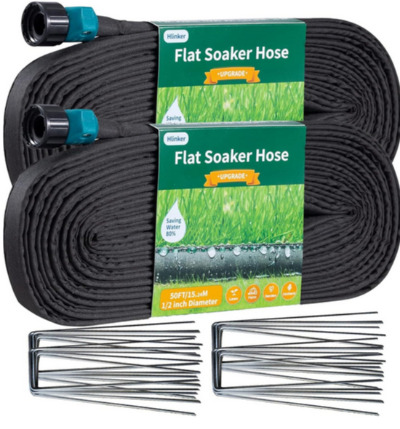
Product Overview
This is very similar to the previous model, but the manufacturer claims slightly higher water savings—88% instead of 80%. That’s a pretty specific claim, and it suggests they’ve made some tweaks to the design or testing methodology.
It’s still a 100-foot system (two 50-foot sections) with stakes included and dual-layer construction.
Best Use Cases
Like the previous model, this works great for any garden where you want a complete package with stakes included. The slightly higher water savings claim might matter if you’re in a drought area or water costs are high where you are.
Key Features Explained
The design is basically the same as many flat hoses, but the manufacturer is claiming better efficiency. This could be from slightly different hole sizing, different materials, or just from more careful testing.
The dual-layer protection is there. The flat profile is there. The stakes are included.
Real-Life Usage Insight
In use, this hose performs like other quality flat soaker hoses. Water comes out at a nice, plant-friendly rate. The stakes keep everything in place.
Whether the 88% water savings claim is meaningfully different from 80% in real-world use is honestly hard to verify. Both figures represent excellent water efficiency compared to sprinklers or hand-watering.
Honest Pros
- Stakes included for easy positioning
- Dual-layer construction
- 100-foot coverage
- Linkable design
- Very similar feature set to competing models
- Flat design means good storage
Honest Cons
- The 88% water savings claim is very specific and harder to independently verify
- Similar to other models, so the differentiation is mainly marketing
- Stakes are still just plastic and will degrade over time
- No major advantage over similarly-priced competitors
Performance Discussion
Performance is solid and consistent with other quality flat soaker hoses. Water delivery is even, pressure handling is good, and the construction quality is apparent.
The water savings claim is reasonable. Whether it’s exactly 88% or a few points different doesn’t change the practical reality that you’re using way less water than with a sprinkler.
Ease of Use
Setup is simple. The stakes help with positioning. Everything is straightforward.
Value for Money
The price is competitive. You’re paying for a complete system with stakes. Whether the specific water savings claim justifies any price difference compared to similar models is debatable.
Comparison: Side-by-Side Breakdown
Let’s look at how these five models stack up against each other.
Length and Coverage
Models 1, 2, 4, and 5 all offer 100 feet of coverage. Model 3 gives you 50 feet. If you’ve got a bigger garden, models 1, 2, 4, and 5 start with better coverage.
Durability
Model 2 is explicitly “heavy duty” and uses thicker materials. Models 1, 4, and 5 use dual-layer construction. Model 3 relies on Gilmour’s reputation. For harsh conditions or long-term use, Model 2 has the edge.
Unique Features
Models 4 and 5 include stakes. Model 3 uses the weeper design. The others are standard flat hoses with holes.
Brand Trust
Gilmour (Model 3) is the most established brand here. The others are reliable but less famous.
Linkability
Models 1, 2, 4, and 5 are linkable. Model 3 is not. If you need flexibility to expand, this matters.
Water Savings
Models 1, 2, 4 claim 80% water savings. Model 5 claims 88%. Model 3 doesn’t specify but is still a drip system so savings are significant.
Price Range
All of these fall in a reasonable mid-range for quality soaker hoses. Model 2 is probably the most expensive due to heavy-duty construction. Model 3 is competitive. Models 1, 4, and 5 are similar to each other.
Buying Guide
So you’ve read about all five models. How do you decide which one is actually right for your garden?
Assess Your Garden Size
The first thing to figure out is how much ground you actually need to water. Measure your beds and rows. Add up the total length. Do you need 50 feet? 100 feet? 150 feet?
If you need less than 50 feet, Model 3 is enough. If you need around 100 feet, any of the others work fine. If you need more than 100 feet, you’ll need to get additional hoses no matter which model you choose.
Think About Your Garden Layout
Is your garden laid out in simple rows? Then any of these work fine. Does your garden have tons of curves and weird corners? The straight flat hoses might be frustrating. But honestly, even flat hoses bend okay—they’re just easier to manage with simpler layouts.
Consider Durability Needs
Are you the type who leaves your hose out year-round? Model 2 with its heavy-duty construction might be worth the extra money. Do you carefully put everything away in fall? Any of these will last multiple seasons.
If you live somewhere really hot or with intense sun, the UV protection from dual-layer construction matters. That’s Models 1, 2, 4, and 5.
Decide About Stakes
Do you want stakes included, or are you fine sorting that out yourself? Models 4 and 5 include them. The others don’t, but stakes are cheap and easy to find if you want them.
Think About Expandability
Might you need to expand coverage in the future? Linkable hoses (Models 1, 2, 4, and 5) give you that flexibility. Model 3 doesn’t link, so if you need more coverage, you’re buying completely new hoses.
Budget Reality
All of these are in a reasonable price range for quality soaker hoses. Model 2 is the premium option. The others are closer together in price. Don’t let price be the only factor—a $10 difference now isn’t worth it if the hose fails in one season.
Who Should Buy Each Model?
Model 1: Flat Soaker Hose 100 FT
Buy this if you want a solid middle-ground option. Good quality, 100-foot coverage, proven design. You’re not paying extra for durability you don’t need, and you’re not skimping on features.
Model 2: Heavy Duty Flat Garden Soaker Hose
Buy this if you’re hard on equipment and live somewhere harsh. You want maximum durability and you’re willing to pay for it. This is for the person who keeps things for years.
Model 3: Gilmour 50′ Black Flat Weeper
Buy this if you want a trusted brand and 50 feet is what you need. You like the idea of a weeper design. You prefer having a single, established brand backing your purchase.
Model 4: 2026 Flat Soaker Hose with Stakes
Buy this if you like the idea of stakes included, want 100 feet of coverage, and don’t need heavy-duty construction. The stakes add real convenience.
Model 5: 2026 Flat Soaker Hose with Stake (88%)
Buy this if you’re convinced by the slightly higher water savings claim and want stakes included. You value maximum efficiency.
Common Mistakes to Avoid
Buying Too Short a Hose
People often underestimate their garden size. A 50-foot hose that ends three feet before the last bed is useless. Measure twice, buy long. You can always coil up extra hose.
Ignoring Water Pressure
Some cheap soaker hose can’t handle normal home water pressure. These models all handle standard pressure fine, but it’s worth confirming before you buy. You shouldn’t need a pressure regulator for any of these.
Assuming Linkable Hoses Work Like Magic
Linked hoses work fine, but the connection point can sometimes be a weak spot for leaks. Make sure your connectors are tight. It’s not complicated, but it matters.
Leaving the Hose in Direct Sun
Even with UV protection, leaving a hose constantly in intense sun shortens its life. Try to position it so it gets some shade, or coil it away when not in use.
Not Adjusting Layout as Your Garden Changes
Your hose setup from one season might not be ideal the next season if you’ve reorganized your plants. Take five minutes to re-route and reposition as needed. It’s one of the benefits of soaker hoses that you can adjust easily.
Forgetting to Turn Off the Water
An easy mistake, but leaving the water running all night can actually damage your hose over time and wastes water. Set a timer if you’re the forgetful type.
Not Flushing the Hose Before First Use
Even new hoses can have dust or debris inside. Run water through it for a minute before you start using it for real watering.
Final Verdict
All five of these soaker hoses are genuinely good options. This isn’t a list where one is obviously perfect and the others are compromises. You’re really looking at choosing based on your specific situation.
If You Need Easy Confidence: Model 1, the basic Flat Soaker Hose 100 FT, gives you everything you need without overthinking it. It’s proven, it’s available, it works. You can’t go wrong here.
If You Want Durability: Model 2’s heavy-duty construction is worth it if you’re going to beat it up or live somewhere harsh. It’ll still be functional years from now.
If You Trust Established Brands: Model 3 from Gilmour is the safe choice. You’re getting a name that’s been around forever backing your purchase. The weeper design is also genuinely good if you prefer uniform watering.
If You Want Convenience: Models 4 and 5 with included stakes actually save you a step and some money. The stakes are small but they’re nice to have.
Real Talk
Your garden doesn’t need fancy. It needs functional. Any of these five models will get water to your plants efficiently. Pick the one that matches your garden size, your budget, and your situation. You’ll be happier watering because you’ll spend less time fiddling with hoses and more time just, you know, watering.
The water savings are real. You’ll see it in your water bill if you’re in an area where water costs money. Your plants will be healthier because they’re getting slow, deep watering instead of fast surface watering.
Get yourself a soaker hose. Lay it out. Turn it on. Enjoy having more free time. That’s really what this is about.
Setup Tips for Success
Once you’ve picked your soaker hose, here are some practical tips to make it work even better.
Laying It Out
Run your hose along the base of your plants, not in the middle of the row. You want water reaching the roots, not spraying everywhere. Soaker hoses work best when they’re basically right at soil level.
If you’ve got a long straight row, just lay the hose straight. If you’ve got a curved bed, curve the hose with it. The flat design makes this easy.
Controlling Water Flow
You don’t need to blast it on full pressure. Start with medium flow and adjust from there. You want water coming out at a rate where it can actually soak into the soil, not run off.
If you’ve got very permeable soil that drains fast, slightly higher flow works. If you’ve got clay that holds water, lower flow is better. Watch how the water behaves the first time you turn it on and adjust.
Timing Your Watering
Early morning is best. It gives water time to soak down before any heat, and it means plants have moisture through the day. Late evening works okay too. Avoid midday watering because the sun will evaporate water before it soaks in.
How long to run it depends on your soil, plants, and weather. A good start is about an hour for most gardens. If your soil dries out, run it longer. If it stays soggy, run it shorter.
Protecting Your Setup
If you’re using stakes, that’s half the battle right there. If you’re not, just arrange your hose so it’s not in the way of where you’re walking. It’s easy to step on a hose and damage it without even meaning to.
If you’ve got pets, make sure they can’t chew or mess with the hose. Dogs especially like to attack soaker hoses for some reason.
End of Season Storage
Turn off the water and let the hose drain. Coil it carefully and store it somewhere cool and out of direct sun. A shaded shed is perfect. Don’t store it kinked or twisted—lay it in a loose coil.
If you’re in a freezing climate, definitely drain it completely before winter. Ice inside a hose can damage the internal structure.
Maintenance and Longevity
Good news: soaker hoses don’t need much maintenance.
Cleaning
If water pressure seems lower than it used to be, the holes might be clogged. You can run water backward through the hose to flush it, or just turn it on hard for a minute and let debris work its way out. Most soaker hoses have debris screens you can take off and rinse.
Inspection
Every few weeks during the growing season, check for leaks. Small pinhole leaks are inevitable eventually, but you want to catch big problems early. If you spot a leak you can’t live with, you can patch it with tape as a temporary fix.
Repairs
Small leaks near the middle of the hose can be wrapped with plumber’s tape or patched with a rubber patch kit. Leaks at the connections usually mean the connector needs tightening.
If the hose splits or has a really bad leak, you’ve got two options: use it anyway if it’s a small leak (water still gets out and mostly goes where you want), or get a replacement section. Soaker hoses are cheap enough that replacement is usually easier than serious repairs.
Water Savings: The Real Impact
Let’s talk about actual numbers because this matters.
A typical sprinkler system uses about 2,000 gallons per 1,000 square feet per watering. Hand-watering is somewhere in between. A soaker hose system uses maybe 400 gallons for the same area.
If you’ve got a 500-square-foot garden and you water twice a week, we’re talking about:
- Sprinkler: 2,000 gallons per week
- Soaker hose: 400 gallons per week
That’s 1,600 gallons saved per week. Over a summer that’s 20,000 gallons saved.
If your water costs $2 per 1,000 gallons, that’s $40 saved per summer. If you pay $4 per 1,000 gallons, that’s $80 saved.
Even at the low end, a soaker hose pays for itself in one summer. And you get healthier plants and less work. That’s a pretty good deal.
The Bottom Line
You need to water your garden. A soaker hose is the smartest way to do it. It uses less water, your plants get healthier, and you get back some of your time.
Any of these five models will do the job. They’re all quality options. Pick the one that fits your garden size, your budget, and your situation.
Set it up, turn it on, and enjoy having one less thing to worry about. Your garden will thank you.
That’s really all there is to it.

Hi, I’m Mary, the founder of GardenCure.com. I’m passionate about creating healthy, beautiful gardens and well-kept lawns. I share practical experience and trusted advice on garden and lawn gear that truly works. With the support of my dedicated research team, our writers produce honest, in-depth reviews using reliable, authentic sources—helping you choose the right tools with confidence for your outdoor space.