How to Find a Leak in Your Sprinkler System?
There’s nothing worse than realizing your sprinkler system isn’t working the way it should. You check your water bill and it’s way higher than normal. Your grass doesn’t look as green as it used to. Something is definitely wrong. The culprit? A leak in your sprinkler system.
In this article
Finding a sprinkler system leak might sound like a job for the professionals, but here’s the good news: you can do it yourself. You don’t need fancy equipment or years of experience. All you need is patience, a few basic tools, and a willingness to get a little wet. In this guide, I’ll walk you through everything you need to know about detecting leaks in your irrigation system so you can save money and keep your lawn looking perfect.
Why Leaks in Sprinkler Systems Matter
Before we jump into finding leaks, let’s talk about why you should care. A small leak in your sprinkler system might not seem like a big deal at first. You might think, “Oh, it’s just a little water.” But that little water adds up fast.
When your sprinkler system has a leak, you’re wasting water. A single leak can waste hundreds of gallons of water every month. That means your water bills go up significantly. A leak that runs 24/7 can cost you serious money by the end of the month. We’re talking hundreds of dollars in some cases.
Beyond your wallet, leaks hurt the environment. We live in a world where water is becoming scarcer. Wasting water through sprinkler leaks doesn’t just affect your bill—it affects your community. Leaks also prevent your lawn from getting the water it actually needs. The water leaks out in the wrong places instead of watering your grass evenly.
The longer you wait to fix a leak, the more damage it does. Water sits in your soil, killing roots and creating muddy patches. It can even damage your foundation or create erosion problems in your yard. The best time to find and fix a leak is right now.
Common Types of Sprinkler System Leaks
Not all sprinkler leaks are the same. They happen in different parts of the system and look different. Once you know what you’re looking for, spotting a leak becomes much easier.
Leaks at the Connection Points
The easiest leaks to find are often at the connection points. These are the spots where pipes connect to other pipes or to sprinkler heads. Water loves to escape from these joints. You might see water dripping or spraying from where two pieces of pipe meet. This type of leak is usually pretty obvious if you look closely.
Leaks in the Main Supply Line
The main supply line runs from your water source to the rest of your sprinkler system. If this line has a hole or crack, water will leak out along its entire length. This is a serious problem because water is escaping before it even gets to your sprinkler heads. You might notice a wet area in your lawn that runs in a line across your yard. This is often a sign of a main line leak.
Leaks at Sprinkler Heads
Your sprinkler heads take a lot of abuse. They get stepped on, run over by lawnmowers, and exposed to the sun and weather. It’s not surprising that they sometimes develop leaks. Water might spray out from cracks in the head itself, or you might see water bubbling up around the base of the head.
Underground Leaks
These are the tricky ones. An underground leak happens when a pipe buried beneath your lawn cracks or breaks. You can’t see the pipe, so you can’t see the water coming out. But you can definitely see the signs. Look for areas in your yard that are unusually wet, muddy, or soggy. You might see patches of bright green grass in the middle of brown grass—that’s the leak feeding extra water to one spot.
Leaks in the Valve Box
Your sprinkler system has a valve box buried in your yard. This box houses the valves that control water flow to different zones of your lawn. If water is leaking from the valve box, you’ll notice water pooling around the area where the box sits.
How to Check Your System for Leaks
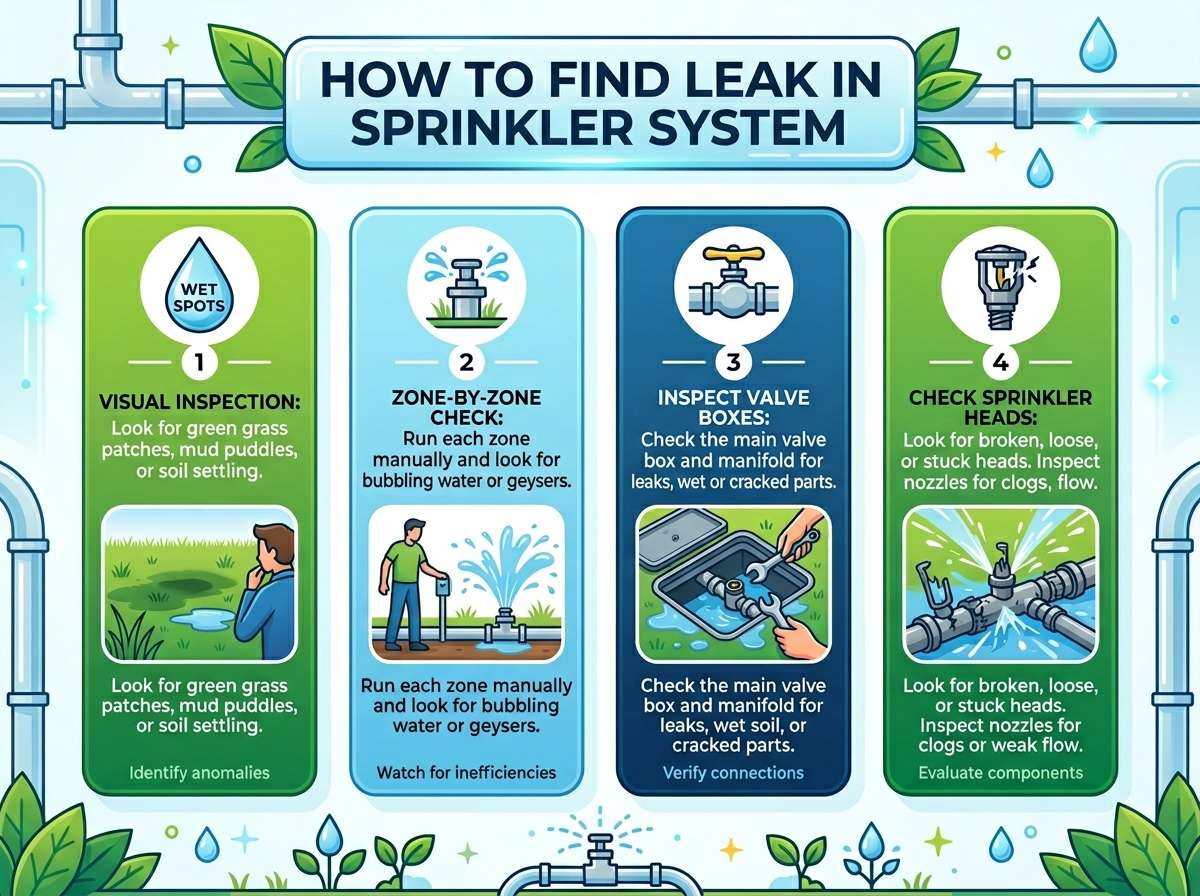
Now that you know what types of leaks exist, let’s talk about how to actually find them. Start by doing a visual inspection of your entire sprinkler system.
Turn On Your System
First, turn on your sprinkler system just like you normally would for watering your lawn. Let it run for a few minutes. This is the best way to see where water is going and where it shouldn’t be going.
Walk around your entire yard while the system is running. Look at each sprinkler head. Listen for sounds that don’t belong. A hissing sound means air is escaping from somewhere. A spraying sound that seems off could indicate a leak at a connection.
Look for Obvious Water Leaks
Look for any water shooting out from places it shouldn’t. Are sprinkler heads leaking at their base? Is water dripping from connection points? Is there water spraying from a crack in a pipe? These are all signs of leaks you can see directly.
Check for Soggy Spots in Your Lawn
Turn off your system and wait a day or two. Don’t water your lawn during this time. Now walk around your yard and look for areas that are still soggy or wet. Soggy spots that stay wet longer than the rest of your lawn usually mean water is leaking right there.
Pay attention to areas that don’t make sense. Is there a perfectly circular wet spot in the middle of your driveway? That could be a main line leak running under your drive. Is there one section of grass that’s much greener and thicker than the surrounding areas? That extra green spot might be sitting on top of a leak.
Watch Your Water Meter
This is a trick that professional leak detectors use, and you can do it too. Go find your water meter. It’s usually a box buried in the ground near your street or attached to your house.
Write down the number on your meter. Make sure nobody in your house uses any water for two hours. Set a timer and don’t flush toilets, run showers, or use sinks during this time. After two hours, check your meter again. If the number went up, you have a leak somewhere in your system.
To narrow down if the leak is in your irrigation system specifically, turn off the water valve that controls your sprinkler system. Then repeat the test. If the meter still goes up, your leak is in your house plumbing. If the meter stays the same, the leak is definitely in your sprinkler system.
Detailed Steps to Find Sprinkler Leaks
Ready to do some hands-on detection? Follow these steps to track down exactly where your leak is hiding.
Step 1: Check All Visible Components
Get down on your hands and knees and inspect every part of your sprinkler system you can see. This means looking at every sprinkler head, every connection point, and every section of visible pipe.
Look for water that’s actively leaking or dripping. Put your hand near suspected leak areas. Can you feel water spraying? Listen carefully for hissing or dripping sounds. Sometimes you can hear a leak before you see it.
Step 2: Inspect Each Zone Separately
Most sprinkler systems divide your lawn into zones. Each zone waters a different part of your property. Turn on one zone at a time instead of running your whole system at once. This makes it much easier to spot problems.
When you run just one zone, you know any leaks you find are in that specific zone. This narrows down your search area significantly. Work your way through each zone systematically.
Step 3: Look at the Base of Each Sprinkler Head
Sprinkler head leaks often happen right where the head sits in the ground. Water bubbles up around the base or leaks out the sides. Inspect the ground around each head carefully. Is the soil wet when it shouldn’t be? Is water pooling there?
Step 4: Trace the Path of Pipes
Think about where your pipes run. They usually go from your water source to the valve box, then branch out to different zones. The main supply line follows the most direct route. Secondary lines branch off to water different areas.
Look for signs of water damage along these paths. Wet soil, puddles, or unusually lush grass growing in a line all point to a pipe leak underground. Mark these areas on a map or just remember where they are.
Step 5: Dig Carefully if Needed
If you suspect a leak in a specific location, you might need to dig to confirm it. Dig carefully in the wet area. Go slowly so you don’t damage the pipe further. Once you expose the pipe, you’ll usually see the problem immediately. There will be a hole, crack, or loose connection where water is escaping.
Step 6: Check the Valve Box
Open your valve box and look inside. Are the valves wet? Is there water sitting in the bottom of the box? Water here indicates a leak in the valve connections or in the pipes right near the box.
Special Techniques for Hidden Leaks
Sometimes a leak is sneaky and doesn’t want to be found. These special techniques help you track down the tough ones.
The Dye Test
Get some food coloring or dye designed for detecting leaks. You can find leak detection dye at garden stores or online. Near a suspected leak area, carefully pour a small amount of dye into the soil. Watch where the dye flows. The dye will be pulled toward the leak by the escaping water. Follow the dye to locate the exact leak spot.
The Pressure Test
This technique requires a pressure gauge, which you can buy or rent. Attach the gauge to one of your sprinkler system valves. Check the water pressure when the system is running and when it’s off.
If pressure drops significantly when you turn off the system, you likely have a leak. The faster the pressure drops, the bigger the leak. This test doesn’t tell you exactly where the leak is, but it confirms you definitely have one.
The Sound Test
Grab a screwdriver or a long metal rod. Place one end on the pipe (or on the ground near the pipe) and hold the other end against your ear. Move along the suspected leak area while listening. A loud hissing or rushing sound will get louder as you approach the leak. This lets you pinpoint the leak location.
What to Look For in Wet Spots
Not every wet spot in your yard means there’s a leak. But the right kind of wet spot does. Learn to tell the difference.
A leak-related wet spot usually appears in the same place every day. It doesn’t go away after a few hours in the sun. The ground feels boggy and soft, not just damp. The wet spot might appear even when it hasn’t rained and you haven’t watered your lawn recently.
Leak-caused wet spots often have a circular or oval shape. They tend to be in one specific area, not spread across a whole section of lawn. The grass or soil right in the wet spot might look different from the surrounding area—either greener and thicker or dead and brown depending on the severity.
How to Find Leaks Without Digging
Let’s be honest—digging up your yard is a hassle. You want to know if you have a leak before you start digging. These methods help you find leaks without getting your whole yard torn up.
Watch for Mold or Algae
Areas with leaking water develop mold or algae growth. If you see dark green or black patches on the ground that weren’t there before, you might be looking at water leaking from below. Mold grows where there’s constant moisture.
Look for Insect Activity
Certain insects are attracted to the damp soil created by leaks. If you notice an unusual amount of insects in one area of your lawn, a leak might be feeding them that moisture.
Check for Soil Erosion
Water escaping from a leak can wash away soil. You might notice a slight dip or depression in your lawn where soil has been carried away by escaping water. This is particularly common with larger leaks.
Monitor Grass Growth Patterns
Leaking water makes grass grow faster and thicker in that spot. Look for sections of grass that are noticeably lush and full compared to the surrounding lawn. This excessive growth is a dead giveaway.
Checking Your Valve Box for Leaks
Your valve box is crucial to your sprinkler system. If it’s leaking, you need to know. Here’s how to check it properly.
First, locate your valve box. It’s usually a plastic or concrete box buried in the ground. Walk around your yard looking for a lid or cover at ground level. You might find multiple boxes if your system is large.
Open the box carefully. The lid might be stuck, so take your time. Look inside. You should see valves and pipes, but you shouldn’t see standing water. If there’s water pooling in the bottom of the box, you have a leak.
Touch the valves and pipes. They should feel dry. If they’re wet or have water dripping from them, that’s your leak. Water might be leaking from where pipes connect to the valves, or it could be coming from a crack in the valve itself.
Feel the ground around the outside of the box. The soil shouldn’t be wet beyond the box edges. Soggy soil around the box usually means water is leaking from connections inside the box and seeping out.
When You Find the Leak
Once you locate your leak, take a moment to document it. Take a photo if you can. Note exactly where it is and what type of leak it is (dripping connection, cracked pipe, etc.). This information helps if you call a professional for repairs.
Don’t panic. Most sprinkler leaks are fixable. Small connection leaks might just need tightening. Cracked pipes can be repaired with patch kits or replaced entirely. If you’re comfortable with DIY repairs, you can fix many simple leaks yourself with supplies from a hardware store.
If the leak is complex or underground, it might be worth calling a professional. They have special equipment to locate leaks without digging up your whole yard, and they can repair them quickly.
Prevention: Stop Future Leaks
Now that you’ve found and fixed your leak, let’s make sure you don’t have to do this again anytime soon.
Keep your sprinkler system in good shape by doing regular maintenance. Check your system at the start of watering season and at the end. Look for obvious problems. Tighten any loose connections you find.
Be careful when landscaping around your sprinkler system. Mark where your pipes run so you don’t accidentally dig through them. Avoid running heavy machinery over areas where you know pipes are buried.
Winterize your system if you live somewhere cold. Frozen water in pipes causes cracks. Proper winterization prevents this damage.
Water your lawn sensibly. Overwatering creates extra pressure in your system, which can cause leaks. Use a smart timer that adjusts watering based on weather. This reduces pressure and saves water.
Key Takeaways
Finding a leak in your sprinkler system is totally doable without professional help. Start by turning on your system and looking for obvious leaks. Check your water meter to confirm you have a leak. Look for soggy spots in your lawn that stay wet longer than normal. Inspect your valve box and all visible pipes and connections.
Use special techniques like the dye test or sound test if you need to narrow down a hidden leak’s location. Once you find the leak, decide whether you can fix it yourself or need professional help.
The sooner you find and fix a leak, the sooner you stop wasting water and money. A small leak that goes unnoticed can cost you hundreds of dollars over time. The effort you put into finding your leak now will pay off immediately when you see your next water bill.
Keep your system maintained going forward. Regular checks prevent most leaks from happening in the first place. Your lawn will look greener, your water bill will stay reasonable, and you’ll know you’re not wasting one of our most important resources.
Happy leak hunting, and here’s to a lawn that stays perfectly watered.

Hi, I’m Mary, the founder of GardenCure.com. I’m passionate about creating healthy, beautiful gardens and well-kept lawns. I share practical experience and trusted advice on garden and lawn gear that truly works. With the support of my dedicated research team, our writers produce honest, in-depth reviews using reliable, authentic sources—helping you choose the right tools with confidence for your outdoor space.