How to Fertilize Arborvitae?
Arborvitae trees are amazing. They grow tall. They look beautiful. They give your yard privacy and shade. But here’s the thing: these trees need proper feeding to stay healthy and strong. If you want your arborvitae to shine and reach its full potential, fertilizing is not optional. It’s essential.
In this article
In this guide, I’ll walk you through everything you need to know about feeding your arborvitae trees. You’ll learn when to fertilize, what type of fertilizer works best, and how much to use. By the end, you’ll feel confident managing your trees like a pro.
Why Your Arborvitae Trees Need Fertilizer
Let’s start with the basics. Your arborvitae needs nutrients to grow strong. The soil in your yard might not have all the nutrients these trees require. Especially if your trees are new or if the soil is poor quality.
Fertilizer gives your trees the nutrients they crave. These nutrients help leaves stay green and thick. They help branches grow sturdy. Strong arborvitae trees resist disease better. They handle stress from weather and pests more easily.
Think of fertilizer like a vitamin supplement. Your trees can survive without it. But they’ll do so much better with it. Better growth means better appearance. Better appearance means a more attractive yard.
Arborvitae is a popular evergreen shrub. Many people plant it as a hedge or screening plant. These trees have shallow root systems. This means they need consistent care and feeding. Shallow roots can’t reach deep into the soil to find nutrients. So you need to bring the nutrients to the roots.
When to Fertilize Your Arborvitae Trees
Timing matters a lot. Feed your trees at the right time, and they’ll respond with vigorous growth. Feed them at the wrong time, and you might waste fertilizer or even hurt the trees.
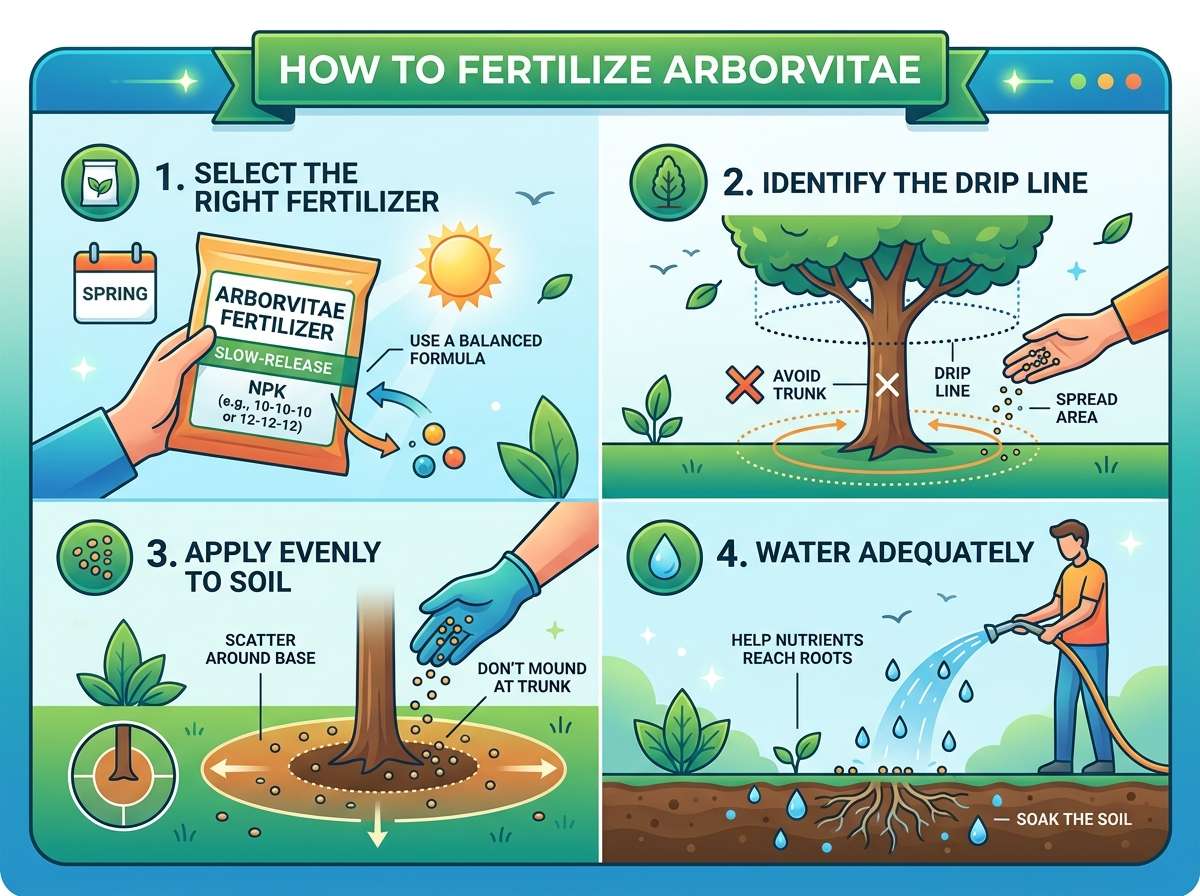
The best time to fertilize arborvitae is in spring. As the soil warms up and trees wake from dormancy, that’s when to start feeding. Spring fertilizing helps trees power through their active growing season. You’ll see new green shoots emerge faster.
You can also feed in early summer. Just don’t wait too long. If you fertilize too late in the season, you’ll stimulate new growth that won’t have time to harden off before winter. Tender new growth is vulnerable to cold damage and frost.
Most people fertilize just once per season. A single application in spring works well for established trees. Younger trees or trees in poor soil might benefit from a second feeding in early summer. Just make sure this second feeding happens at least eight weeks before the first frost.
Never fertilize in fall or winter. This is crucial. Late-season fertilizing pushes new soft growth. Winter arrives, and that tender growth dies back. Your tree wastes energy. Plus, the tree goes into dormancy stressed, not strengthened.
The absolute best time is early spring, right as new growth starts. That’s when your arborvitae is ready to use those nutrients most effectively.
Choosing the Right Fertilizer Type
Many fertilizer options exist. You need to pick the right one for arborvitae care. The good news: arborvitae isn’t too picky. But some options work better than others.
Balanced fertilizers are your friend. Look for products labeled with three numbers, like 10-10-10 or 5-5-5. These numbers represent nitrogen, phosphorus, and potassium. A balanced ratio means equal parts of each nutrient. This works great for general tree health.
Nitrogen is important for green foliage and strong growth. Your evergreen arborvitae especially loves nitrogen. But don’t overdo it. Too much nitrogen causes excessive soft growth. This growth is weak and disease-prone.
Slow-release fertilizers are excellent for arborvitae. These products feed your tree gradually over time. The nutrients release steadily as the soil warms up. This mimics nature better than quick-release products. Your tree gets fed consistently without nutrient spikes.
Granular fertilizers work well for arborvitae trees. These are solid pellets you spread on the ground. They’re easy to apply and affordable. You simply sprinkle the granules around the tree base and water them in. The water activates the fertilizer and carries nutrients down to the roots.
Liquid fertilizers are fast-acting. You dilute them in water and apply the mixture around the tree. Liquid options work quickly but don’t last as long as granular products. Some gardeners like them for quick nutrient boosts.
Organic options include compost, aged manure, and fish emulsion. These natural fertilizers feed your soil while nourishing your tree. The soil organisms break down the organic material slowly. This creates long-term nutrient availability. Many experienced gardeners prefer organic options for tree health and soil structure.
Synthetic fertilizers are manufactured chemically. They provide fast results. Some folks prefer them because they’re precisely formulated. Both organic and synthetic options work for arborvitae. Choose based on your preferences and values.
Look for fertilizers specifically designed for evergreens or acid-loving plants. These formulas often contain iron and other micronutrients that evergreens love. They’ll give you better results than generic products.
How Much Fertilizer Does Your Arborvitae Need
Application rates matter. Too little fertilizer won’t do much good. Too much can burn roots or cause problems. The right amount hits the sweet spot.
Read the label carefully. Different products have different concentrations. The instructions tell you exactly how much to apply based on tree size. Follow the label directions.
Generally, young arborvitae trees (less than 3 years old) need less fertilizer than mature trees. They have smaller root systems. About half the recommended rate works well for young trees.
For established arborvitae trees, follow the package instructions. Most recommend applying 1 to 3 pounds of balanced fertilizer per tree each season. The exact amount depends on the tree’s size, age, and the fertilizer concentration.
For a tree that’s 5 feet tall, you might use about 1.5 to 2 pounds of balanced granular fertilizer. For a tree that’s 10 feet tall, you might use 2 to 3 pounds. These are just starting points. The label is your best guide.
With liquid fertilizers, you’ll dilute according to package directions and apply to the root zone. Usually, you’re mixing something like 1 ounce of concentrate per gallon of water. Again, follow the label exactly.
The best strategy: don’t overdose. Underfertilizing is safer than overfertilizing. You can always apply more next season if your tree isn’t responding well. But you can’t undo damage from too much fertilizer.
How to Apply Fertilizer Correctly
Application method is just as important as fertilizer choice and timing. Correct application gets nutrients to the roots where they do the most good.
Clear the area around your tree first. Pull back any mulch near the trunk. You want to access the soil where the feeder roots live. Most arborvitae roots spread as far out as the tree is tall. So a 6-foot-tall tree has roots extending 6 feet from the trunk in all directions.
For granular fertilizers, sprinkle the product evenly across the root zone. Start about 6 inches from the trunk. Spread it out to beyond the drip line (that’s the edge of the tree’s canopy). Try to distribute it evenly. You’re aiming for consistent coverage, not piling fertilizer in one spot.
After spreading granules, water deeply. Water helps activate the fertilizer and carries nutrients down to the roots. Without water, granular fertilizer sits on the surface doing little good. A good soaking rain is perfect. If no rain comes, water with a hose.
For liquid fertilizers, mix according to package directions. Pour the solution around the base of the tree. Again, cover the root zone. Water in if the soil is dry. Liquid fertilizers are already in solution, so watering isn’t always necessary. But it helps distribute nutrients through the soil.
Avoid direct contact with the tree trunk. Fertilizer shouldn’t touch the bark. Keep it at least 6 inches away from the trunk. This prevents damage and keeps nutrients where roots are actually located.
Don’t fertilize immediately after transplanting. New trees need time to recover from transplant shock. Wait at least two to three weeks before fertilizing a newly planted arborvitae. This gives roots time to settle in.
Foliar feeding is another option. This means spraying diluted fertilizer on the leaves. Evergreens can absorb some nutrients through their foliage. Use very dilute fertilizer for this method. Spray in early morning or evening, not during hot sun. Foliar feeding works fast but doesn’t replace soil feeding. Use it as a supplement, not a main strategy.
Understanding Soil and Nutrient Needs
Your soil tells you a lot about what your arborvitae needs. Different soils have different nutrient levels. Understanding your soil helps you feed more intelligently.
Arborvitae prefers slightly acidic to neutral soil. A pH between 6.0 and 7.0 is ideal. If your soil is too acidic or too alkaline, nutrients won’t be available to roots even if they’re present in the soil. This is called nutrient lock-up.
A soil test is incredibly valuable. Send a sample to your local extension office. For about $20 to $50, you’ll learn your soil’s pH and nutrient levels. You’ll get specific recommendations for your trees. This takes guesswork out of fertilizing.
Heavy clay soils drain poorly. Roots can sit in wet conditions, which causes rot. Arborvitae doesn’t like wet feet. If your soil is heavy clay, improve drainage by adding compost when you plant. Adding compost also improves nutrient availability.
Sandy soils drain too fast. Nutrients wash away before roots can absorb them. Sandy soil needs frequent light feedings rather than one heavy application. Mixing in compost helps sandy soil retain nutrients longer.
Loamy soil is the sweet spot. It has good drainage and decent nutrient-holding capacity. Most plants, including arborvitae, love loamy soil. If your soil is loam, standard fertilizing works great.
Mulching around your tree helps your fertilizing efforts. A 2 to 3 inch layer of wood chips holds moisture and keeps the soil cooler. As mulch breaks down, it adds organic matter and improves soil structure. Better soil means better nutrient availability. The best mulch is hardwood chips or shredded bark. Avoid piling mulch against the trunk.
Common Fertilizing Mistakes to Avoid
Lots of folks make mistakes with arborvitae fertilizing. Learning these pitfalls helps you do better.
The biggest mistake: overfertilizing. More fertilizer doesn’t mean better trees. Too much nitrogen creates lush soft growth that’s disease-prone. Excessive fertilizer can burn roots. Salt buildup in soil can damage roots. Stick to recommended rates. Your tree will thank you.
Fertilizing at the wrong time is common. Fall and winter fertilizing causes problems. It stimulates growth that can’t harden off. This growth dies in cold weather, stressing the tree. Only fertilize in spring or early summer.
Using the wrong product is avoidable. Don’t use fertilizers meant for lawns on your trees. Lawn fertilizers often have too much nitrogen and the wrong nutrient ratios for woody plants. Use tree-specific or evergreen-specific products.
Applying fertilizer too close to the trunk is wrong. The trunk has no roots. You’re wasting fertilizer and risking bark damage. Spread fertilizer across the root zone, not piled at the base.
Forgetting to water after applying granular fertilizer happens often. Without water, granular products don’t work well. Always water deeply after spreading granules.
Ignoring soil condition is a miss. If your soil is terrible, fertilizer won’t help much. Improving soil is at least as important as adding fertilizer. Work on soil quality first.
Not feeding young trees enough is a problem some folks have. Young arborvitae needs consistent nutrition for strong establishment. Don’t skip fertilizing young trees. Just use lighter rates.
Fertilizing a struggling tree without addressing the underlying problem wastes effort. If your tree is sick or dying, fertilizer won’t fix it. Find out what’s wrong first. Maybe it’s a pest problem. Maybe it’s a disease. Maybe it’s poor drainage. Fix the real issue. Then fertilizer helps recovery.
Special Situations and Adjustments
Some situations need different fertilizing approaches.
If you’re using arborvitae as a hedge, fertilize all trees consistently. Space applications evenly along the hedge line. A healthy hedge needs even nutrient distribution.
Stressed trees need extra care. Trees stressed by drought, disease, or transplanting benefit from careful, light fertilizing. Use half the normal rate. Feed more frequently (every six weeks instead of annually). This supports recovery without overwhelming stressed roots.
Container-grown arborvitae has different needs than in-ground trees. Container trees can’t access deep soil nutrients. They depend completely on what you provide. Container trees need fertilizing every three to four weeks during growing season. Use a balanced liquid fertilizer at half strength.
Trees in poor soil benefit from organic amendments. Mix compost into the top few inches of soil around the tree. This improves soil gradually while providing nutrients. Organic matter helps soil retain nutrients and moisture.
Newly planted trees need special handling. Don’t fertilize for the first two or three weeks. Let roots settle. Then start with half-strength applications. Build up to full strength over the first season.
Mature established trees might need less frequent feeding. If your tree is healthy and growing well, one spring application each season might be plenty. If it’s growing slowly or looking pale, increase to two applications per season (spring and early summer).
Trees in high-traffic areas near roads get exposed to salt. Salt damages roots and locks up nutrients. These trees might need more frequent light feedings to overcome salt stress. Flush the soil with extra water in spring to help remove accumulated salt.
Organic Fertilizing Strategies
Many gardeners prefer organic methods. If that’s you, here are excellent organic options.
Compost is nature’s perfect fertilizer. Well-made compost is nutrient-rich and improves soil structure. Spread 2 to 3 inches around the tree base each spring. The soil organisms break it down slowly, feeding your tree all season.
Aged manure is another organic winner. Horse or cow manure that’s been sitting for a year works great. Fresh manure can burn roots and is too hot. But aged manure feeds gently and improves soil. Use 2 to 3 inches around the tree.
Fish emulsion is a liquid organic fertilizer. It’s made from fish processing byproducts. Apply it diluted to water around the tree base. It smells strong but works fast. Fish emulsion provides nitrogen and trace minerals.
Seaweed or kelp extracts are packed with micronutrients. They also contain natural growth hormones. Mix according to directions and apply to the soil. This works especially well for stressed trees.
Bone meal is great for phosphorus and calcium. It supports root development. Mix it into soil at planting time. It releases slowly over time.
Blood meal is high in nitrogen. It helps with green foliage and growth. Use it sparingly because it’s concentrated. Too much causes salt buildup.
Composted leaves are free if you collect fall leaves. Shred them and let them decompose. This homemade compost feeds your trees and costs nothing.
Coffee grounds are nitrogen-rich and free from local coffee shops. Dry them first. Scatter around trees. They improve soil as they decompose.
Grass clippings (if from untreated lawns) can go around your tree as mulch. As they break down, they feed the soil. Never use clippings from treated lawns.
Organic fertilizing takes patience. Results develop slower than synthetic products. But the benefits to soil health are tremendous. Over time, organic matter improves soil structure, water retention, and nutrient availability.
Fertilizing Schedule Overview
Here’s a simple year-round schedule for fertilizing arborvitae:
Early spring when growth starts: Apply balanced granular fertilizer. Water deeply. This is your main feeding.
Late spring if needed: Some trees benefit from liquid foliar spray. This gives a nutrient boost when trees are growing rapidly.
Early summer (optional): If your tree is young, stressed, or in poor soil, apply a second feeding. Make it light. This is for extra support, not heavy feeding.
Summer through fall: No fertilizing. Your tree can focus on hardening off for winter.
Winter: Never fertilize. This is rest time for your tree.
This schedule works for most gardeners and most arborvitae situations. You can adjust based on how your tree responds.
Reading Fertilizer Labels Like a Pro
Understanding fertilizer labels helps you make smart choices.
The three numbers on every fertilizer package represent NPK. Nitrogen, phosphorus, potassium. A label reading “10-5-5” means 10% nitrogen, 5% phosphorus, 5% potassium. The remaining 80% is filler and other ingredients.
For arborvitae, balanced products (10-10-10, 5-5-5) work best. You might see products with higher first numbers (like 15-5-5). These are nitrogen-heavy. They promote leafy growth. They can work but might create too-soft foliage. Lower numbers like 5-5-5 are gentler and work well for trees.
Look for products that list micronutrients like iron, magnesium, and manganese. These trace elements matter for evergreen health. They help maintain that rich green color.
Check if it’s slow-release or quick-release. Slow-release is better for trees. Quick-release gives fast results but doesn’t last long.
See if it’s organic or synthetic. Both work. Organic costs more but improves soil. Synthetic acts faster and costs less.
Read application rates carefully. Some products recommend 1 pound per tree. Others recommend 2 pounds. The label tells you what’s right for that specific product. Follow it exactly.
Check for warnings about application timing or precautions. Some products can’t be used in extreme heat. Others can’t be used near water. The label has important safety information.
Troubleshooting Fertilizer Problems
Even with good intentions, things sometimes go wrong.
Brown or scorched foliage after fertilizing usually means too much fertilizer. Flush the area with water to dilute excess fertilizer. Water deeply several times over a few days. This helps wash excess fertilizer away from roots. Next time, use less product.
Pale or yellowish foliage despite fertilizing might mean the wrong nutrient. This could be iron deficiency. Use a fertilizer formulated for acid-loving plants or evergreens. These have chelated iron that roots can absorb.
No visible growth after fertilizing could mean several things. Maybe you need more fertilizer. Maybe the timing was off. Maybe there’s an underlying problem like pests or disease. Maybe the soil pH is wrong and nutrients are locked up. A soil test helps diagnose this.
Excessive soft growth after fertilizing means too much nitrogen. This growth attracts pests and gets disease. Water frequently to help this growth harden off. Don’t fertilize again soon. Let the tree recover.
Weak or dead branches despite fertilizing could indicate other problems. Maybe the tree isn’t getting enough water. Maybe there’s a pest or disease issue. Fertilizer alone can’t fix these problems. You need to address root causes.
Final Thoughts on Arborvitae Fertilizing
Fertilizing arborvitae is straightforward once you understand the basics. Spring timing. Balanced fertilizer. Proper application. Consistent care. That’s really the whole story.
Your arborvitae responds to good care. Feed it right, and it repays you with dense green foliage, strong structure, and years of beauty. The effort you put in now pays dividends for decades.
Start with one spring application this season. Watch how your tree responds. Next season, adjust based on results. Maybe your tree needs more feeding. Maybe it thrives on less. You’ll figure out what works for your specific tree and situation.
Arborvitae care isn’t complicated. It just requires basic knowledge and consistency. You’ve got that knowledge now. So go out there. Fertilize your trees. Enjoy the results. Your yard will look amazing, and your arborvitae will thank you for the good nutrition.
Happy gardening!

Hi, I’m Mary, the founder of GardenCure.com. I’m passionate about creating healthy, beautiful gardens and well-kept lawns. I share practical experience and trusted advice on garden and lawn gear that truly works. With the support of my dedicated research team, our writers produce honest, in-depth reviews using reliable, authentic sources—helping you choose the right tools with confidence for your outdoor space.