5 Best Fertilizer for Olive Trees In 2026
If you grow olive trees, you already know that feeding them right makes all the difference. A good olive tree fertilizer turns a struggling plant into a healthy powerhouse that produces abundant fruit and grows stronger every season. But with so many options out there, finding the right one can feel like searching for a needle in a haystack.
In this article
I’ve put together this complete guide to help you find the best olive tree fertilizer for your specific situation. Whether you’re growing olives in pots or in the ground, whether you want organic options or fast-acting liquid formulas, this roundup covers everything you need to know.
Why Olive Trees Need the Right Fertilizer
Olive trees are hungry plants, but they have specific needs that differ from other fruit trees. They crave nitrogen for green leafy growth, phosphorus for strong roots and flowering, and potassium for overall health and fruit quality. But that’s not the whole story.
Olive trees also need magnesium, calcium, iron, and other micronutrients. When these elements fall short, your trees start showing signs of stress. Leaves turn yellow or mottled. New growth stays weak and spindly. Flower production drops, which means less fruit.
The right fertilizer gives your olive trees exactly what they’re craving at the right time of year. Liquid fertilizers get to work fast, often showing results within weeks. They’re easy to apply, and you can adjust the strength based on how your tree responds.
Most olive tree fertilizers come in liquid form because this delivery method works best. Liquids absorb quickly through the roots and can reach leaves when you spray them on. They don’t sit around in the soil waiting to break down. This makes them perfect for both potted trees and outdoor plantings.
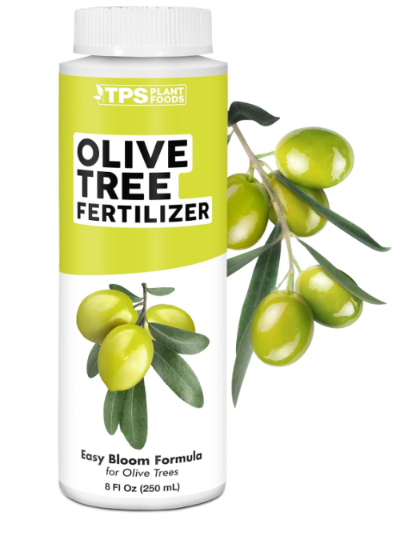
TPS NUTRIENTS Olive Tree Fertilizer – 8 oz Liquid Plant Food
Product Description
TPS NUTRIENTS makes a focused olive tree fertilizer that comes in an 8-ounce bottle. This is a liquid concentrate you mix with water before applying. The bottle is compact, easy to store, and lasts longer than you might expect because a little goes a long way.
The formula is specifically designed for olive trees. It’s not a generic all-purpose plant food that gets tweaked for olives. The nutrient ratios were built from the ground up with olive trees in mind.
Best Use Cases
This product shines when you have a single olive tree or a small collection. One bottle gives you plenty of applications. It works great for potted olive trees on patios or balconies. Apartment dwellers and small-space gardeners love it because you’re not storing a huge container.
It’s also ideal if you’re testing out fertilizer for the first time. You’re not committing to a year’s supply of something you’re unsure about. You can try it, see how your tree responds, and then decide if you want to stick with the brand.
Key Features Explained
The formula boosts bigger harvests by feeding the soil and the tree’s foliage. When you spray it on the leaves, trees absorb nutrients directly. When you water it into the ground, the roots grab it fast. This dual-action approach means your tree gets fed multiple ways.
The “stronger trees” part matters just as much as bigger harvests. A well-fed olive tree develops thicker branches, deeper roots, and better disease resistance. It handles stress better, whether that’s extreme heat, cold snaps, or dry spells.
Real-Life Usage Insight
People who use this fertilizer report visible improvements within two to three weeks. New leaves come in darker and fuller. The tree looks perkier and more vibrant. When you mix it according to the label and apply it every two to three weeks during the growing season, results show up consistently.
One thing users appreciate is that it doesn’t burn foliage even if you accidentally mix it too strong. This means you can be a little generous without worry. It also doesn’t create a weird smell or residue that bothers neighbors in shared spaces.
Honest Pros and Cons
Pros:
- Specifically formulated for olive trees, not a generic product
- Small bottle makes it perfect for apartment living or limited space
- Works on both indoor and outdoor trees
- Visible results within weeks
- Safe enough that mistakes don’t kill your tree
- Mixes easily without weird clumps
Cons:
- The 8-ounce size means more frequent reordering if you have multiple trees
- Smaller bottles cost more per ounce than bulk options
- You need to remember to dilute it correctly before applying
Performance Discussion
This fertilizer performs reliably. It doesn’t do anything flashy or promise overnight miracles, but it does exactly what it says. Your tree gets the nutrients it needs, shows visible improvements, and keeps growing stronger.
The performance is steady rather than dramatic. Some people get excited looking for a product that transforms their tree overnight, but olive trees are slow growers. This fertilizer keeps them on a healthy growth trajectory. Over months and seasons, that adds up to a genuinely improved tree.
Ease of Use
Mixing and applying takes about five minutes. You pour the concentrate into a watering can, add water to the marked level, stir, and water your tree. The label is clear, and the mixing instructions are foolproof. First-timers have no trouble figuring it out.
The bottle has a simple pour spout, not some fancy measured cap, but it works fine. You get the hang of how much to pour after one or two applications.
Value for Money
An 8-ounce bottle costs around $15-20, depending on where you buy it. Since one bottle makes multiple gallons of fertilizer, your cost per application comes down significantly. If you have one tree and apply fertilizer every two weeks for six months, you might use one to two bottles. That’s reasonable.
For a single tree owner, the value is solid. For someone with ten olive trees, the cost-per-tree creeps up, and bulk options might make more sense.
Bottom Line
TPS NUTRIENTS delivers what it promises. It’s a straightforward, no-fuss option that works. If you want a quality olive tree fertilizer and don’t need massive quantities, this is a solid choice.
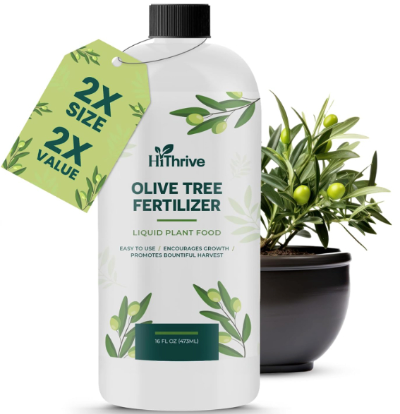
HiThrive 16oz Olive Tree Fertilizer – 2-in-1 Liquid Plant Food
Product Description
HiThrive comes in a 16-ounce bottle and makes 16 gallons of finished fertilizer. That’s the magic stat right here—one bottle goes incredibly far. It’s a concentrate you mix with water, and the yield is honestly impressive.
This is a 2-in-1 formula, meaning it addresses both macronutrients (nitrogen, phosphorus, potassium) and micronutrients (iron, magnesium, zinc, manganese, and more) in one bottle. You’re getting comprehensive nutrition without buying separate supplements.
Best Use Cases
HiThrive is perfect if you have multiple olive trees or plan to feed your trees regularly throughout the season. The 16-gallon yield means you’re not constantly reordering. It’s also great for people with garden space who water multiple plants and want an efficient system.
It works on potted trees and ground-planted trees equally well. Some growers use it for their main feeding and then use other products for supplemental care. It’s flexible enough to fit into different growing approaches.
Key Features Explained
Lush foliage development means your trees get thick, full leaves that capture maximum sunlight. These leaves are the food factory of your tree. More leaf area means more photosynthesis, which means more energy for the tree to grow and produce fruit.
Strong roots matter because they’re the foundation for everything else. They anchor the tree, absorb water and nutrients, and store energy for next season. A fertilizer that builds robust roots is building your tree’s future.
Bountiful harvests and plump fruits are where olives really matter. You don’t grow olive trees to admire the leaves—you want olives. This formula tilts toward supporting that goal. The nutrient mix encourages flowering and fruit development. The plumpness of the fruit means better yields per branch.
Real-Life Usage Insight
People who switch to HiThrive often stick with it because of the sheer convenience. Making 16 gallons from one bottle means less frequent trips to the store and less storage clutter. You make a batch, water multiple trees, and you’re done.
Users report that their trees respond well, especially to the micronutrient component. If you’ve had trees with yellowing leaves despite plenty of nitrogen, HiThrive’s micronutrient package often fixes that within weeks. The tree looks healthier, more vibrant, and more robust.
The 2-in-1 approach means you’re not juggling multiple bottles. One product handles the full nutrition picture. That simplicity appeals to busy growers.
Honest Pros and Cons
Pros:
- 16 gallons per bottle is incredible value
- Covers macronutrients and micronutrients in one product
- Makes large batches, reducing prep time
- Results are visible and consistent
- Works for various tree types and growing situations
- No frequent reordering headaches
Cons:
- The 16-ounce bottle is bigger to store
- Making large batches means you’re committed to using them
- If you only have one potted tree, you’re making way more fertilizer than you need
- Cost per application is lower, but upfront cost is higher
Performance Discussion
HiThrive performs excellently for most growers. The micronutrient inclusion is a real advantage because it prevents deficiency symptoms that often plague olive trees in certain soils. Trees that have struggled with yellowing or stunted growth often turn around on this formula.
The performance is balanced. It doesn’t overstimulate vegetative growth at the expense of fruit. It doesn’t push so hard on flowering that the tree exhausts itself. It keeps things in proportion, which is what olive trees need.
Ease of Use
Making a large batch is straightforward, but it requires a container. You’re mixing 16 ounces into enough water to create 16 gallons. That’s not difficult, but it’s more involved than single-gallon mixes. You need a bucket, a measuring cup, and about two minutes to set it up.
Once the batch is made, application is easy. You use your standard watering method with the prepared fertilizer.
Value for Money
HiThrive offers exceptional value because of the 16-gallon yield. Your cost per gallon of finished fertilizer is very low. If you have multiple trees or a regular feeding schedule, you’re saving money compared to smaller bottles.
For a single potted tree that you feed once a month, you’re overpaying per application because you’re making way more than you need. You’d be better off with a smaller option.
Bottom Line
HiThrive is the choice for efficiency and value. If you have multiple olive trees or commit to regular feeding, this product shines. It’s reliable, comprehensive, and economical.
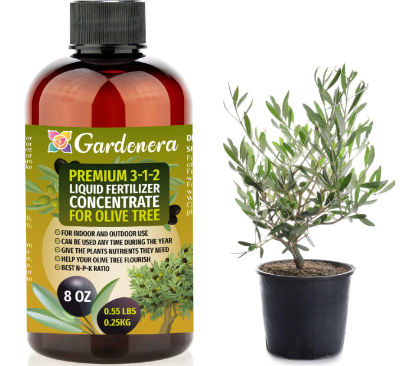
Gardenera Premium Liquid Olive Tree Plant Fertilizer – 3-1-2 Concentrate, 8oz
Product Description
Gardenera’s premium formula comes in an 8-ounce bottle with a specific NPK ratio of 3-1-2. This means it’s higher in nitrogen than phosphorus and potassium, which is an intentional choice designed to boost vegetative growth and foliage development first.
It’s labeled as organic plant food for olive trees, so if you’re gardening organically, this gives you a certified option. The formula is also suitable for indoor plants and flowers, making it versatile if you have a mixed collection.
Best Use Cases
This product is ideal if your olive tree is weak, has sparse foliage, or isn’t growing vigorously. The higher nitrogen ratio encourages leaf and branch development. If you’re trying to fill out a young tree or recover a stressed tree, this nutrient balance makes sense.
It’s also good for indoor olive trees that struggle with leggy growth or pale leaves. Indoor growing often means less light, and the extra nitrogen helps compensate by pushing more foliation.
The organic certification appeals to growers who want clean inputs and aren’t willing to compromise on chemical-free gardening. If that matters to you, Gardenera is the pick.
Key Features Explained
The 3-1-2 ratio is different from most olive fertilizers, which trend toward more balanced or phosphorus-heavy formulas. This specific ratio prioritizes growth. When your tree needs to bulk up and fill out, higher nitrogen makes sense.
The organic designation means the nutrients come from naturally derived sources, not synthesized chemicals. Organic growers believe this feeds the soil microbes and builds long-term soil health, not just the plant itself.
Real-Life Usage Insight
People using Gardenera report that their trees green up and grow noticeably faster. The extra nitrogen shows results quickly—usually within one to two weeks. Leaves get darker and fuller. New growth comes in at a faster pace.
Some growers report that using this as their primary fertilizer all season gives them bushier, more attractive trees. The trade-off is that fruit production might not be as heavy as with more balanced formulas. That’s the organic consequence of pushing nitrogen.
Honest Pros and Cons
Pros:
- Organic certification satisfies eco-conscious growers
- Higher nitrogen ratio stimulates growth fast
- Visible results within weeks
- Works for multiple plant types, so you can use it on other houseplants
- 8-ounce bottle is manageable to store
- Clean, natural ingredients
Cons:
- Higher nitrogen might reduce flower and fruit production if used all season
- Cost per ounce is higher than some bulk options
- Organic formulas sometimes work slower than synthetic alternatives
- The 3-1-2 ratio isn’t ideal if your goal is maximum fruit yield
Performance Discussion
Gardenera performs very well for vegetative growth. If you measure success by foliage production, color, and branch development, this is one of your best options. The organic ingredients deliver results without any harsh chemical feel.
If you measure success by fruit yield, this might not be your top pick. The nutrition balance supports green growth more than flowering and fruiting. Some growers use it for spring feeding to encourage growth, then switch to something more balanced later.
Ease of Use
Mixing and applying is just as easy as other liquid concentrates. You dilute, pour, and water. The label directions are clear, and there are no tricky steps.
Value for Money
An 8-ounce bottle runs about $15-18 for organic product. That’s mid-range pricing. You’re paying a premium for the organic certification, but if that matters to your growing philosophy, it’s worth it.
For cost-per-application on a single tree, the value is reasonable. For multiple trees, you might end up buying more bottles than you’d like.
Bottom Line
Gardenera is the organic choice that delivers growth. If you want natural inputs and aren’t primarily focused on fruit production, this is solid.
GARDENWISE Olive Tree Fertilizer – Multi-Purpose Fruit Tree Formula, 8 oz
Product Description
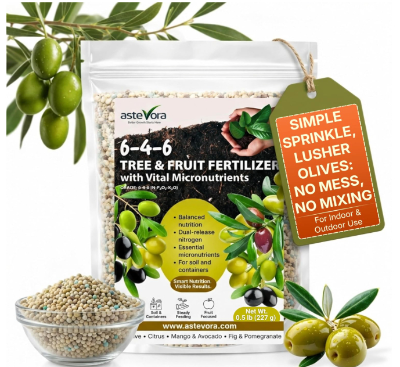
GARDENWISE makes a fruit tree fertilizer that works on olive trees, citrus, lemon, lime, fig, avocado, mango, apple, pomegranate, and more. This broad compatibility makes it useful if you have a mixed orchard or a variety of fruit trees.
It comes in an 8-ounce bottle and works on both potted and outdoor trees. The formula is a general fruit tree blend rather than olive-specific, but it’s designed with the needs of all these trees in mind.
Best Use Cases
GARDENWISE is perfect if you have multiple types of fruit trees and want one fertilizer for all of them. Buying separate products for each tree type gets expensive and complicated. One bottle handles everything.
It’s also good if you grow different fruit trees at different times or weren’t sure what you’d be growing when you started. The broad-spectrum approach means you’re never stuck with a specialist product that doesn’t apply to your situation.
For potted trees, the compatibility with container growing means you’re getting a formula that understands the constraints of pot life. Container trees can’t extend roots deep into rich soil, so the fertilizer addresses that limitation.
Key Features Explained
The multi-tree compatibility is the main story here. The nutrient ratio balances the needs of trees that might want slightly different things. Citrus loves potassium. Olive trees appreciate phosphorus. This formula finds middle ground that keeps all of them happy.
It’s designed for both potted and outdoor trees, which means it addresses the different challenges each environment presents. Potted trees lose nutrients faster through drainage. Outdoor trees face more variable weather. The formula works in both contexts.
Real-Life Usage Insight
People with mixed orchards love GARDENWISE because they’re not juggling five different bottles. They buy one product, and all their trees get fed. The results are solid across the board—nothing spectacular, but everything thrives.
Users report that the product is forgiving. If you forget to fertilize on schedule, your trees don’t seem to suffer badly. If you accidentally over-apply slightly, nothing crashes. It’s reliable and stable.
Honest Pros and Cons
Pros:
- Works on many different fruit tree types
- Simplifies your fertilizer routine if you have mixed plantings
- Forgiving if application isn’t perfect
- Works on both potted and outdoor trees
- 8-ounce bottle is easy to store
- Reasonable price for a multi-use product
Cons:
- It’s a compromise formula, not optimized for any single tree type
- If olives are your primary focus, a specialized olive formula might perform better
- It’s not specialized enough if you want maximum yields
- Broader compatibility sometimes means less impressive results for specific trees
Performance Discussion
GARDENWISE performs well as an all-around maintenance fertilizer. Your trees stay healthy, grow steadily, and produce fruit. It’s not the most exciting choice—it won’t transform a sad tree overnight—but it keeps things balanced and moving forward.
The performance is reliable and steady. If your goal is to maintain healthy trees with decent fruit production, you get that. If your goal is maximum performance and fruit yield, you might want something more specialized.
Ease of Use
Mixing and applying is straightforward. It’s a standard liquid concentrate with clear directions. No mystery or complexity.
Value for Money
At around $12-16 for an 8-ounce bottle, GARDENWISE is competitively priced. Your value gets better the more tree types you own. With five different fruit trees, you’re saving money compared to buying five specialized products.
With a single olive tree, you’re paying the same price as more specialized options, so the value proposition is less compelling.
Bottom Line
GARDENWISE is the practical choice for mixed fruit tree growers. It’s a no-fuss product that keeps everything healthy without being exceptional.
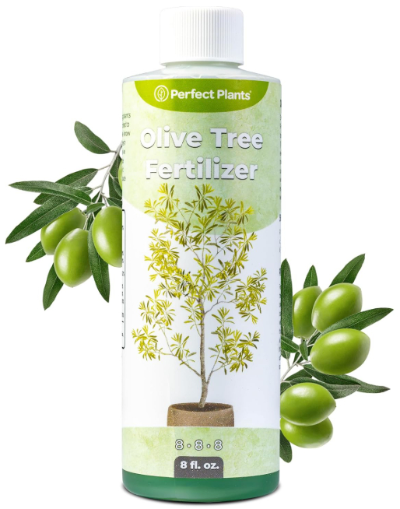
Perfect Plants Liquid Olive Tree Fertilizer – High Nutrient Content for Flowering & Fruit Production
Product Description
Perfect Plants makes a liquid olive tree fertilizer designed specifically to boost flowering and fruit production. This is a focused formula aimed at growers who prioritize yields. It’s suitable for both indoor and outdoor growing.
The high nutrient content claim is backed up by a formula tilted toward phosphorus and potassium, the two nutrients that drive flowering and fruit development. It’s not about growing bigger leaves—it’s about getting more olives on your tree.
Best Use Cases
This is your product if fruit production is your main goal. You’re not growing olives for the pretty foliage. You want to harvest. Perfect Plants understands that and built their formula accordingly.
It’s excellent for mature trees that have good structure and foliage. You’re not worried about growth anymore—you’re trying to maximize what the tree produces.
It also works well for trees that have established themselves. Younger trees might benefit from more balanced nutrition, but once a tree is established, tilting toward fruit production makes sense.
Key Features Explained
The high nutrient content means concentrated doses of the elements that drive yields. You’re getting phosphorus and potassium in proportions that say “make flowers, make fruit” to the tree.
The specific focus on flowering and fruit production is unusual in olive tree fertilizers. Many are balanced. Many emphasize growth. This one is unapologetic about its single-minded focus on yields.
Real-Life Usage Insight
Growers using Perfect Plants report impressive flower production. Olive trees treated with this product often bloom more heavily. More flowers means more potential fruit. The fruit that develops often looks plumper and higher quality.
People report that applying this fertilizer monthly during the growing season gives them noticeably better harvests compared to using general-purpose products. The difference isn’t subtle—it’s visible on the branch.
Honest Pros and Cons
Pros:
- Specifically designed to maximize flowering and fruit
- High nutrient concentration means visible results
- Clear focus on yield makes this the pick for production-minded growers
- Works for both indoor and outdoor trees
- Results show in the form of more and better fruit
- Matches the goal of most olive growers
Cons:
- It’s not ideal if you’re trying to encourage vegetative growth
- The high nutrient content means you need to follow directions precisely
- Too much application can cause nutrient burn in some cases
- If your tree isn’t yet established, too much flowering pressure might stress it
Performance Discussion
Perfect Plants performs excellently for its specific mission: making olive trees produce more fruit. The results are measurable. Trees that bloomed sparsely often bloom heavily. Fruit size and quality improve.
The performance assumes your tree is healthy and established. If you apply this to a young, weak tree, you might get disappointing results because the tree can’t support the flowering it’s being pushed to do.
Ease of Use
Mixing and applying is standard for liquid concentrates. The label is clear about how much to use and when to apply. Following the directions closely is important because the high nutrient content means mistakes matter more.
Value for Money
Perfect Plants typically costs around $14-20 for an 8-ounce bottle. The value is high if you actually get increased yields. Even a modest improvement in your olive harvest easily justifies the fertilizer cost.
For indoor potted trees where you’re not actually harvesting fruit, the value proposition is less compelling. You’re paying for fruit-boosting capacity you’re not using.
Bottom Line
Perfect Plants is the champion for fruit production. If yields matter to you, this is worth trying.
Product Comparison: Quick Reference Guide
| Feature | TPS NUTRIENTS | HiThrive | Gardenera | GARDENWISE | Perfect Plants |
|---|---|---|---|---|---|
| Bottle Size | 8 oz | 16 oz | 8 oz | 8 oz | 8 oz |
| Yield | Varies | 16 gallons | Varies | Varies | Varies |
| NPK Focus | Balanced | Balanced | High N (3-1-2) | Balanced | High P & K |
| Organic | No | No | Yes | No | No |
| Multi-Tree Use | Olive-specific | Olive-specific | General + Indoor | 7+ fruit types | Olive-specific |
| Best For | Single trees | Multiple trees | Growth + Organic | Mixed orchards | Maximum fruit |
| Price Range | $15-20 | $15-20 | $15-18 | $12-16 | $14-20 |
Complete Buying Guide: How to Choose the Right Fertilizer
Assess Your Growing Situation
Start by thinking about your actual olive tree setup. Are you growing a single potted tree on an apartment balcony? Do you have five established trees in the ground? Are you trying to recover a struggling tree or maintain a healthy one?
Your answer shapes which product makes sense. A single tree in a pot? TPS NUTRIENTS or Gardenera. Multiple trees? HiThrive shines. Mixed fruit trees? GARDENWISE saves money. Maximum yield focus? Perfect Plants.
Know Your Soil
If you don’t know your soil type, take a guess: sandy, clay, or loam? Sandy soils drain fast and lose nutrients quickly, so frequent feeding helps. Clay soils hold nutrients longer. Loamy soils are the goldilocks middle.
If your soil tends to be lacking and depleted, you might want something with comprehensive micronutrients like HiThrive. If your soil is rich and you just need balanced feeding, something simpler works.
Set Your Goal
Are you trying to grow a lush, healthy tree? Grow it faster? Maximize fruit production? Maintain it once established? Keep it organic?
Each goal points to different products. Growth-focused? Gardenera. Maintenance? GARDENWISE. Yield-focused? Perfect Plants.
Consider Your Budget and Commitment
Be honest about how much you’re willing to spend and how often you’ll fertilize. If you hate having to remember things, you need the most convenient option. If you’re a detail-oriented gardener, you’ll fertilize reliably.
Bigger bottles mean lower per-application cost but higher upfront cost. Smaller bottles cost more per use but require less commitment upfront.
Test Before Committing
If you’re unsure, buy the smallest bottle available and try it for one season. See how your tree responds. Notice if you like the results. Then decide if you want to continue or try something different.
One bottle is enough to test an approach without huge expense.
Who Should Buy Each Product?
TPS NUTRIENTS suits apartment dwellers, single-tree owners, and people trying a product for the first time. It’s also perfect if you prefer brands that stay focused on their specialty.
HiThrive is ideal for growers with multiple olive trees or those who commit to frequent feeding. It’s also great for people who value efficiency and want to minimize shopping trips.
Gardenera appeals to organic gardeners, people with mixed houseplants, and growers where foliage quality matters. It’s for the environmentally conscious.
GARDENWISE works for anyone with more than one fruit tree type. It’s the practical choice for diverse orchards. It appeals to growers who want simplicity.
Perfect Plants is for serious growers focused on yield. If your goal is a bountiful harvest, this is your product.
Common Mistakes to Avoid When Fertilizing Olive Trees
Using Too Much Fertilizer
More fertilizer doesn’t mean more growth. Olive trees prefer moderate, consistent feeding. Over-fertilizing causes salt buildup in soil, burns roots, and actually reduces growth. Follow the label. Seriously.
Ignoring Micronutrients
Nitrogen, phosphorus, and potassium get all the attention, but magnesium, iron, and zinc matter too. If your tree has yellowish leaves but plenty of nitrogen, a micronutrient deficiency is likely. HiThrive addresses this; some other products don’t.
Fertilizing Out of Season
Olive trees have growth cycles. Feeding them heavily in fall when they’re slowing down wastes fertilizer. Concentrate feeding on spring and early summer when growth happens. Fall and winter, go light.
Not Adjusting for Potted Trees
Potted trees lose nutrients through drainage much faster than ground trees. They often need more frequent feeding with lighter concentrations. What works for an outdoor olive tree might underfeed a potted one.
Ignoring pH
Olive trees prefer slightly alkaline to neutral soil (pH 7 to 8). If your soil is very acidic, even great fertilizer doesn’t help as well because the tree can’t absorb nutrients properly. Know your soil pH if possible.
Mixing Wrong Ratios
When you’re preparing concentrate, get the ratio right. Too weak and you’re basically feeding the tree nothing. Too strong and you risk burn. The label exists for a reason.
Using the Same Product All Year
Some growers benefit from switching products based on season. Heavy nitrogen in spring for growth, then shift to higher phosphorus and potassium in summer for flowering and fruit. You can rotate products seasonally.
Forgetting to Water Before Fertilizing
Applying fertilizer to dry soil can cause burn. Always water your tree first to moisten the soil, then apply fertilizer. This prevents shock and ensures even absorption.
Applying in Extreme Heat
If the temperature hits 90°F or above, skip fertilizing. The heat stress on the tree and the fertilizer salts together create an unfriendly environment. Wait for cooler weather.
How to Apply Olive Tree Fertilizer: Simple Steps
For Ground Trees
- Water your tree thoroughly to moist soil (not soggy)
- Mix concentrate with water according to label directions
- Pour the prepared fertilizer around the base of the tree
- Water again lightly to help distribute
- Do this every 2-3 weeks during the growing season
For Potted Trees
- Water the pot until water drains out the bottom
- Mix concentrate with water (sometimes use half-strength for pots)
- Pour the prepared fertilizer slowly into the pot
- Let it drain; don’t let water sit in the saucer
- Apply every 1-2 weeks during growing season (more frequent than ground trees)
For Foliar Feeding
- Mix concentrate very dilutely (half or less of soil feeding strength)
- Spray on both sides of leaves until they drip slightly
- Do this in early morning or evening, never in full sun
- The tree absorbs nutrients through the leaves
- Use this method once monthly as a supplement to soil feeding
Real Results: What to Expect
Timeline for Results
- Weeks 1-2: Subtle improvements in leaf color and appearance
- Weeks 3-4: New growth comes in noticeably fresher and fuller
- Weeks 5-8: Overall tree vigor increases, darker green color
- Months 2-3: Established improvement in growth pattern and flower production
- Months 3-6: You see real differences—more branches, more flowers, potentially better fruit
Don’t expect miracles in two weeks. Olive trees are steady growers. Good nutrition keeps them on a healthy trajectory. Over months, that adds up to genuine improvement.
Signs Your Tree is Responding Well
- Leaves get darker, more vibrant green
- New growth comes in at good pace
- Leaf size increases
- Branch thickness increases noticeably
- Flower production ramps up
- Fruit quality and size improve
Signs You Need to Adjust
- Leaves stay pale despite fertilizing
- Growth doesn’t speed up after 4-6 weeks
- Leaf edges brown (possible over-fertilizing)
- Yellowing between leaf veins (likely micronutrient issue)
- Tree looks the same or worse after a month
If things aren’t working, try a different product, adjust your frequency, or check if another issue (watering, light, pests) is the real problem.
Final Verdict: The Best Fertilizer for Different Situations
Best Overall for Most Growers: HiThrive Olive Tree Fertilizer
The 16-gallon yield is incredible value. The 2-in-1 formula handles all macro and micronutrients. It performs reliably for most growing situations. If you’re picking one product and don’t have extreme preferences, HiThrive wins.
Best for Single Trees: TPS NUTRIENTS Olive Tree Fertilizer
The 8-ounce bottle is perfect-sized for apartment living or a single tree. The quality is solid. You don’t over-buy.
Best for Organic Growers: Gardenera Premium Olive Tree Fertilizer
If organic certification matters and you value vegetative growth, Gardenera delivers clean inputs and real results.
Best for Multiple Fruit Types: GARDENWISE Fruit Tree Fertilizer
Simplifying your routine by using one product on all fruit trees saves money and sanity.
Best for Maximum Fruit Production: Perfect Plants Olive Tree Fertilizer
If yields are your obsession, the phosphorus and potassium emphasis of Perfect Plants aligns with your goal.
Wrapping Up: Your Olive Tree Feeding Journey
Growing olive trees successfully comes down to three things: light, water, and nutrients. You control nutrients through fertilizer. The right fertilizer makes the difference between a struggling tree and a thriving one.
The products in this roundup are all legitimate, quality options. They’re not gimmicks or overpromised miracle workers. They’re real fertilizers that work when you use them right.
Start by thinking about your situation. One tree or many? Potted or ground? Focused on growth, maintenance, or yield? Organic or conventional? Your answers point you toward the right product.
Then commit to a consistent schedule. Feed every 2-3 weeks during the growing season. Water before fertilizing. Follow the label directions. Give it time to work.
Within a few months, you’ll see your tree improve. The new growth will be stronger. The leaves will be greener. The tree will look happier and more robust.
That’s not magic. That’s just what happens when olive trees get the nutrition they need.
Pick your fertilizer, stick with your plan, and enjoy watching your olive trees thrive.
Quick Tips to Remember:
- Liquid concentrates are faster and more efficient than granules
- Always dilute according to label—stronger isn’t better
- Feed during active growing season; ease off in fall and winter
- Different products have different strengths—match the product to your goal
- Results take time—think seasons, not weeks
- Consistency beats perfection—regular moderate feeding beats occasional heavy feeding
- Water first, then fertilize, to prevent root burn
- Potted trees need more frequent feeding than ground trees
- Watch your tree’s response and adjust if needed
- One good season of solid nutrition builds your tree’s foundation for the next season
Growing olive trees is rewarding. Feed them right, and they’ll reward you with growth and fruit that makes all the effort worthwhile.
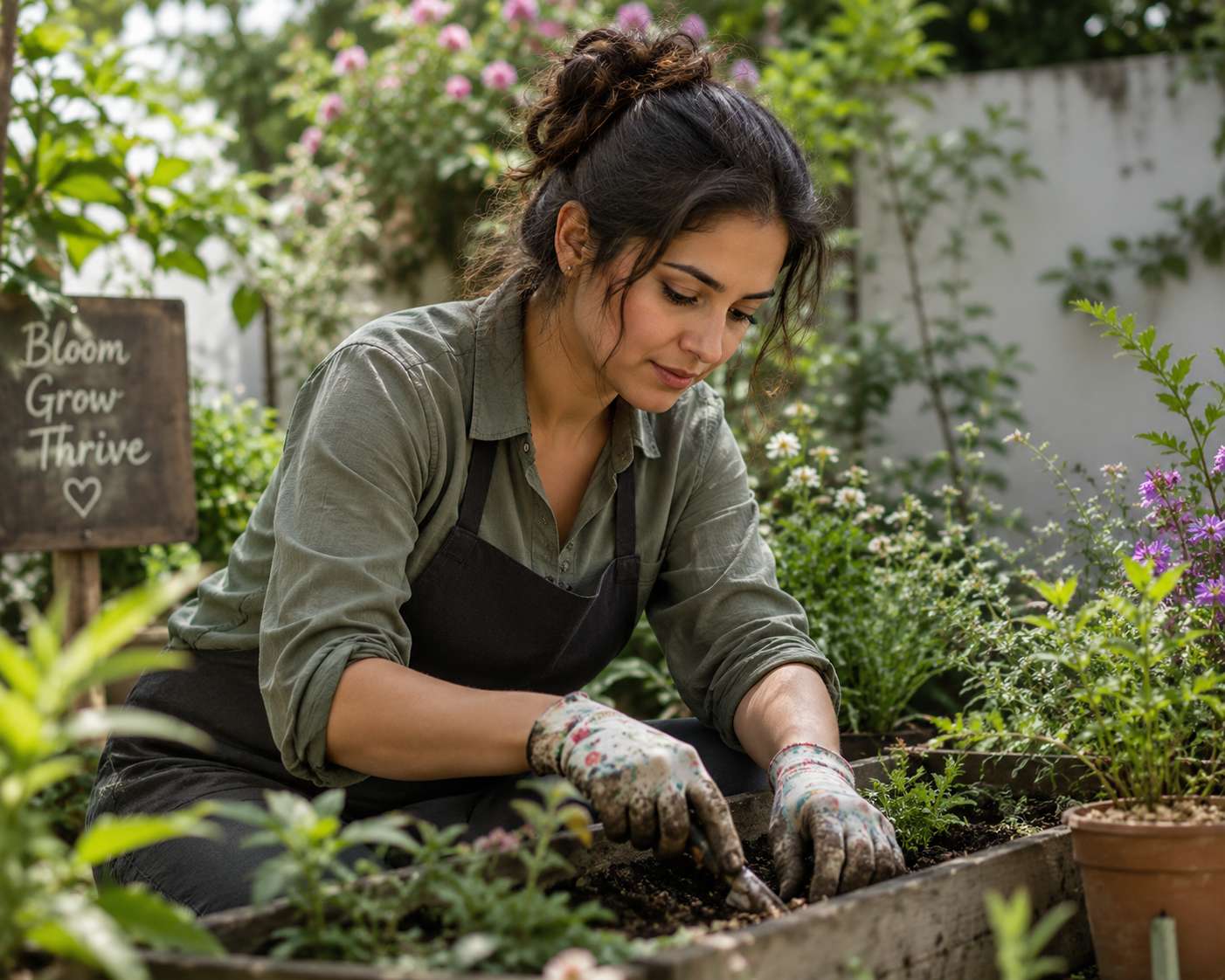
Hi, I’m Mary, the founder of GardenCure.com. I’m passionate about creating healthy, beautiful gardens and well-kept lawns. I share practical experience and trusted advice on garden and lawn gear that truly works. With the support of my dedicated research team, our writers produce honest, in-depth reviews using reliable, authentic sources—helping you choose the right tools with confidence for your outdoor space.