
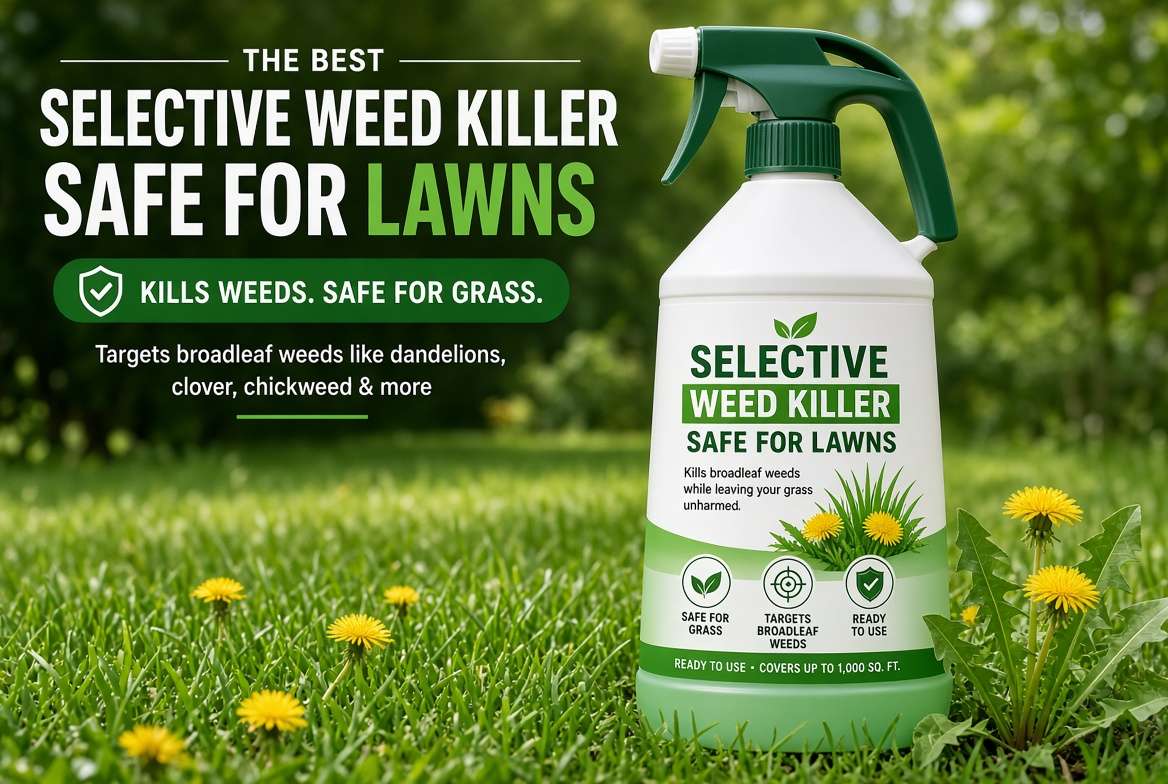
5 Best Weed Killer That Won’t Kill Grass In 2026
If your lawn looks more like a weed patch than a green carpet, you already know the struggle. You want the dandelions gone, the clover gone, and the crabgrass gone, but you don’t want to end up with brown patches where your grass used to be. That’s the tricky part. A lot of weed sprays are strong enough to wipe out everything they touch, grass included, if you’re not careful.
In this article
The good news is that there are herbicides made just for this job. They’re called “selective” weed killers, and they’re built to target broadleaf weeds while leaving turfgrass alone. In this roundup, I’m going to walk you through five of the most talked-about lawn weed killers on the market right now, break down how each one works, and help you figure out which one fits your yard, your budget, and your patience level.
I’ve dug into the labels, active ingredients, and real usage patterns for each product so you get a straight answer instead of marketing fluff. No hype, no exaggerated claims, just an honest look at what each product does well and where it falls short.
Let’s get into it.
Quick Comparison Table
| Product | Type | Active Ingredients | Best For |
|---|---|---|---|
| Ortho WeedClear with Comfort Wand | Ready-to-use, wand sprayer | 2,4-D, Quinclorac, Dicamba | Beginners, spot treatment |
| Spectracide Weed Stop Concentrate | Concentrate, mix with water | 2,4-D, Mecoprop-p, Dicamba, Sulfentrazone | Large lawns on a budget |
| Bonide Chickweed, Clover & Oxalis Killer | Ready-to-use spray | Triclopyr, MCPA, Dicamba | Tough, hard-to-kill weeds |
| Gordon’s SpeedZone | Concentrate, mix with water | 2,4-D, Mecoprop-p, Dicamba, Carfentrazone-ethyl | Fast results, stubborn weeds |
| Sunday Dandelion Doom | Ready-to-use spray | Iron HEDTA (chelated iron) | Pet owners, natural-leaning households |
Now let’s break each one down in detail.
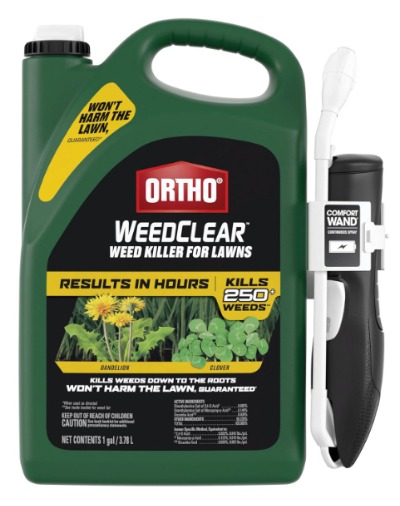
1. Ortho WeedClear Weed Killer for Lawns with Comfort Wand, 1 Gal.
Product Description
Ortho WeedClear is one of the most recognizable names in home weed control, and this version comes with the Comfort Wand attachment, a battery-powered sprayer that clicks onto the bottle so you don’t have to pump anything by hand. The formula uses a blend of 2,4-D, quinclorac, and dicamba, three active ingredients that work together to attack weeds through their leaves and travel down into the root system. Ortho says it handles over 250 types of common lawn weeds, including dandelion, clover, chickweed, poison ivy, and dollarweed.
Best Use Cases
This one shines for spot treatment. If you’ve got scattered weeds popping up across your yard rather than a full-blown weed takeover, the wand lets you walk around and zap each one without soaking your whole lawn. It’s also a solid pick for people who hate mixing chemicals and just want to grab a bottle and go.
Key Features Explained Simply
- Comfort Wand applicator: A battery-powered wand gives you a steady, continuous spray so your hand doesn’t get tired from squeezing a trigger over and over.
- Rainproof in about an hour: Once it dries, rain won’t wash the product away and ruin your work.
- Root-level kill: The active ingredients don’t just burn the leaves, they travel through the plant and kill the root too, so weeds are far less likely to grow back from the same spot.
- Safe grass list: It’s labeled safe for common lawn types like Kentucky bluegrass, tall fescue, ryegrass, bermudagrass, zoysiagrass, and buffalograss, though it’s not meant for Floratam St. Augustine grass.
Real-Life Usage Insight
Homeowners tend to reach for this one when they spot a handful of dandelions or clover patches scattered across the yard rather than a lawn overrun with weeds. Because it’s a spot treatment product, folks who try to spray their entire lawn with it often find themselves refilling the wand more than they expected. It works best when you treat it like a precision tool rather than a broadcast spray.
Pros
- No mixing required, just attach and spray
- Battery-powered wand saves your hand from cramping
- Works on a wide range of grass types
- Visible wilting often shows up within a day
Cons
- Meant for spot treatment only, not for covering an entire yard
- Batteries can die at inconvenient times
- Not safe for Floratam St. Augustine lawns
- Costs more per ounce compared to concentrates
Performance Discussion
For scattered broadleaf weeds, this product does what it says. The three active ingredients cover a lot of ground between them, catching weeds that a single-ingredient herbicide might miss. Results usually show up within a day or two, with full die-off in about one to two weeks. Tougher, deep-rooted weeds sometimes need a second round.
Ease of Use
This is about as simple as weed control gets. Pull the tab to activate the batteries, unfold the wand, and start spraying. There’s no measuring, no mixing bucket, and no cleanup afterward. It’s a great option if you’re new to lawn care and don’t want to deal with dilution ratios.
Value for Money
You’re paying a bit of a premium for the convenience of the wand system, and the 1-gallon bottle won’t stretch as far as a concentrate would on a big property. For small to medium yards with occasional weed problems, though, the time saved is worth the extra cost.
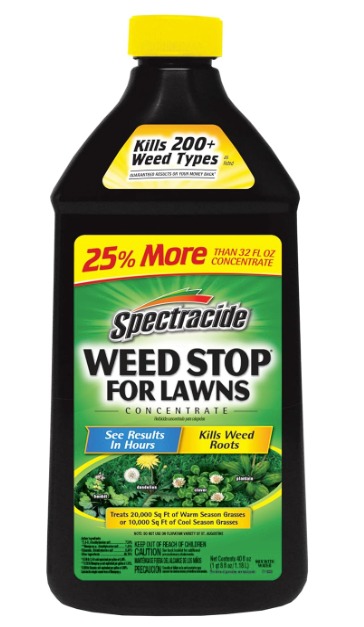
2. Spectracide Weed Stop for Lawns Concentrate, 40 Oz
Product Description
Spectracide Weed Stop is a concentrate, meaning you mix it with water in a sprayer before applying it. The formula contains four active ingredients: 2,4-D, mecoprop-p, dicamba, and sulfentrazone. That last one, sulfentrazone, is what gives this product an edge on some of the tougher, harder-to-kill broadleaf weeds compared to simpler three-way blends.
Best Use Cases
This is the go-to option if you’ve got a larger lawn and don’t want to burn through bottle after bottle of ready-to-use spray. Because it’s a concentrate, one bottle can treat a much bigger area once diluted, which makes it a smart pick for anyone managing more than a small patch of grass.
Key Features Explained Simply
- Four-way active ingredient blend: More active ingredients means a broader range of weeds get hit, including some stubborn ones like ground ivy and ate weeds resistant to basic 2,4-D-only sprays.
- Rainproof formula: Once it dries, a sudden rain shower won’t undo your work.
- Mix-and-spray setup: You dilute it into a pump sprayer or hose-end sprayer, giving you control over how much area you cover in one go.
- Grass-safe when used as directed: Labeled for common lawn types, so your turf stays intact while weeds take the hit.
Real-Life Usage Insight
Because this comes as a concentrate, folks who are used to ready-to-spray bottles sometimes underestimate how much water to add or forget to shake the mixture well before spraying. Reading the dilution chart on the label matters here, more than with any ready-to-use product on this list. Once mixed correctly, coverage is generous, and a single 40 oz bottle can treat a large stretch of lawn over multiple applications.
Pros
- Covers a lot more square footage per dollar than ready-to-use sprays
- Four active ingredients tackle a broader weed list
- Rainproof once dry
- Works on both northern and southern lawn types with the right dilution
Cons
- Requires mixing, which adds a step for beginners
- Needs a separate sprayer, which is an added cost if you don’t already own one
- Strong smell during and shortly after application
- Not for use above 90°F, or lawn injury can happen
Performance Discussion
This concentrate tends to work fast, with visible wilting on treated weeds often showing up within a day. The four-ingredient blend gives it an advantage against weeds that shrug off simpler formulas. It’s not a miracle worker on the toughest perennial weeds like ground ivy that’s had years to establish, but for most common lawn invaders, it gets the job done in one to two applications.
Ease of Use
There’s a small learning curve here since you need a sprayer and have to measure the concentrate correctly. Once you’ve done it once or twice, though, the process becomes routine. The label includes a clear mixing chart, so it’s not complicated, just an extra step compared to grab-and-spray products.
Value for Money
Ounce for ounce, this is one of the more budget-friendly options on this list, especially if you’re treating a decent-sized lawn. The upfront cost of a sprayer evens out over time since you’ll reuse it for future treatments.
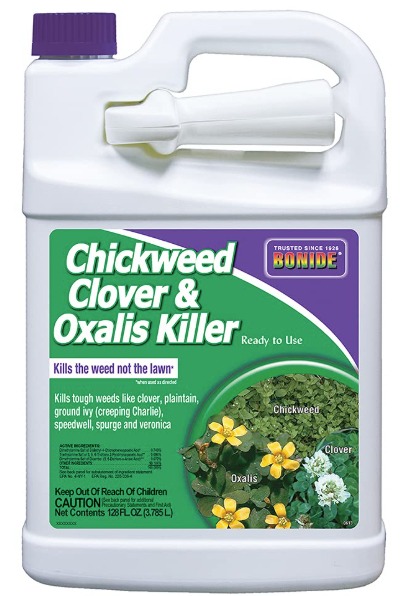
3. Bonide Chickweed, Clover & Oxalis Killer, 128 Oz Ready-to-Use Spray
Product Description
Bonide’s formula is built around what the brand calls “Horsepower,” a combination of triclopyr, MCPA, and dicamba. This trio is known for handling weeds that other blends tend to struggle with, especially chickweed, clover, oxalis, ground ivy, and wild violet. It comes in a large 128 oz ready-to-use bottle with a trigger sprayer, so there’s no mixing involved despite the bigger size.
Best Use Cases
If your lawn’s main problem is one of those notoriously stubborn weeds, chickweed that spreads like a carpet, clover that keeps coming back, or oxalis that laughs off basic sprays, this product is worth a look. It’s also a strong pick if you want a large ready-to-use bottle without dealing with concentrate math.
Key Features Explained Simply
- Triclopyr-based formula: Triclopyr is particularly good against woody and broadleaf weeds that resist standard 2,4-D sprays.
- Systemic action: The product moves through the plant down to the root, not just burning the surface leaves.
- Large ready-to-use size: At 128 oz, you get a lot of product without needing to mix anything.
- Blue marker dye option: Some versions include a non-staining dye so you can see exactly where you’ve already sprayed, which helps avoid missed spots or double treatment.
Real-Life Usage Insight
People dealing with a clover invasion or a chickweed carpet tend to report the most satisfaction with this one, since it’s specifically formulated with those weeds in mind. Because it’s a big bottle, it’s tempting to spray heavily, but the label recommends treating only the weeds themselves rather than blanket-spraying the whole lawn, since overuse can stress your grass even with a selective formula.
Pros
- Handles notoriously tough weeds like chickweed, oxalis, and ground ivy well
- Large 128 oz size means fewer refills for bigger properties
- No mixing needed despite the large volume
- Starts working overnight in many cases
Cons
- Heavier bottle can be a bit awkward to carry around the yard
- Best results need a day or two without mowing before and after spraying
- Not recommended for use in California due to regional restrictions
- Trigger sprayer can fatigue your hand over a big area compared to a wand
Performance Discussion
This formula tends to perform especially well on weeds that other three-way blends only partially knock back. Triclopyr gives it a real advantage on ground ivy and similar creeping weeds. Full die-off usually takes a few days to a week, and the label notes it starts working overnight in many cases, with rainproof protection kicking in within hours of drying.
Ease of Use
Since it’s ready-to-use, there’s no mixing at all, just shake and spray. The trigger sprayer is straightforward, though covering a large area by hand can get tiring compared to a continuous-spray wand. Still, for most homeowners treating patches rather than acres, it’s an easy product to work with.
Value for Money
The 128 oz size gives you a lot of product for the price, and since it’s ready-to-use, you’re not paying extra for a separate sprayer. For anyone battling specific stubborn weeds, the targeted formula makes the value even better since you’re less likely to need repeat purchases.
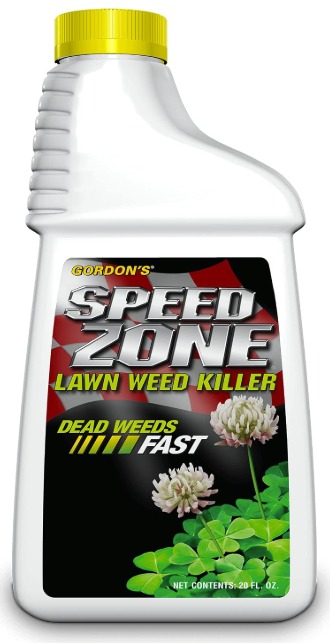
4. Gordon’s SpeedZone Lawn Weed Killer, 20 Ounces, 652400
Product Description
SpeedZone earns its name honestly. This concentrate blends four active ingredients, 2,4-D, mecoprop-p, dicamba, and carfentrazone-ethyl, and that last ingredient is the real standout. Carfentrazone-ethyl is a fast-acting compound that causes visible browning and wilting on treated weeds within hours, way faster than most standard weed killers that take a day or two to show anything.
Best Use Cases
This is the pick for people who want to see results fast, and for lawns dealing with a wide mix of over 100 different broadleaf weeds, including wild violet, clover, garlic, and poison ivy. It’s also popular for cooler weather applications since it stays effective even when temperatures start dropping in fall.
Key Features Explained Simply
- Carfentrazone-ethyl for speed: This ingredient causes rapid cell damage in weeds, so you’ll notice browning within a day of spraying.
- Four-way blend: Combining four active ingredients means broader coverage across different weed species.
- Rainfast quickly: Becomes rainproof in a matter of hours after application dries.
- Works across turf types: Labeled for both cool-season grasses like Kentucky bluegrass and tall fescue, and warm-season types like bermuda and zoysia.
Real-Life Usage Insight
People tend to describe this one as strong, sometimes even calling it “hot” because of how fast it acts and how potent the mix is. That strength is exactly why careful mixing matters here more than with milder products. Overdoing the concentration or spraying too close to flower beds and ornamental plants can lead to drift damage, since the same fast action that kills weeds quickly can also stress nearby plants if it drifts onto them.
Pros
- Visible results often within 24 hours, faster than most competitors
- Effective on a long list of broadleaf weeds, including some tougher ones
- Works on both cool-season and warm-season turf
- Small bottle covers a large area once diluted
Cons
- Strong formula means you need to be precise with mixing and application
- Higher risk of drift damage to nearby flowers or shrubs if you’re not careful
- Not the best choice for beginners nervous about handling concentrates
- Some regional shipping restrictions apply
Performance Discussion
If speed is what you care about, this is the strongest performer on this list. The carfentrazone-ethyl component means you’ll see weeds curling and browning noticeably faster than with a standard 2,4-D blend. Complete kill usually lands somewhere between one and two weeks, similar to other four-way blends, but the early visible damage gives a satisfying sense that it’s actually working, which some homeowners find reassuring.
Ease of Use
This one does require mixing with water in a pump or hose-end sprayer, and because the concentrate is potent, following the exact dilution ratio really matters. It’s not a difficult process once you’ve read the label, but it’s not as beginner-friendly as a ready-to-use bottle.
Value for Money
A little goes a long way here since the concentrate is strong, so the 20 oz bottle can treat a surprisingly large area across multiple applications. For anyone comfortable mixing their own spray, this offers strong value thanks to how far it stretches.
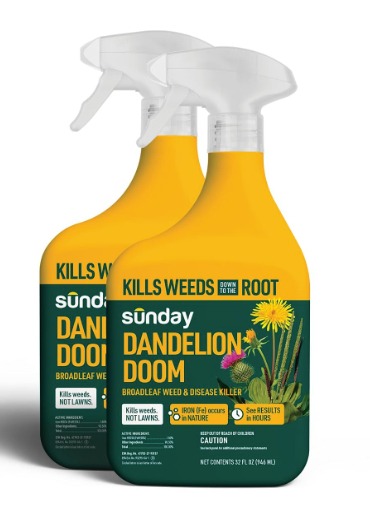
5. Sunday Dandelion Doom, Iron-Based Weed & Moss Killer, 32 Oz 2-Pack
Product Description
Sunday’s Dandelion Doom takes a different approach entirely. Instead of synthetic herbicides like 2,4-D or dicamba, it uses chelated iron, specifically Iron HEDTA, as its active ingredient. Iron is absorbed quickly by broadleaf weeds and moss, overwhelming their cells and causing them to dry out and die, while grass absorbs iron more slowly and actually benefits from it, often turning a deeper green as a side effect.
Best Use Cases
This one is a strong fit for households with pets or kids who spend a lot of time on the lawn, since iron-based herbicides are generally viewed as gentler than synthetic chemical blends. It also doubles as a moss killer, which makes it useful for shady, damp areas of the yard where moss tends to creep in alongside weeds.
Key Features Explained Simply
- Iron HEDTA active ingredient: A chelated iron compound that weeds absorb rapidly, unlike grass, which takes it in slowly and greens up instead of dying.
- Also kills moss and algae: Beyond typical broadleaf weeds, it tackles moss and algae growth too, and even helps suppress lawn diseases like dollar spot and rust.
- Fast visible results: Wilting can show up within hours of spraying on a sunny day.
- Rainfast in about 3 hours: Quicker turnaround than many synthetic competitors before rain becomes a non-issue.
Real-Life Usage Insight
People who’ve dealt with moss creeping into shaded, damp corners of their lawn tend to appreciate that this product handles both weeds and moss in one bottle. Because it’s iron-based, it can leave orange or rust-colored stains on concrete, pavers, or sidewalks if it drips or drifts onto hard surfaces, so it’s smart to spray carefully near paths and patios and rinse any spills right away.
Pros
- Gentler ingredient profile that appeals to pet and family-friendly households
- Doubles as a moss and algae killer, not just a weed spray
- Fast visible wilting, often within hours on a sunny day
- Greens up grass as a bonus effect instead of stressing it
Cons
- Can stain concrete, pavers, and other hard surfaces if it drips
- Best performance depends on sunny conditions, cloudy days slow it down
- Covers a smaller area per bottle compared to concentrates
- May need repeat applications on well-established, deep-rooted weeds
Performance Discussion
Iron-based herbicides work differently than synthetic ones, and Dandelion Doom holds up its end well on common lawn weeds like dandelion, clover, and chickweed, along with moss. It tends to work fastest in direct sun, since sunlight speeds up how quickly the iron oxidizes weed tissue. Shaded spots take longer to show results. It’s not quite as aggressive on truly stubborn, deep-rooted perennial weeds as some of the four-way synthetic blends on this list, but for common lawn weeds and moss, it performs reliably.
Ease of Use
This is a no-mixing, ready-to-use spray with an adjustable nozzle, so it’s genuinely simple to use straight out of the bottle. The 2-pack format means you get backup product without running out mid-project.
Value for Money
You’re paying a bit more per square foot of coverage compared to concentrates, but the trade-off is a gentler formula and the bonus of moss control. For smaller lawns or targeted spot treatment, especially in households prioritizing a lighter chemical footprint, it’s a fair deal.
Comparison Insights
Looking at all five side by side, a few patterns stand out.
Speed of results: Gordon’s SpeedZone and Sunday Dandelion Doom both tend to show visible changes the fastest, though for different reasons. SpeedZone uses carfentrazone-ethyl for rapid cell damage, while Dandelion Doom relies on iron oxidation that speeds up in sunlight.
Ease of application: Ortho WeedClear and Sunday Dandelion Doom are both ready-to-use with zero mixing, making them the friendliest for beginners. Spectracide and SpeedZone require dilution and a separate sprayer, which adds a step but usually saves money per square foot.
Toughness on stubborn weeds: Bonide’s triclopyr-based formula and SpeedZone’s four-way blend tend to outperform on notoriously hard-to-kill weeds like ground ivy, chickweed, and wild violet.
Coverage and value: Concentrates like Spectracide and SpeedZone stretch further per dollar once diluted, while ready-to-use products like Ortho, Bonide, and Sunday cost more per square foot but save time and hassle.
Ingredient approach: Four of the five products use synthetic herbicides such as 2,4-D, dicamba, mecoprop-p, triclopyr, or carfentrazone-ethyl. Sunday Dandelion Doom stands apart with its iron-based formula, appealing to anyone who wants a gentler option.
Buying Guide: What to Look for in a Grass-Safe Weed Killer
Check the Grass Type List
Not every product is safe on every lawn. Some formulas warn against certain grasses, like Floratam St. Augustine, because those grass types are more sensitive to specific herbicides. Always match the product label to your actual lawn type before spraying anything.
Decide Between Concentrate and Ready-to-Use
Concentrates cost less per square foot but need mixing and a sprayer. Ready-to-use bottles cost more per ounce but save time and skip the guesswork. If you’ve got a large yard, concentrates usually make more financial sense. For smaller yards or occasional spot treatment, ready-to-use is often worth the extra cost.
Look at the Active Ingredients
- 2,4-D: A classic, widely used broadleaf herbicide, generally effective but sometimes needs a second application on tougher weeds.
- Dicamba: Often paired with 2,4-D for broader coverage.
- Mecoprop-p: Adds extra punch against clover and other creeping weeds.
- Triclopyr: Strong against woody and hard-to-kill broadleaf weeds.
- Carfentrazone-ethyl: Known for speeding up visible results.
- Iron HEDTA: A gentler, non-synthetic option that also handles moss.
Think About Application Method
Wands and battery sprayers are easiest on your hands and great for spot treatment. Trigger sprayers work fine for smaller areas but can tire you out over a big yard. Hose-end or pump sprayers, used with concentrates, cover the most ground with the least physical effort per square foot.
Consider Temperature and Timing
Most of these products work best when applied to actively growing weeds, generally in temperatures between 45°F and 90°F. Spraying above 90°F risks lawn damage, and spraying in cold, dormant conditions often means weaker results since the weeds aren’t actively absorbing anything.
Who Should Buy These Products
New homeowners or lawn care beginners: Ready-to-use options like Ortho WeedClear or Sunday Dandelion Doom remove the guesswork, since there’s no mixing involved.
People with large lawns: Concentrates like Spectracide Weed Stop or Gordon’s SpeedZone stretch your budget much further once diluted properly.
Anyone battling stubborn, established weeds: Bonide’s triclopyr blend or SpeedZone’s four-way mix are built to knock down weeds that shrug off basic sprays.
Pet owners and families who spend a lot of time outdoors: Sunday Dandelion Doom’s iron-based formula tends to feel like a safer middle ground while still getting the job done.
Anyone dealing with moss alongside weeds: Sunday Dandelion Doom covers both problems in a single bottle, saving you from buying a separate moss killer.
Common Mistakes to Avoid
Spraying on a windy day. Drift can carry herbicide onto flower beds, vegetable gardens, or your neighbor’s yard, causing damage you didn’t intend.
Mowing too soon before or after spraying. Most labels recommend waiting a day or two on either side of mowing so the leaves have enough surface area to absorb the product.
Ignoring the temperature range. Spraying above 90°F can stress or damage your grass, and spraying in cold weather often means the weeds barely respond since they’re not actively growing.
Overdosing the concentrate. More product doesn’t mean better results. Overly strong mixes can stress your lawn and, in some cases, still fail to fully kill deep-rooted weeds.
Skipping the label’s grass compatibility section. Some formulas aren’t safe on certain grass types, and this is the single most common cause of accidental lawn damage.
Expecting instant, permanent results from one application. Many established weeds, especially ones with deep taproots, need a second treatment two to three weeks later to fully finish the job.
Watering right after spraying. Doing this before the rainproof window has passed can wash away the product before it has a chance to work.
Final Verdict
All five of these products do what they promise: they knock out weeds without taking your grass down with them, as long as you follow the label. Which one comes out on top really depends on your situation.
If you want the simplest, most beginner-friendly option, Ortho WeedClear with Comfort Wand is hard to beat for spot treatment convenience. If you’re working with a bigger lawn and want to stretch your dollar, Spectracide Weed Stop Concentrate gives you strong coverage at a lower cost per square foot. For truly stubborn weeds like chickweed, oxalis, and ground ivy, Bonide Chickweed, Clover & Oxalis Killer brings a formula built specifically for that fight. If speed matters most to you and you don’t mind mixing a concentrate, Gordon’s SpeedZone shows results faster than almost anything else on this list. And if you’d rather lean toward a gentler, iron-based approach that also handles moss, Sunday Dandelion Doom is a solid, family-friendly pick.
There’s no single “best” answer here, only the best fit for your lawn, your weed problem, and how hands-on you want the process to be. Read the label, match the product to your grass type, apply it under the right conditions, and any one of these five will help you get your lawn back without losing the grass along the way.

Hi, I’m Mary, the founder of GardenCure.com. I’m passionate about creating healthy, beautiful gardens and well-kept lawns. I share practical experience and trusted advice on garden and lawn gear that truly works. With the support of my dedicated research team, our writers produce honest, in-depth reviews using reliable, authentic sources—helping you choose the right tools with confidence for your outdoor space.

One Comment