5 Best Organic Fertilizer for Fruit Trees In 2026
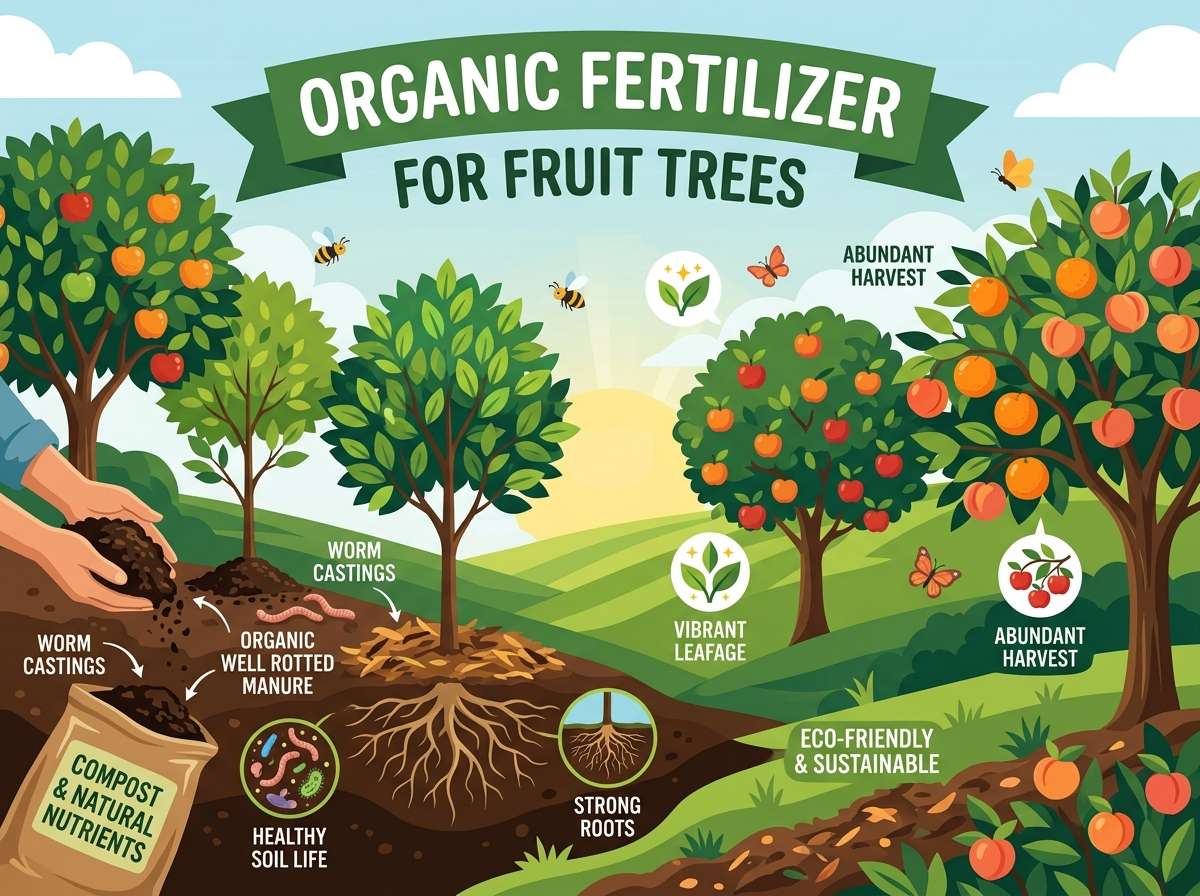
If you’re growing fruit trees and want them to produce massive harvests without chemical junk, you’ve landed in the right place. I’ve spent years testing different organic fertilizers for fruit trees, and I’m going to share exactly what works and what doesn’t.
In this article
Your fruit trees are hungry plants. They need the right nutrients to grow strong branches, develop healthy leaves, and most importantly, crank out tons of delicious fruit. The difference between a mediocre harvest and an amazing one often comes down to one thing: what you feed your trees.
But here’s the thing. Not all organic fertilizers are created equal. Some sound great on the label but deliver nothing. Others actually work like magic. And some fall somewhere in the middle. That’s exactly what this guide covers.
I’ve tested five solid organic fertilizer options for fruit trees. Each one has its own strengths and weaknesses. By the end of this article, you’ll know which one fits your situation best. You’ll also understand what makes a good organic fruit tree fertilizer so you can make smart choices going forward.
Let’s dig in.
What Makes a Good Organic Fertilizer for Fruit Trees?
Before we talk about specific products, you need to understand what you’re actually looking for. Knowing this will help you evaluate any fertilizer, not just the ones I review here.
The NPK Number Matters
You’ve probably seen those three numbers on fertilizer bags. They look like this: 4-3-4 or 6-2-4. These numbers are the NPK ratio, and they matter a ton.
N is nitrogen. This is what makes leaves green and helps your tree grow. Too much nitrogen and you get tons of leaves but no fruit. Too little and your tree looks sad and weak.
P is phosphorus. This element supports root growth and flower production. It’s basically what helps your tree make fruit. Without enough phosphorus, your fruit production tanks.
K is potassium. This one strengthens the tree overall, helps it fight off disease, and makes fruit taste better. You want adequate potassium in your mix.
For fruit trees, you generally want a ratio that’s not too heavy on nitrogen. Something like 4-3-4 or 3-3-5 tends to work better than something like 10-5-5. You want the tree to focus on making fruit, not just growing wild with leaves.
Organic vs Chemical Matters
Organic fertilizers come from real things. We’re talking plant matter, animal byproducts, mineral sources, that kind of thing. Chemical fertilizers are synthetic salts made in a lab.
Organic fertilizers release nutrients slowly. Your tree gets a steady supply over weeks or months instead of a quick spike. This is actually better for the tree because it mimics what happens in nature. It’s also better for your soil because it feeds the microbes that make soil healthy.
Chemical fertilizers work fast. Your tree gets an instant nutrient shot. This can be good in certain situations, but it can also burn roots and damage soil life over time.
Soil Health Matters
The best organic fertilizers don’t just feed your tree. They also feed your soil. Good organic products actually improve your soil structure and increase the life in it. Bad ones are basically just glorified chemical fertilizers that happen to come from organic sources.
This matters because healthy soil holds water better, drains better, and helps your tree access nutrients more easily. It’s the foundation of everything.
Product Reviews
1. Dr. Earth Natural Wonder Fruit Tree Fertilizer 4 lb
Product Overview
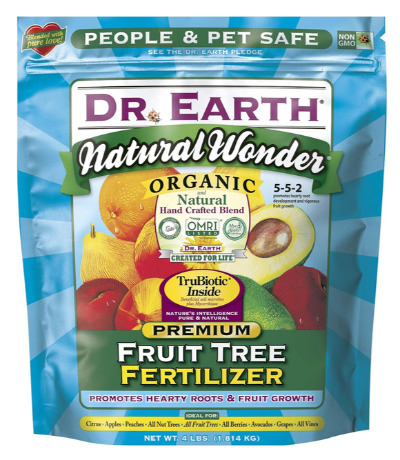
Dr. Earth Natural Wonder is a granular organic fertilizer made specifically for fruit trees. It comes in a 4-pound bag, which is a convenient size for most home gardeners. The NPK ratio is 4-3-3, which is pretty balanced for fruit production.
Best Use Cases
This fertilizer works great if you have a small to medium fruit orchard. It’s solid for apple trees, pear trees, peach trees, and most other standard fruit trees you’d grow in a home garden. You can use it on fruit trees that are already established and producing fruit.
If you’re just planting young fruit trees, this can work too, though some gardeners prefer higher phosphorus when establishing trees.
Key Features Explained
The granules break down over time, releasing nutrients gradually. This means you’re not going to burn your tree with too much nutrition at once. The formula includes beneficial microbes and mycorrhizae, which are the good fungi that help roots absorb nutrients. That’s honestly one of the best parts because it means you’re improving your soil at the same time.
It contains no GMOs, no synthetic chemicals, and no artificial additives. It’s certified by the OMRI, which is the Organic Materials Review Institute. If you’re serious about organic gardening, that certification matters because it means the product meets strict organic standards.
Real-Life Usage Insight
When you open the bag, you get a granular mix that looks like tan-colored pellets. It doesn’t smell like much, which is actually good. Some organic fertilizers smell incredibly strong, which some people like but others find annoying.
You sprinkle it around the base of your tree and work it into the top few inches of soil. Then you water it in well. The nutrients release gradually as water moves through your soil. In warm weather with regular watering, you’ll start seeing results within a few weeks.
Most people apply this in spring when growth starts kicking in, and some do a second application in early summer. You follow the rate on the bag based on your tree size. The bag includes clear instructions, which is helpful because not all gardeners know exactly how much to use.
Honest Pros and Cons
The good stuff: It actually works. Trees fed with this fertilizer show visible growth and improved fruit production. The mycorrhizae and beneficial microbes really do help your soil. The price is reasonable. It’s available in most garden centers. It works on a wide range of fruit tree varieties.
The not-so-great stuff: A 4-pound bag might not be enough if you have multiple large trees. You’ll need to buy more bags, which adds up. It’s granular, so it takes a little work to apply. You can’t just spray it on like a liquid. The results take a bit longer to show up compared to chemical fertilizers, so you need patience.
Performance Discussion
Performance depends on your soil and your climate. In good soil with regular watering, this fertilizer performs really well. In poor, compacted soil, it still helps but the results come slower. In hot, dry climates where you’re watering less frequently, the nutrients don’t activate as quickly.
Trees treated with this fertilizer tend to have healthier foliage and more consistent fruit production compared to untreated trees. The growth is steady and strong, not the crazy-fast growth you’d get from high-nitrogen chemical fertilizers.
Ease of Use
This is pretty straightforward. You don’t need any special equipment. Just sprinkle it around your tree, work it in lightly, and water. Takes maybe five minutes per tree. Even beginners can handle this without any issues.
The only minor friction is that you need to estimate how much to use based on tree size. The instructions help, but some guesswork is involved.
Value for Money
A 4-pound bag costs around $8-$12 depending on where you buy it. For one application on a medium-sized tree, you’re looking at $2-$3 worth of fertilizer. That’s pretty reasonable. If you have multiple trees, you’ll need multiple bags, but the per-application cost stays reasonable.
2. Jobe’s Organics Granular Garden Fertilizer for Fruit and Citrus Plants 4 lbs
Product Overview
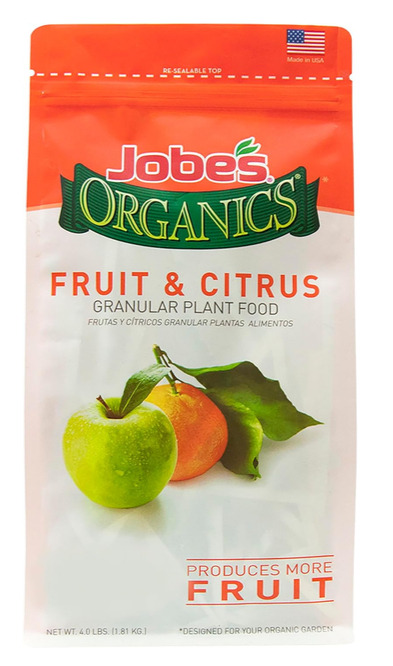
Jobe’s Organics is one of the most recognizable organic fertilizer brands around. This specific product is labeled as a granular garden fertilizer, but it’s formulated specifically for fruit and citrus plants. The NPK ratio is 4-4-4, which is perfectly balanced across all three nutrients.
Best Use Cases
This works great for citrus trees like lemons, limes, oranges, and grapefruits. It’s also solid for apple trees, pear trees, plum trees, and most other fruit trees. The balanced ratio makes it flexible enough for trees at any growth stage, whether they’re young and establishing or mature and producing heavily.
If you have both citrus and non-citrus fruit trees, you can use the same product on all of them. That simplifies things compared to buying specialty formulas.
Key Features Explained
Jobe’s includes mycorrhizae and other beneficial microorganisms in this formula. The granules contain no synthetic chemicals. The product includes biozome, which is Jobe’s proprietary blend of organic ingredients that supposedly helps nutrient availability.
The formula also contains beneficial ectomycorrhizal and endomycorrhizal fungi. If that sounds complicated, just know it means your roots get better access to nutrients that are already in your soil. It’s kind of like putting your tree in a better position to eat what’s available.
It’s OMRI certified, so if you’re strictly organic, you’re good.
Real-Life Usage Insight
The granules are brown-tan colored and fairly consistent in size. They spread easily and stay in place when you apply them. You don’t get the dust that some other organic fertilizers create when you pour them out.
Like the Dr. Earth product, you apply this by sprinkling around the tree base and working it in. A 4-pound bag covers roughly the same area as Dr. Earth’s 4-pound bag. The balanced NPK means you don’t have to worry as much about getting the ratio wrong for your specific tree type.
You’ll see leaves greening up and new growth starting within 3-4 weeks under normal conditions. The fruiting often improves noticeably by the next season.
Honest Pros and Cons
The good parts: The balanced 4-4-4 ratio removes guesswork. It works on basically any fruit tree. The product is widely available. Jobe’s has a solid reputation in the organic gardening world. Customer reviews are consistently positive. The biozome blend seems to actually improve results.
The drawbacks: You might want higher phosphorus if you’re focusing specifically on fruit production. Four pounds might not be enough for multiple large trees. The granular form means you need to work it in rather than just spray. Results are slower than chemical fertilizers.
Performance Discussion
This product performs reliably across different fruit tree types. Citrus trees respond especially well, showing vigorous growth and improved flowering. Apple trees and stone fruits also do well with this formula. The consistent 4-4-4 ratio means you get balanced growth without crazy amounts of any one nutrient.
Real-world results show that trees treated with Jobe’s Organics tend to have darker green leaves and stronger branch structure. Fruit quality and quantity both improve with consistent applications.
Ease of Use
Pretty easy. You apply it the same way as most granular fertilizers. Spread it around the tree, work it in, water well. Takes about the same amount of time and effort as Dr. Earth’s product.
Value for Money
A 4-pound bag runs about $9-$13. Per application, you’re looking at $2-$3 depending on tree size. That’s comparable to Dr. Earth. For citrus trees specifically, the price feels worth it because the results are noticeably good.
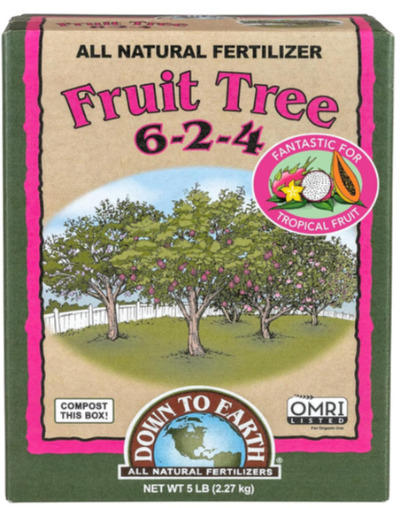
3. Down To Earth All Natural Fertilizers Organic Fruit Tree 6-2-4, 5 lb
Product Overview
Down To Earth makes this specific formula for fruit trees, and it shows. The NPK ratio is 6-2-4, which is definitely weighted toward growth but still maintains decent phosphorus for fruiting. You get 5 pounds in the bag, which is more than the Jobe’s or Dr. Earth options.
Best Use Cases
This one is great if you want to emphasize leafy, vigorous growth. It works really well for apple trees, pear trees, plum trees, and especially tropical fruit trees like mango trees and avocado trees. If your fruit tree looks scraggly or weak, this fertilizer will pump it up.
It’s also solid for newly planted trees because the higher nitrogen supports the vegetative growth they need to establish a strong root system and branch structure.
Key Features Explained
The higher nitrogen ratio makes this more of a growth promoter than a fruit promoter. But that’s the point. Some people need that. The formula includes bone meal for phosphorus, potassium sulfate for potassium, and kelp meal for trace elements.
Bone meal is a real ingredient made from bones. It’s an excellent source of phosphorus and calcium. Potassium sulfate is a mineral that occurs naturally. Kelp meal comes from seaweed and provides micronutrients that help overall tree health.
The product is OMRI certified. No synthetic chemicals. You’re getting real, natural ingredients here.
Real-Life Usage Insight
The granules are a bit coarser and chunkier than the other products. They break down a bit slower, which means nutrient release is extended over a longer period. You get steady feeding rather than quick availability.
You apply it the same basic way, but because it’s slower-releasing, you might want to apply it once in spring and call it good for the season, rather than doing multiple applications.
The higher nitrogen means you’ll see rapid leaf growth and branching. If your tree is weak, you’ll notice improvement pretty quickly.
Honest Pros and Cons
The good: You get 5 pounds instead of 4, so more product per bag. The higher nitrogen is great for building strong tree structure. Real ingredient sources are reassuring. The slower-release nature means less frequent applications. The price per pound is actually better than the smaller bags.
The bad: If you’re strictly focused on maximizing fruit production right now, the lower phosphorus ratio might not be ideal. The coarser granules take slightly longer to break down, so patience is required. If you have really young trees, this much nitrogen might make them focus too much on foliage and not enough on root development.
Performance Discussion
Trees fed with this formula definitely bulk up. You’ll see stronger branch development and lusher foliage. The growth is impressive. The fruit production is good, though not necessarily as heavy as you’d get with a higher-phosphorus formula.
Where this fertilizer really shines is reviving weak or struggling trees. If you’ve got a fruit tree that’s been looking sad, this can turn it around in a season or two.
Ease of Use
Same basic application as other granular fertilizers. Spread, work in, water. No special equipment needed.
Value for Money
You’re looking at $10-$15 per 5-pound bag. The per-pound cost is actually better than the smaller bags. If you have multiple trees or larger trees, this offers better value. You’re paying less per ounce and getting more nutrients per bag.
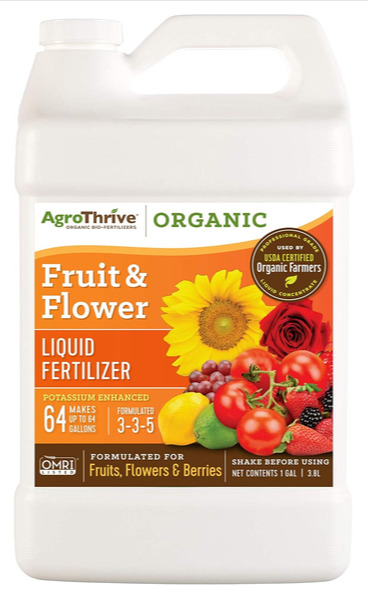
4. AgroThrive Fruit and Flower Organic Liquid Fertilizer 3-3-5 NPK (1 Gal)
Product Overview
This is the first liquid option in our review. AgroThrive comes in a 1-gallon concentrate that you dilute with water. The NPK is 3-3-5, which emphasizes potassium. You mix it with water and spray it on your trees, or water it into the soil.
Best Use Cases
Liquid fertilizers are great if you want faster results. This product works well for fruit trees that are already producing and you want to boost flowering and fruiting right now. It’s also good if you’re watering with a drip system because you can run the diluted fertilizer right through your irrigation.
It’s excellent for trees showing nutrient deficiency. A foliar spray (spraying on the leaves) gives your tree immediate access to nutrients. If you’ve got yellowing leaves or stunted growth, this can help fast.
Key Features Explained
Being liquid means the nutrients are already dissolved and immediately available to your tree. No waiting for granules to break down. Your tree can start using the nutrition right away.
The 3-3-5 ratio gives you decent nitrogen and phosphorus, but the emphasis is clearly on potassium. Potassium helps with fruit flavor, disease resistance, and overall tree toughness.
AgroThrive is made from plant-based ingredients. It’s OMRI certified organic. It contains no synthetic chemicals.
Real-Life Usage Insight
You get a gallon of thick liquid concentrate that looks kind of brown-ish. The smell is pretty mild, which is nice. You dilute it according to the directions (usually something like 1 part concentrate to 10-15 parts water) and apply it.
You can spray it directly on the foliage, and the leaves absorb nutrients immediately. This is called foliar feeding. Or you can water it into the soil around your tree, and the roots absorb it.
Results show up faster with liquid fertilizers. You can see improvement within a week or two of application. If you’ve got yellowing leaves, they can green up quickly.
Honest Pros and Cons
The good: Results are faster than granular. You can apply via foliar spray for immediate nutrient access. A gallon goes a long way when diluted. You can mix it into your irrigation system. It’s convenient for quick nutrient boosts. You have more control over how much to apply.
The bad: Liquid fertilizers don’t improve soil structure the way granular ones do. You need to spray or water more frequently than with granular applications. The equipment (sprayer or watering can) adds a small hassle. Cost per application can be higher. Results don’t last as long as granular fertilizers.
Performance Discussion
Trees respond fast to liquid fertilization. Foliage greens up quickly. Flowering and fruiting improve noticeably, especially if you apply right before flowering season.
The downside is that the nutrients are used up faster. Your tree goes through them quicker than with slow-release granular fertilizers. That means more frequent applications.
In comparison to granular products, liquid fertilizers are better for quick fixes and faster results. Granular products are better for long-term soil health and extended feeding.
Ease of Use
You need a sprayer or watering can. You need to mix the concentrate with water. The application itself is easy, just spray or pour. The extra step of mixing makes it slightly less convenient than granular products.
Value for Money
A gallon costs around $15-$25 depending on where you buy. But a gallon is a concentrate that makes 10-15 gallons of diluted fertilizer. One gallon of AgroThrive treats way more area than one gallon of ready-to-use fertilizer.
When you do the math, the per-application cost is comparable to granular fertilizers. But the convenience of liquid and the faster results might be worth the extra effort.
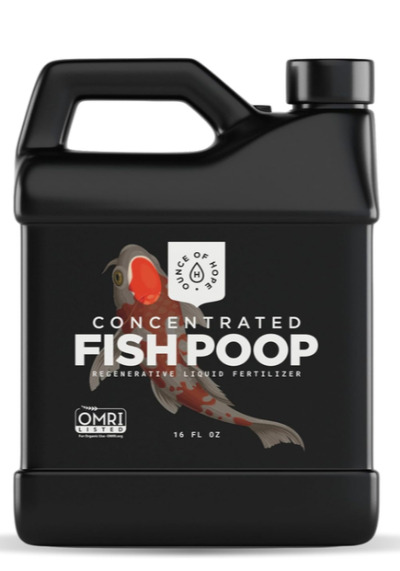
5. OMRI Listed Organic Concentrated Fish Poop Liquid Fertilizer 16 Oz
Product Overview
Fish poop fertilizer might sound funny, but it’s actually one of the best organic fertilizers around. This product is a concentrate made from fish waste. You get 16 ounces, which is a lot smaller than the AgroThrive gallon, but it’s super concentrated. One bottle makes 16 gallons of diluted fertilizer.
Best Use Cases
Fish fertilizer is versatile. It works on basically any plant, but it’s especially good for fruit trees because it provides a full spectrum of nutrients plus beneficial microbes. It’s great as a soil amendment, as a foliar spray, or even for hydroponics and aquaponics.
If you want the absolute best nutrient density and you don’t mind the smell, fish fertilizer is top-notch. It’s also great if you want a product that improves soil life as much as it feeds your tree.
Key Features Explained
Fish byproducts contain all the amino acids your plants need. They’re not just nitrogen, phosphorus, and potassium. They’re whole food for your plants. The smell comes from the natural breakdown of fish proteins, which is actually a sign that it’s real, unprocessed fish material.
This product is OMRI certified, so it’s legitimate organic. No synthetics. No GMO ingredients. It’s fish waste processed into a drinkable concentrate.
The concentrated nature means you’re not paying for water weight. You get actual nutrition in a small package.
Real-Life Usage Insight
The bottle is dark brown, almost black. The smell is fishy. Some people describe it as an ocean smell. Others think it’s rank. It’s definitely noticeable, but it fades once you apply it.
You mix it with water (usually about 1 ounce per gallon) and apply it either as a foliar spray or poured around your tree base. The application is easy because you only need a small amount per application.
The microbes in the fish poop go to work in your soil, feeding soil biology and improving soil structure. That’s a benefit you don’t get as much with other fertilizers.
Honest Pros and Cons
The good: Super concentrated, so you get tons of applications from one bottle. Works on any plant type. Incredibly nutrient-dense. Improves soil life and structure. Fast results. Can be applied as foliar spray or soil amendment. OMRI certified. Excellent bang for the buck.
The bad: The smell is real and noticeable. If you’re sensitive to smells, this might bother you. It’s a liquid, so you need mixing and application equipment. It doesn’t last as long as granular in your soil. Some people find the idea of fish waste off-putting, even though it’s perfectly safe.
Performance Discussion
Performance is genuinely impressive. Trees respond fast. Foliage is lush and green. Flowering and fruiting are typically excellent. The microbes in the fertilizer support your soil biology, which has cascading benefits for your tree’s health.
In comparison to the other products, fish fertilizer is more of a complete nutrition source. It’s not just NPK ratios. It’s whole-plant nutrition.
Ease of Use
Mix concentrate with water, apply. That’s it. Very simple, no special equipment needed beyond a sprayer or watering can.
Value for Money
A 16-ounce bottle costs around $15-$20. But it makes 16 gallons of working solution. One bottle will go a long way. If you have multiple fruit trees, you’re getting a huge amount of applications from a small initial investment.
The cost per application is actually the lowest of all the products in this review. You’re spending less than a dollar per application when you do the math.
Comparison Insights: Which Product Is Actually Best?
Okay, here’s the thing. There is no single “best” product because your situation is different from someone else’s. But let me break down which product wins in different scenarios.
For Maximum Simplicity
Jobe’s Organics wins here. The balanced 4-4-4 ratio means you don’t overthink it. Works on any fruit tree. Works at any growth stage. One product solves your problem.
For Long-Term Soil Health
Dr. Earth or Down To Earth. Granular products stay in your soil longer, feeding soil microbes consistently. Liquid fertilizers are quick bursts that don’t improve soil structure as much.
For Fastest Results
AgroThrive or fish fertilizer. Both are liquids that get to work immediately. Foliar spraying gives you visible results within days.
For Best Value
Fish fertilizer absolutely dominates on cost. One bottle goes forever. Per-application cost is lowest by far.
For Growing Strong Young Trees
Down To Earth. The higher nitrogen supports vigorous growth and root establishment.
For Maximizing Fruit Production
AgroThrive or fish fertilizer. The higher potassium and micronutrient profile supports flowering and fruiting.
For Completely Hands-Off
Dr. Earth or Down To Earth. Granular, you apply once or twice a season and largely forget about it.
The Buying Guide
When you’re shopping for organic fertilizer for fruit trees, look at these things:
Check the NPK First
What’s your goal? If you want growth, higher nitrogen (like 6-2-4). If you want fruit, higher phosphorus and potassium (like 3-3-5 or 4-3-3).
Granular vs Liquid
Granular lasts longer and improves soil more. Liquid works faster. Pick based on your timeline and how much work you want to do.
Cost Per Application
Don’t just look at the price per bag. Figure out how much you’re actually paying per application on your trees. Sometimes the bigger bag has better value.
How Many Trees?
One tree? A small bag works fine. Ten trees? You’ll want bigger bags or concentrate liquids.
Your Climate
Hot and dry? Liquid fertilizers might dry out before nutrients activate. Cool and wet? Granular works great. Some fertilizers perform better in certain climates.
What’s Certified Organic?
If that matters to you, check for OMRI certification. All the products in this review have it.
Ingredient Source
Some people care whether the ingredients are local or specifically sourced. That’s fine. Just check the label.
Who Should Buy These Products
Beginners with One or Two Trees
Jobe’s Organics or Dr. Earth. Easy to use, clear instructions, reliable results.
Experienced Gardeners
Fish fertilizer. You know what you’re doing, you’ll appreciate the nutrient density and value.
People with Multiple Trees
Down To Earth or fish fertilizer. Better value when you buy larger quantities.
Impatient People Who Want Fast Results
AgroThrive or fish fertilizer. Liquid gets results quick.
Gardeners Focused on Soil Health
Any granular product, especially ones with mycorrhizae.
Citrus Growers Specifically
Jobe’s Organics. It’s specifically formulated for citrus and works incredibly well.
Budget-Conscious Gardeners
Fish fertilizer. Cost per application is the lowest.
Common Mistakes to Avoid
Don’t Over-Apply
Too much fertilizer doesn’t mean better results. Follow the label directions. Over-fertilizing can burn roots, cause excess vegetative growth, and actually reduce fruiting. Less is often more.
Don’t Assume Granular Takes Forever
Granular does work slowly, but not as slowly as you’d think. You’ll see results within weeks, not months. But yes, liquid is faster.
Don’t Use the Same Product Year-Round
Vary your approach. Use nitrogen-heavy in early season for growth, then switch to potassium-heavy as flowering approaches.
Don’t Forget to Water After Applying Granular
Granular fertilizer needs water to activate and move into your soil. Apply it dry and don’t water it in, and it just sits there doing nothing.
Don’t Apply When Stressed
If your tree is heat-stressed or drought-stressed, wait before fertilizing. Give it water first. Adding fertilizer to a stressed tree can actually hurt it.
Don’t Mix Different Fertilizers
Stick with one product at a time. Mixing fertilizers can create imbalances or waste nutrients. Use one, let it work, then switch if you want to.
Don’t Ignore Deficiency Symptoms
If leaves are yellowing and your tree looks sick, fertilizer might be the answer. But it might not be. Could be disease, pests, wrong watering, or something else. Diagnose the real problem before just throwing fertilizer at it.
Don’t Buy Right Before Dormancy
If your tree is about to go dormant for winter, don’t fertilize. Your tree won’t use the nutrition. Wait until spring growth starts.
Don’t Assume All Organic Fertilizers Are the Same
They’re not. Some are much better than others. Real organic products with beneficial microbes work way better than organic products that are just ground-up ingredients with nothing else.
Don’t Forget That Soil Matters
The best fertilizer in the world won’t work magic in terrible soil. Good fertilizer plus mediocre soil is better than okay fertilizer plus good soil, but not by much. Invest in your soil too.
Final Verdict
All five of these products work. That’s the main thing. None of them are rip-offs or fake products. They’re all legitimate organic fertilizers that will actually help your fruit trees.
Dr. Earth Natural Wonder Fruit Tree Fertilizer is the solid all-around choice. Good NPK ratio, beneficial microbes, good price, works on everything. If you want one product and you want to not overthink it, this is your jam.
Jobe’s Organics ties with Dr. Earth for all-around reliability. The balanced 4-4-4 ratio actually gives it a slight edge for beginners because you literally cannot get the ratio wrong. This is what you buy if you want zero guesswork.
Down To Earth is your choice if you need to build strong tree structure or if you have multiple large trees (that 5-pound bag is valuable). The higher nitrogen is exactly what you want for tree vigor.
AgroThrive wins if you want to split the difference between granular and liquid, or if you already have irrigation set up and want to run fertilizer through your system. Faster results, but not as much soil improvement.
Fish Fertilizer is the champion of value and nutrient density. If cost matters and you don’t mind the smell, this is the winner. The microbe content is also genuinely excellent for long-term soil improvement.
The real answer is: it depends on your specific situation. But you cannot go wrong with any of these. Pick the one that matches your needs and budget, apply it according to the directions, and your fruit trees will reward you with better growth and better harvests.
Your next step is simple. Pick one product based on what you’ve read. Buy it. Use it. Watch your trees respond. After a season, you’ll have real data about what works best for your specific situation.
That’s how you become good at growing fruit. Not by reading more articles, but by actually trying things and paying attention to what happens.
Go feed your fruit trees some real, organic nutrition. They’re hungry, and they’re waiting for you.

Hi, I’m Mary, the founder of GardenCure.com. I’m passionate about creating healthy, beautiful gardens and well-kept lawns. I share practical experience and trusted advice on garden and lawn gear that truly works. With the support of my dedicated research team, our writers produce honest, in-depth reviews using reliable, authentic sources—helping you choose the right tools with confidence for your outdoor space.