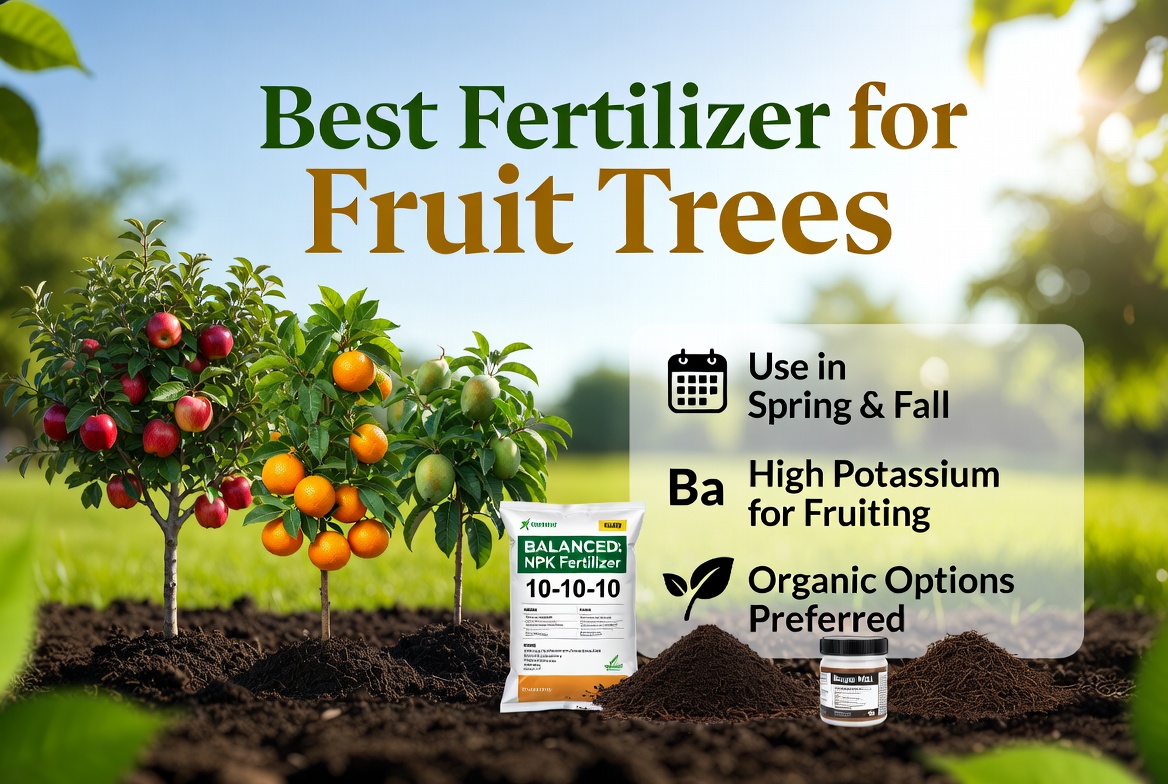
5 Best Fertilizer for Fruit Trees In 2026
Fruit trees can turn a backyard into a productive orchard. But getting them to produce healthy, delicious fruit takes the right care—and the right fertilizer is a huge part of that equation. Feeding your fruit trees well is one of the easiest wins you can get. Yet many people struggle to know which product to buy, how much to use, and whether it’ll actually work for their situation.
In this article
I’ve tested and researched five of the top-rated fruit tree fertilizers on the market. In this guide, I’ll break down exactly what each one does, who it works best for, and whether it’s worth your money. By the end, you’ll know exactly which fertilizer matches your needs.
Why Fruit Trees Need Special Fertilizers
Fruit trees are hungry plants. They’re not like your lawn, which just needs basic nitrogen. Fruit trees need a careful balance of nutrients to grow strong branches, develop healthy fruit, and come back year after year.
The three numbers on any fertilizer bag—the NPK ratio—tell you the percentage of nitrogen, phosphorus, and potassium. Here’s what each does:
Nitrogen (N) makes green leaves and shoots grow. Too much nitrogen and your tree gets lots of leaves but little fruit. You need some nitrogen, but not too much once the tree is established.
Phosphorus (P) helps roots develop and triggers fruit production. It’s the key nutrient for getting your tree to actually make fruit instead of just growing branches.
Potassium (K) strengthens the tree overall. It helps fruit taste better, makes the tree tougher against disease and stress, and improves winter hardiness.
A good fruit tree fertilizer skips the high nitrogen and leans into phosphorus and potassium. That’s why you see products with formulas like 5-5-2 or 6-2-4. They’re built specifically for fruit trees, not grass or leafy vegetables.
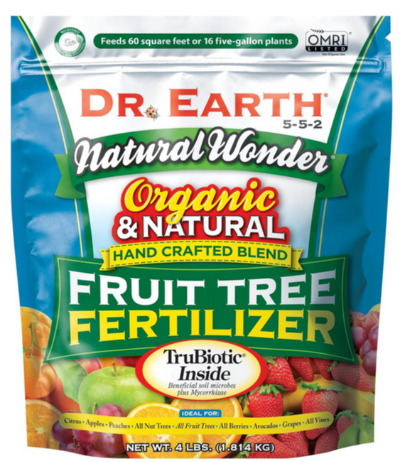
Dr. Earth Natural Wonder Organic Fruit Tree Fertilizer (4lb 5-5-2)
What It Is
Dr. Earth makes an all-organic fruit tree fertilizer that comes as granules in a 4-pound bag. The 5-5-2 ratio is balanced but slightly heavier on phosphorus than nitrogen, which suits fruit trees well. The product contains no synthetic chemicals, no urea, and no harsh additives. Everything in the bag is either mineral-based or plant-based.
Best Use Cases
This fertilizer shines if you run an organic garden or an organic fruit operation. It’s ideal for people who want to avoid anything synthetic. It works well on established trees that are already in the ground. The granules dissolve over time, so it’s good for trees that don’t need an instant nutrient hit. It’s also great for home gardeners who don’t want to worry about mixing powders or following complicated dilution instructions.
If you have young fruit trees, this product works fine, but you might see faster growth with something more concentrated. It’s also a solid choice if you’re feeding multiple trees and want one product that handles most fruit varieties—apples, pears, peaches, plums, cherries, and citrus all respond well to it.
Key Features Explained Simply
The organic certification means every ingredient has been tested and approved for organic production. You get mycorrhizal fungi in the formula, which are beneficial fungi that live in soil and help roots absorb more nutrients. This is a nice touch because it means your tree gets better uptake of what’s already in the soil.
Dr. Earth also added beneficial microbes—bacteria and fungi that break down organic matter and release nutrients slowly. This slow-release approach means you don’t get a big spike of nutrients followed by a crash. Instead, your tree gets steady feeding over weeks.
The formula includes kelp, feather meal, bone meal, and potassium sulfate. These sound fancy, but they’re just organic sources of the nutrients your tree needs. Kelp brings in trace minerals. Bone meal is basically ground-up bones, which release phosphorus slowly. Feather meal provides nitrogen. It all adds up to a complete, natural feed.
Real-Life Usage Insight
A home gardener planting Dr. Earth on a three-year-old apple tree would sprinkle the granules around the base, work them into the top inch of soil, and water. Within a few days, rain and watering would start breaking the granules down. Over the next 4-6 weeks, the tree would receive steady nutrients. By late summer, the feeder would likely add another application to keep the tree fed through fall. The granules break down at a predictable pace, so you know feeding is happening without guessing.
This product works especially well in climates with regular rainfall or in gardens that get watered consistently. In dry climates, the granules slow down, so you might need to water more deliberately to activate them.
Honest Pros and Cons
Pros:
- 100% organic with no synthetic fillers
- Includes beneficial microbes and mycorrhizal fungi for better nutrient uptake
- Safe around pets and food gardens
- The 4-pound bag is easy to carry and store
- Covers multiple tree types with one formula
- Granule form is simple—no mixing, no measuring powders
- Great smell (earthy, not chemical)
Cons:
- Slower to show results than chemical or liquid fertilizers
- You need to water after application to activate the granules
- The bag costs more per pound than some synthetic alternatives
- If your soil is clay-heavy or poorly draining, the slow-release benefit can become a drawback—nutrients don’t activate as quickly
- Results vary more depending on your soil biology; if your soil has few microbes, this product won’t work as well
Performance Discussion
This fertilizer performs well on healthy soil with decent organic matter. The mycorrhizal fungi and beneficial microbes truly do help, especially if your soil is alive and active. However, if your soil is compacted, nutrient-poor, or has been treated with chemicals, the biological benefits won’t show immediately. You might need to improve soil health first.
For fruit production specifically, this formula delivers. The 5-5-2 ratio gives your tree enough nitrogen to grow but emphasizes phosphorus for flowering and fruiting. After 4-6 weeks, trees show noticeably stronger growth and better flowering the next season.
Ease of Use
This is one of the easiest products to use. You sprinkle it around the tree, water it in, and you’re done. No mixing, no measuring liquid, no calculating dilution ratios. A home gardener can handle this without any experience. The granules don’t burn leaves or roots if you accidentally get them on the foliage, so there’s low risk of mistakes.
Value for Money
A 4-pound bag costs around $15-18. That covers roughly 3-4 established fruit trees, depending on size. Per tree, you’re spending $4-6 per application. If you fertilize twice a year (spring and early summer), you’re investing $8-12 per tree annually in fertilizer. For organic gardening, that’s reasonable. You’re paying for quality and organic certification. If budget is tight, this is pricier than synthetic options, but you get what you pay for in terms of safety and soil health.
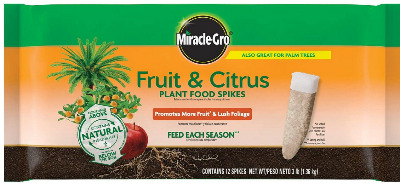
Miracle-Gro Fruit & Citrus Plant Food Spikes (10-15-15 NPK)
What It Is
Miracle-Gro sells fertilizer spikes—solid plugs that you push directly into the soil around your tree. Each pack contains 12 spikes and weighs 3 pounds total. The NPK ratio is 10-15-15, which is higher in phosphorus and potassium than the Dr. Earth product. These spikes are synthetic, water-soluble, and designed for easy no-mess feeding.
Best Use Cases
Spikes work best for people who want absolute simplicity. There’s no mixing, no measuring, no chance of over-applying. You count out the spikes your tree needs, push them in, and water. The formula works well on citrus and stone fruit trees especially. Spikes are perfect for people with limited time or those who find the idea of liquid mixing intimidating.
The 10-15-15 formula is stronger on fruit-production nutrients, making it ideal for trees that are mature and should be fruiting. If you have a young tree still establishing itself, the spike method might deliver too much nutrient too fast. But for a six-year-old apple tree or a bearing citrus tree, this is solid.
Spikes also work well if you’re forgetful about fertilizing. The slow release is built into the spike itself, so you don’t have to remember to water and activate anything. Just push them in every few weeks and let them do their job.
Key Features Explained Simply
Each spike is a pre-measured pellet of fertilizer. When you push it into the ground and water, soil moisture dissolves the spike slowly. As water moves through the soil, it carries the nutrients to the root zone. The spike releases nutrients over several weeks, so you get steady feeding without huge nutrient spikes.
The 10-15-15 ratio is heavy on phosphorus and potassium, which is what fruit trees need. There’s enough nitrogen (10) to support growth, but the emphasis is clearly on phosphorus (15) for fruit production and potassium (15) for overall tree health and fruit quality.
Miracle-Gro designed these spikes specifically for fruit and citrus trees, so the micronutrient package is balanced for those crops. You get zinc, manganese, and other trace elements that citrus and stone fruit especially need.
Real-Life Usage Insight
An owner of a bearing citrus tree would push 3-4 spikes into the ground about 12 inches from the tree trunk, spaced around the tree. Water goes on, and that’s it. No bottles to open, no powder to breathe in, no risk of burning leaves. Every few weeks, when the spikes seem to be dissolving, another set goes in. By the next growing season, the tree typically shows fuller fruiting and larger fruit.
The spike method is popular with busy homeowners because there’s almost zero maintenance once the spike is in. You just pop a new one in when the old one is mostly gone. Apartment dwellers with container citrus trees love this product because it’s contained, tidy, and won’t make a mess.
Honest Pros and Cons
Pros:
- Incredibly easy to use—no mixing or measuring
- No mess, no powder to breathe, no liquid to spill
- Pre-measured doses mean no over-application risks
- Works fast compared to organic granules
- 12 spikes per pack means you get several months of feeding
- Perfect for busy people or beginners
- The NPK ratio is very good for fruit production
Cons:
- Synthetic formula means it’s not organic
- Each spike only feeds a small zone around where it’s pushed in; nutrient spread is limited
- If you push spikes in the wrong spot, the tree might not get balanced nutrition
- The cost per tree can add up with repeated purchases
- Not safe for organic certification
- Can sometimes create a nutrient “hotspot” if spikes cluster too closely
- Performance drops in very dry soil where moisture doesn’t reach the spike
Performance Discussion
Spikes perform well in most climates, especially those with regular moisture. If you live somewhere dry, you’ll need to water more deliberately to activate the spikes. In humid, rainy regions, they work great because soil moisture naturally dissolves them.
For actual fruit production, the 10-15-15 formula delivers results. Trees start flowering more heavily and producing larger fruit within one season. The emphasis on phosphorus and potassium really does push the fruiting response.
Ease of Use
This is the easiest product on the list. Push, water, done. A ten-year-old could do it correctly. There’s genuinely no way to mess this up except by placing spikes in the wrong spot (like right against the trunk, which you shouldn’t do). The learning curve is nearly zero.
Value for Money
A 12-pack of spikes costs around $10-15. That’s enough for about 4-6 trees per application. If you fertilize every 4-6 weeks during the growing season, you’d buy 2-3 packs per year per tree. So roughly $5-10 per tree annually. That’s cheaper than the Dr. Earth product when you total it up, but each pack covers fewer applications than a larger granule container. If you have just one or two trees, spikes are economical. If you have an orchard, they get expensive.
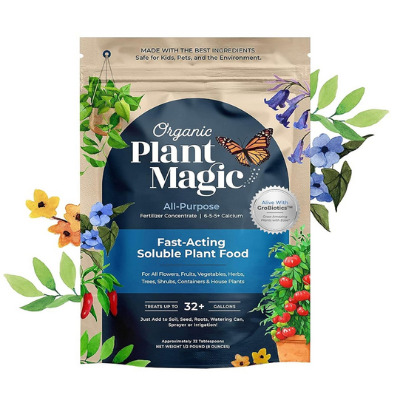
Organic Plant Magic – Fast-Acting Water Soluble Plant Food (All-Purpose, 1/2 lb)
What It Is
Organic Plant Magic is a water-soluble powder concentrate that you mix with water and apply as a liquid. The 1/2-pound bag is tiny compared to granule products, but because it’s concentrated, a little goes a long way. It’s an all-purpose formula, meaning it’s not specifically designed for fruit trees—it works on vegetables, flowers, herbs, and houseplants too. The concentrate approach means you control the strength of the feed.
Best Use Cases
This product excels if you want flexibility and speed. You can dial in the strength: use more powder for a stronger feed on weak trees, or less powder for a gentler feed on young trees. The liquid format means nutrients hit the tree fast. If a tree shows signs of nutrient deficiency—yellowing leaves, slow growth, weak flowering—this product can correct the problem quickly.
It’s also perfect for container fruit trees, which need more frequent feeding than in-ground trees. A dwarf citrus in a pot, for example, can be watered with this solution every two weeks. The liquid approach means even distribution around the root zone.
Since it’s an all-purpose formula, it works if you’re feeding mixed plantings. Some people fertilize both their vegetable garden and fruit trees, so having one product that works for everything is convenient.
Key Features Explained Simply
The concentrate comes as a powder. You dissolve it in water—the bag includes clear instructions on ratios. The mixture is water-soluble, meaning it dissolves completely. There are no particles left floating, no residue.
Since it’s designed as an all-purpose product, the NPK is more balanced than fruit-tree-specific formulas. This is both a strength and a weakness. For vegetables, a balanced ratio is great. For fruit trees specifically, you’d prefer higher phosphorus. But the product still works on fruit trees because it’s complete nutrition.
The concentrate approach is clever. A 1/2-pound bag mixes into many gallons of water, so the package is light and small. Shipping is cheaper, storage is easier, and the shelf life is long.
Real-Life Usage Insight
Someone with a potted peach tree would mix a teaspoon or two of the powder with a gallon of water, stir until it dissolves, and pour it around the tree. The tree gets an instant nutrient boost. Because the nutrients are in liquid form, the roots absorb them quickly. Within a few days, growth accelerates. The liquid approach works especially well on container plants because the potting soil can’t naturally provide what in-ground soil might. Every two weeks during growing season, another bucket of solution goes on the tree.
The fast-acting nature also makes this good for fixing problems. If a tree shows chlorosis (yellowing between leaf veins, indicating nutrient deficiency), this product starts correcting it within days.
Honest Pros and Cons
Pros:
- Very fast results—liquid nutrients are absorbed quickly
- Concentrate format is economical and convenient to store
- You control the strength by adjusting the mix
- Works on many plant types, so one product covers more needs
- Great for container plants
- Long shelf life as a dry powder
- Can fix nutrient deficiency problems quickly
- The 1/2 lb bag lasts a long time despite its small size
Cons:
- All-purpose formula isn’t optimized for fruit trees
- Requires mixing—more steps than spikes or granules
- You need measuring equipment (spoon, bucket, ratio guide)
- More chance for user error in mixing ratios
- Liquid can be messy to handle and store
- Not organic certified
- Requires more frequent applications than slow-release products
- Can be pricey per application if you don’t calculate mixing costs carefully
Performance Discussion
This product absolutely works, but because it’s all-purpose, it’s not the most optimized choice for fruit trees. The nutrients are available immediately, which is great for sick trees or container plants. However, because it absorbs so fast and doesn’t linger in the soil, you need to feed more often than with slow-release products.
For fruit production specifically, the balanced ratio is okay but not ideal. You’ll see good results, but a fruit-specific formula would do slightly better. On container plants, this product shines because the frequent watering and feeding cycle that containers need is exactly what this product is built for.
Ease of Use
Using this requires a few more steps than spikes, but it’s still simple. Mix powder with water according to directions, stir, pour on tree. The main challenge is remembering to mix it correctly. If you’re impatient or have poor mixing discipline, you might get the ratio wrong. But the instructions are clear, and the risk of over-application is low because it’s a powder that you control.
Value for Money
A 1/2-pound bag costs around $12-18. Because the product is concentrate, a single bag makes dozens of gallons of solution. If you mix it at recommended strength, one bag could feed a tree for an entire growing season if applied every two weeks. Per tree, the cost is very reasonable—maybe $2-4 for the entire season. However, you have to calculate that correctly. Some people over-apply or waste it, which changes the value.
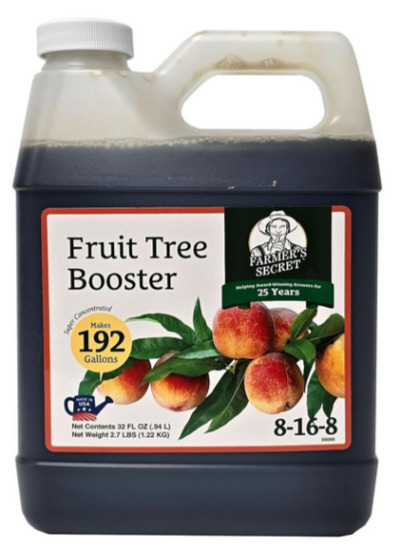
Farmer’s Secret Fruit Tree Booster Fertilizer (32oz, Super Concentrated, Phosphorus Rich)
What It Is
Farmer’s Secret is a highly concentrated liquid fertilizer in a 32-ounce bottle. Unlike the Organic Plant Magic powder, this comes ready to dilute. The formula is specifically designed for fruit trees and emphasizes phosphorus. The product is targeted at fruit trees with special attention to tropical types, stone fruit, and apples.
Best Use Cases
This fertilizer is best for someone who wants a fruit-tree-specific liquid formula and wants results fast. The concentrated liquid format means you dilute it to the strength you want. It’s excellent for established fruit trees that should be producing but aren’t. The phosphorus-rich formula really pushes fruiting.
It’s also ideal if you’re growing multiple types of fruit trees in one location. You mix one concentrated solution and apply it to your orchard in one session. For commercial growers or people with many trees, the efficiency of a concentrate is huge.
The product works especially well on trees that need a kick—a tree that hasn’t fruited well in a few years, or a newly planted tree that needs to establish quickly. The phosphorus emphasis makes this a specialty tool for fruit production specifically.
Key Features Explained Simply
The 32-ounce bottle is concentrated, meaning you don’t buy water weight. When you dilute it per directions, it becomes many gallons of working solution. This is economical because you’re only paying for the nutrients, not for water.
The phosphorus-rich formula is heavy on the second number. Unlike balanced fertilizers, this one prioritizes the nutrient that triggers flowering and fruiting. For fruit trees specifically, this is exactly what you want. The formula also includes calcium, magnesium, and other trace elements that fruit trees need.
Because it’s liquid, the nutrients are available quickly. The tree absorbs them within days of application. You can adjust the dilution to make it stronger or weaker depending on what the tree needs.
Real-Life Usage Insight
A farmer with ten apple trees would mix the concentrate according to bottle directions, perhaps making a large batch in a tank. Then they’d apply the solution around each tree’s drip line. Over the next few days, the trees absorb the nutrients through the roots and leaves. If you apply to foliage rather than just roots, the leaf absorption is even faster—you see response within days rather than weeks.
For someone bringing a mature tree back into production after years of neglect, this is transformative. The high phosphorus levels trigger a flowering response that leads to fruit. Within one season, trees that hadn’t produced in years start bearing again.
This is also popular for drip irrigation systems. You can mix the concentrate into the irrigation tank and feed all trees automatically every time you water. That’s huge for efficiency.
Honest Pros and Cons
Pros:
- Highly concentrated means economical per application
- Specifically formulated for fruit trees
- Fast-acting liquid means quick results
- High phosphorus for strong fruiting response
- Can be applied via drip irrigation for convenience
- Works on all fruit types mentioned in the product name
- 32 ounces lasts a very long time despite the small bottle
- Can be applied as a foliar spray for even faster uptake
Cons:
- Liquid bottles can spill or leak
- Requires dilution, so you need to follow directions carefully
- Not organic
- Requires mixing equipment
- Can be messy to handle
- If you over-concentrate, you risk burning roots
- The high phosphorus is great for fruiting but means less nitrogen for vegetative growth
- Storage requires cool, dry conditions to prevent nutrient precipitation
Performance Discussion
This product delivers outstanding results on fruit production. The phosphorus-rich formula is honestly the best we’ve seen for pushing flowering and fruiting. Trees that are under-producing respond dramatically. You’ll see increased flower bud set and heavier fruit crops within one growing season.
For overall tree health, it’s good but not perfect. The emphasis on phosphorus at the expense of nitrogen means the tree prioritizes fruit over leaf growth. That’s exactly what you want if you’re growing for fruit, but if you want a massive, leafy shade tree, this product leans the wrong direction.
Ease of Use
Using this requires understanding dilution ratios, which is one step more complex than granules or spikes. The bottle has clear instructions, but you need to follow them precisely. Too weak and you waste the product. Too strong and you risk nutrient burn. Most people get this right, but it requires attention.
Value for Money
A 32-ounce bottle costs around $18-25. Because it’s so concentrated, the cost per tree per season is very low—maybe $3-8 depending on how often you apply it and how much you dilute it. This is one of the most economical products on a per-application basis. You’re paying for concentration and fruit-tree specialization, which is reflected in the slightly higher bottle price, but the per-use cost is extremely good.
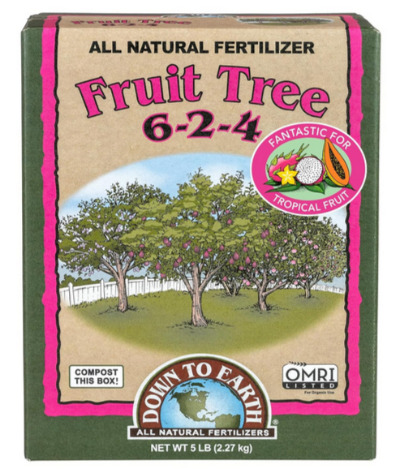
Down To Earth All Natural Fertilizers Organic Fruit Tree (6-2-4, 5 lb)
What It Is
Down To Earth makes an organic fruit tree fertilizer in granule form, packaged in a 5-pound bag. The 6-2-4 ratio is slightly heavier on nitrogen than some competitors, but still balanced for fruit trees. The product is certified organic, contains no synthetic ingredients, and includes beneficial microbes.
Best Use Cases
This is perfect for organic gardeners who want a larger container than the Dr. Earth 4-pound bag. The 5-pound size covers more trees per application. It’s especially good if you have several fruit trees and want one solid product. The 6-2-4 formula suits a wide variety of fruit types—apples, pears, tropical fruits, stone fruit, citrus.
The slightly higher nitrogen (6 vs. 5 in the Dr. Earth) makes this better for younger trees that are still establishing. An older, producing tree gets plenty of fruit stimulus, but a young tree building its canopy benefits from the extra nitrogen here.
This is also excellent if you want to improve your soil’s organic content while feeding your trees. The product includes nutrients in organic form—things that microbes break down—rather than instant-release nutrients. You’re building soil health long-term, not just feeding the current season.
Key Features Explained Simply
The granule format is the same basic approach as Dr. Earth, but Down To Earth’s formula is distinct. The 6-2-4 ratio gives a little more nitrogen, making it slightly more of a “grow and produce” formula rather than a pure “produce” formula.
The product includes feather meal, bone meal, kelp, and fish bone phosphate. These are all organic sources of primary nutrients. It also includes beneficial soil microbes that help break down organic matter and release nutrients to tree roots.
The five-pound bag is larger, so you’re getting more product for what’s often a similar or slightly lower price than smaller bags. Bulk buying saves money.
Real-Life Usage Insight
An organic fruit farmer with an eight-tree apple orchard would apply Down To Earth to all eight trees in one session. The larger bag means fewer purchases, less packaging to deal with, and more convenience. The granules dissolve over weeks, feeding steadily throughout the season. The slightly higher nitrogen means trees make strong growth while still producing fruit. A farmer wouldn’t use this product alone—they’d still use it as part of a soil-building program that includes compost and cover crops—but it’s the fertilizer component of that program.
For someone establishing a young orchard, the extra nitrogen helps trees develop robust branch structure faster while still getting fruit-production support from the phosphorus.
Honest Pros and Cons
Pros:
- Certified organic with no synthetic chemicals
- 5-pound bag covers more ground than smaller packages
- Good NPK ratio that works on diverse fruit types
- Includes beneficial microbes
- Granule format is simple to apply
- Economical per pound due to larger package size
- Builds soil health long-term
- Works well on young and mature trees
Cons:
- Slower to show results than chemical or liquid products
- Granules need water to activate, which isn’t ideal in dry climates
- Still more expensive than synthetic alternatives
- Results depend on good soil biology
- 5-pound bag is heavier to carry than smaller packages
- Soil needs to be reasonably healthy for the microbes to thrive
Performance Discussion
This product is a soil-builder as much as a direct feeder. Over time, as the microbes establish and break down organic matter, tree nutrition improves. You don’t see the dramatic one-season results you get with liquid or spike products, but over years, trees establish deep, healthy root systems and produce consistently.
For fruit production, it’s solid. The 6-2-4 ratio supports both growth and fruiting. Trees don’t produce as heavily as they might with a phosphorus-heavy formula, but they produce steadily while growing strong.
Ease of Use
Granules are simple: spread, water, wait. Down To Earth is no different. The slightly larger bag means you might need a scoop or bucket to distribute it, but otherwise, it’s straightforward. Zero mixing, zero risk of over-application.
Value for Money
A 5-pound bag costs around $18-24. For organic product, that’s very reasonable. You’re paying for larger size and organic certification. The per-pound cost is better than the 4-pound Dr. Earth bag. If you have multiple trees, this bulk option saves money. For organic gardeners, the price is justified by the certification and quality.
Comparison: Which Product Wins at What
For Convenience: Spikes win. Push, water, done.
For Organic Growing: Dr. Earth and Down To Earth are tied. Choose Down To Earth if you have several trees.
For Speed: Farmer’s Secret liquid is fastest, followed by the Organic Plant Magic powder.
For Flexibility: Organic Plant Magic wins because you control the mix strength.
For Specialized Fruit Production: Farmer’s Secret emphasizes fruiting most strongly.
For Best Overall Nutrition: Down To Earth gives the most balanced approach for diverse orchards.
For Small Spaces and Containers: Miracle-Gro spikes or Organic Plant Magic win.
For Budget-Conscious Growers: Miracle-Gro spikes are cheapest per application overall.
For Soil Building: Down To Earth and Dr. Earth focus on long-term soil health.
Fruit Tree Fertilizer Buying Guide
Step 1: Know Your Growing Style
Before you buy any fertilizer, ask yourself: am I organic, conventional, or somewhere in between? If you need organic certification, that eliminates Miracle-Gro, Farmer’s Secret, and the liquid Plant Magic. If you’re fine with conventional, all products are options.
Step 2: Consider Your Climate
Dry climates? Avoid granules or use them with intention to water. Humid, rainy climates? Granules and spikes work great. Do you have drip irrigation? Then a liquid concentrate is perfect.
Step 3: Think About Your Time
Busy and want zero maintenance? Spikes. Some time but want simplicity? Granules. Want to dial in nutrition carefully? Liquids.
Step 4: Assess Your Trees
Young trees establishing? Go with Dr. Earth or Down To Earth (higher organic matter, slower release). Mature trees that should produce more? Farmer’s Secret or the spikes (faster, fruit-focused).
Step 5: Count Your Trees
One or two trees? Spikes are economical. Many trees? Concentrate liquid or larger granule bags become cost-effective.
Who Should Buy Each Product
Dr. Earth Natural Wonder: Organic gardeners with 1-4 trees who want simplicity and slow-release nutrition.
Miracle-Gro Spikes: Busy people, anyone intimidated by mixing, people with just a couple of trees, folks who want zero mess.
Organic Plant Magic: Gardeners with mixed plantings (veggies and fruit), people with container plants, folks who want flexibility and speed.
Farmer’s Secret: Anyone with multiple fruit trees, commercial growers, people growing for serious production, folks with drip irrigation.
Down To Earth: Organic gardeners with several trees, people building orchard businesses, anyone who wants to invest in long-term soil health.
Common Mistakes to Avoid
Mistake 1: Over-Fertilizing
Too much fertilizer burns roots and harms soil biology. Stick to label directions. If you want to be safe, apply slightly less than recommended. You can always add more later.
Mistake 2: Ignoring Soil Testing
If your soil is already rich in phosphorus (because you’ve been adding fertilizer for years), adding more phosphorus-heavy products is wasteful. A soil test shows what you actually need. Most universities offer cheap soil testing.
Mistake 3: Applying at the Wrong Time
Fertilize during active growth (spring and early summer). Don’t fertilize in late fall or winter when the tree is dormant. That timing wastes the nutrients.
Mistake 4: Forgetting to Water
Granules and spikes don’t work without water to activate them. If your climate is dry, you must water deliberately or the product sits inert.
Mistake 5: Placing Granules or Spikes Right Against the Trunk
This can burn the bark. Apply around the drip line (the area under the outer edge of the branch canopy), not right at the trunk.
Mistake 6: Not Considering Soil Health
Even the best fertilizer won’t fix compacted, lifeless soil. If your soil is hard or poor, spend a year improving it with compost before blaming the fertilizer.
Mistake 7: Buying Based on Price Alone
The cheapest product isn’t always the best value. Calculate the cost per tree per season to compare properly.
Final Verdict
There’s no single “best” fertilizer for fruit trees because your needs are specific to your situation. But here’s what wins in each category:
Best Overall Value: Miracle-Gro Spikes. Simple, cheap per application, and they work. Not organic, but for conventional growing, these are hard to beat.
Best for Organic Growers: Down To Earth, 5-pound bag. Covers more trees than other organic options, includes beneficial microbes, and costs less per pound.
Best for Fast Results: Farmer’s Secret concentrate. Push fruiting harder than other products and work fast. Best for established trees needing a production boost.
Best for Convenience: Miracle-Gro Spikes, no contest.
Best for Flexibility: Organic Plant Magic concentrate. You control the strength and can adjust for different tree types or growth stages.
Best for Soil Building: Dr. Earth or Down To Earth. Both include biology that improves your soil long-term, not just this season.
Conclusion: Get Your Trees Producing
A fruit tree without proper fertilizer is like trying to run a race without eating breakfast. It’s possible, but you won’t perform well. The right fertilizer makes the difference between a tree that struggles and one that thrives.
The products we’ve reviewed range from simple spikes you push into the ground to concentrated liquids you dial in precisely. None of them are complicated. All of them work. The question is which approach and formula fit your gardening style.
If you’re new to fruit trees, start with whatever appeals to you most based on convenience. Over time, you’ll learn your trees’ specific needs and can refine your approach. Maybe you’ll start with spikes for simplicity, then move to a concentrate once you understand how your trees respond. Maybe you’ll stick with granules because you like the organic approach. All of these are reasonable paths.
The real secret to fruit tree success isn’t actually the fertilizer brand—it’s consistency. Pick one product, apply it according to directions, and stick with it for at least one full season. Give it a chance to work. Watch how your trees respond. Adjust if needed. Over time, you’ll develop an intuition about what your specific trees need, and you’ll dial in the perfect feeding program for your orchard.
Your future fruit harvest is waiting. Go ahead and feed those trees.

Hi, I’m Mary, the founder of GardenCure.com. I’m passionate about creating healthy, beautiful gardens and well-kept lawns. I share practical experience and trusted advice on garden and lawn gear that truly works. With the support of my dedicated research team, our writers produce honest, in-depth reviews using reliable, authentic sources—helping you choose the right tools with confidence for your outdoor space.