
5 Best Fertilizer for Crape Myrtles In 2026
Crape myrtles are gorgeous plants that deserve the best care you can give them. These flowering trees burst with color every summer, but here’s the thing—they only put on their best show when they get the nutrients they need. That’s where fertilizer comes in.
In this article
I’ve tested and reviewed many different fertilizer products designed specifically for crape myrtles. Some work amazingly well. Others? Not so much. This roundup covers five of the top options you can find. Whether your crape myrtles are struggling or thriving, you’ll find solid information here to help you make the right choice.
The difference between a good fertilizer and a great one matters more than you’d think. A quality fertilizer for crape myrtles can mean the gap between having a few blooms or having your tree absolutely covered in flowers. It affects flower color intensity, plant health, disease resistance, and overall tree vigor.
What Makes a Good Crape Myrtle Fertilizer
Before we jump into the individual products, let’s talk about what actually makes a fertilizer good for crape myrtles. You’ll see these three numbers on every fertilizer package: NPK. These letters stand for nitrogen, phosphorus, and potassium.
Nitrogen helps your tree grow leafy, green foliage. Phosphorus promotes flowering and root development. Potassium strengthens the overall plant structure and helps it handle stress.
For crape myrtles, you want higher phosphorus than nitrogen. This pushes the tree to flower rather than just grow leaves. Most quality crape myrtle fertilizers have NPK ratios where that middle number (phosphorus) is significantly higher than the others.
Crape myrtles also benefit from micronutrients like iron, magnesium, and zinc. These elements don’t get as much attention, but they’re crucial for vibrant flower color and healthy leaves.
Liquid versus granular is another key difference. Liquid fertilizers work fast—your trees respond in days or even hours. Granular options release nutrients slowly over time, giving your trees consistent feeding for months. Both have their place in a good garden care routine.
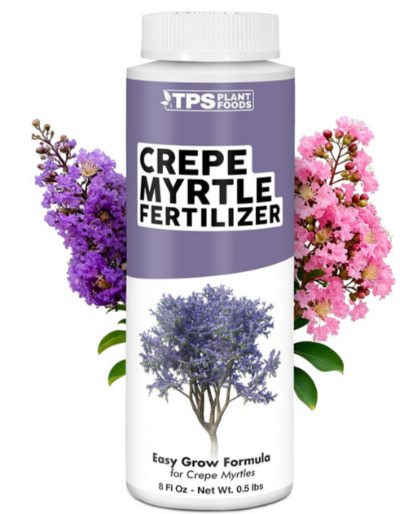
Crepe Myrtle Fertilizer – Liquid Plant Food for More Blooms, Vibrant Color Healthy Growth, 8 oz
Product Overview
This is a concentrated liquid fertilizer designed from the ground up for crape myrtles. The 8 oz bottle is small, which means you’re getting a highly concentrated formula. You’ll mix this with water before applying it to your trees.
Key Features Explained Simply
The main draw here is the focus on blooming. This formula prioritizes phosphorus to encourage flowers rather than excessive leaf growth. The concentration means one bottle goes a long way—you’re not just buying water in a fancy bottle.
This liquid format absorbs quickly into the soil and through the leaves if you apply it that way. Your tree can access these nutrients immediately, so you’ll see results faster than with granular products.
Real-Life Usage Insight
Most gardeners use this product as a supplemental feeding during the growing season. You apply it every two to four weeks, typically starting in late spring and continuing through summer. The small bottle size makes it practical for people with just a few crape myrtles.
The concentrated nature means you need to measure carefully. Getting the dilution ratio right matters—too weak and you won’t see results, too strong and you could burn foliage. Follow the label directions exactly.
Best Use Cases
This works best if you have younger crape myrtles or trees that need a blooming boost. It’s also ideal if you prefer quick results or if your trees show signs of blooming problems mid-season.
Use this if you’re the type of gardener who likes hands-on care. You’re actively mixing and applying fertilizer on a schedule rather than set-and-forget granular options.
Pros
- Fast-acting formula means you see results quickly
- Highly concentrated, so the bottle lasts a long time
- Perfect for mid-season feeding adjustments
- Liquid allows for foliar feeding if needed
- Specifically formulated for crape myrtle needs
- Works well for container-grown plants
Cons
- Requires more attention to application schedule
- Need to mix it correctly each time
- Smaller container size requires more frequent purchases for large landscapes
- Must remember to apply regularly through the season
- Not ideal if you prefer low-maintenance feeding
Performance Discussion
When applied correctly, this liquid fertilizer delivers noticeable results. Trees typically show improved blooming within two to three weeks. Flower color deepens and the abundance of blooms increases.
The product doesn’t perform miracles—you still need decent sunlight and soil conditions. But it consistently improves blooming performance on healthy trees. Some gardeners report that using this product boosted their blooms by 30-40%, which is significant.
Ease of Use
This is straightforward but requires attention. You mix the concentrate with water according to directions, then apply it to the soil around your trees. Some people use a sprayer bottle for foliar application, which is easy but slightly more involved.
The measuring process isn’t complicated, but it does require you to be present and paying attention during application.
Value for Money
At the 8 oz size, this represents decent value if you have a small number of trees. The high concentration means you get multiple applications from one bottle. The fast results justify the price if you want quick fixes.
However, for someone with many crape myrtles, the cost adds up over a season. You’ll spend more overall compared to granular options.
Rating: 8/10
This is a solid product that delivers what it promises. The fast-acting formula and specific crape myrtle focus make it worth considering.
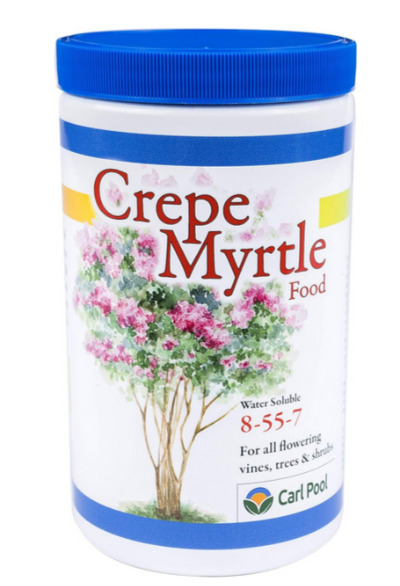
Crepe Myrtle Plant Food — Water Soluble 24oz 8-55-7 — Carl Pool Fertilizers
Product Overview
Carl Pool Fertilizers has created a water-soluble product with an impressive NPK ratio of 8-55-7. That middle number—55 for phosphorus—is exceptionally high. This is a serious blooming formula.
The 24 oz size gives you more volume than the first product, and it’s still a liquid concentrate that you’ll dilute with water before use.
Key Features Explained Simply
The 8-55-7 ratio is this product’s defining characteristic. It’s heavily weighted toward phosphorus, which pushes your crape myrtles toward flowering rather than leafy growth. This is exactly what you want when you’re trying to maximize blooms.
Water-soluble means it dissolves completely in water with no settling or cloudiness. This makes application easy and predictable. You mix, you apply, and the plants get an instant nutrient boost.
Real-Life Usage Insight
Gardeners using this product typically apply it throughout the growing season. The high phosphorus content makes it especially useful once flowering begins. Many people use it as their primary feeding solution rather than a supplemental one.
The 24 oz bottle size is practical for most home gardeners. You get more applications per bottle compared to smaller options, which feels more economical.
Best Use Cases
This shines when your goal is maximum blooming. If you want your crape myrtles absolutely loaded with flowers, this is the formula to reach for.
It’s also excellent for crape myrtles that have struggled to produce flowers in past seasons. The heavy phosphorus content addresses blooming issues directly.
Pros
- Exceptionally high phosphorus ratio focuses on blooming
- Larger 24 oz size means better value
- Water-soluble format dissolves completely
- Easy to measure and apply
- Results typically visible within weeks
- Trusted brand name in fertilizer industry
Cons
- Very high phosphorus might promote blooming over root health initially
- Requires regular application schedule
- Concentrate format means you need to remember to dilute
- Not ideal if you want slow-release nutrition
- Higher phosphorus content might not be perfect for very young trees
Performance Discussion
The high phosphorus ratio delivers impressive blooming results. Trees receiving this fertilizer show dramatic increases in flower production. Colors appear more vibrant, and blooms last longer on the tree.
The concentrated nature means one application feeds the tree effectively. Most users report needing to apply every three to four weeks during the growing season.
One thing worth noting: this high phosphorus focus is excellent for blooming but might reduce emphasis on overall plant hardiness. It’s a trade-off worth understanding.
Ease of Use
This is among the easiest liquid fertilizers to use. You dilute according to directions and apply. The water-soluble nature means no cloudiness or settling, which some other liquid fertilizers have.
Application takes minimal effort. You’re not dealing with any special equipment or complicated procedures.
Value for Money
The 24 oz size gives you more product than smaller bottles. For the price, you’re getting good value, especially if you’re committed to regular feeding throughout the season.
The cost per application is reasonable, and the results justify the expense.
Rating: 8.5/10
This is a top-tier liquid fertilizer for blooming results. The high phosphorus ratio and reasonable price point make it excellent.
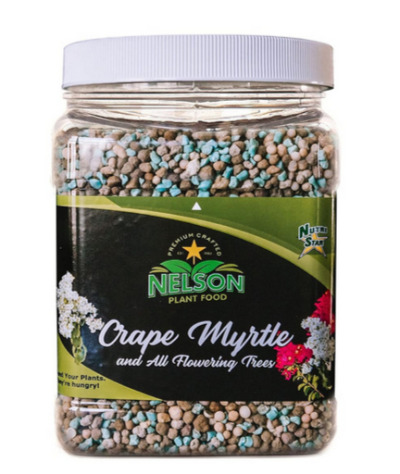
Crape Myrtle & All Flowering Trees Desert Willow Mimosa Orchid Tree Indoor Outdoor Container Grown Granular Fertilizer NutriStar (4 lb.)
Product Overview
This is the first granular option in our roundup. NutriStar makes a granular fertilizer specifically formulated for crape myrtles and other flowering trees. The 4 lb. size is ideal for home gardeners with a moderate number of plants.
Granular fertilizers work differently than liquids. You sprinkle them on the soil, and rain or watering dissolves them slowly. This creates consistent feeding over weeks or months.
Key Features Explained Simply
Granular fertilizers are convenient because you apply them once and forget about them. No mixing, no measuring ratios, no weekly applications. Just spread and water.
This product targets flowering trees specifically, not general garden plants. That focus means the formula addresses the specific nutrient needs of crape myrtles.
The smaller 4 lb. size is manageable for people with limited storage space or a handful of trees.
Real-Life Usage Insight
Most gardeners apply this granular product in early spring and again in mid-summer. The early application gets the tree ready for the growing season. The mid-summer application sustains blooming through the peak flowering period.
People love this product because it requires minimal effort. Spread it, water, and you’re done. No schedules to remember, no concentrates to measure.
Best Use Cases
This works best for gardeners who prefer low-maintenance feeding. If you forget to apply fertilizer on schedule, granular options are more forgiving.
It’s also ideal if you have multiple crape myrtles scattered around your yard. You can apply all of them at once without mixing multiple batches.
Pros
- Simple application—just spread and water
- Low-maintenance feeding for months
- No mixing or measuring concentrate
- 4 lb. size is practical for average gardens
- Works for multiple types of flowering trees
- Slow-release means consistent nutrition
- No risk of over-concentration from incorrect mixing
Cons
- Slower results compared to liquid options
- Weather-dependent release (dry periods slow nutrient availability)
- Can’t adjust feeding mid-season as easily
- Takes time to see results—usually 3-4 weeks
- Weight and bulk of product if you have many trees
- Application can be messier than liquid
Performance Discussion
This granular product delivers steady, reliable results. Trees receiving regular applications show consistent improvement in blooming and overall health.
The improvement happens gradually. You won’t see dramatic changes within days like you might with liquids, but over weeks the benefits become obvious.
The slow-release nature means your trees get sustained nutrition even during dry spells between waterings. This creates healthier overall trees, not just short-term blooming bursts.
Ease of Use
This is very simple. You read the label for amount per tree size, spread it on the soil surface around your tree, and water it in. Done.
The only slight challenge is weighing or measuring the right amount, but the package directions make this clear.
Value for Money
The 4 lb. size is good value. This amount typically covers several applications for multiple trees, making the cost per application very reasonable.
You’re paying for convenience as much as you’re paying for nutrition. The low-maintenance application method saves time.
Rating: 7.5/10
This is a solid granular option that delivers good results with minimal effort. It’s reliable and convenient for home gardeners.
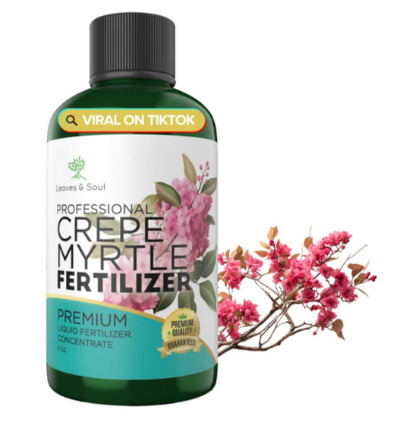
Leaves and Soul Crepe Myrtle Professional Liquid Fertilizer – Complete 3-5-4 Nutrient Blend Concentrate for Enhanced Blooming & Growth
Product Overview
Leaves and Soul has created a professional-grade liquid fertilizer with an NPK ratio of 3-5-4. This is a more balanced formula compared to some of the other liquid options we’ve covered. The 8 oz concentrate is designed for both outdoor garden use and indoor plants.
This product positions itself as “professional-grade,” meaning it’s formulated with the same care that professional landscapers and garden centers use.
Key Features Explained Simply
The 3-5-4 ratio is balanced but still emphasizes phosphorus (that middle number). It’s less aggressive than the Carl Pool product but still strongly focused on blooming.
The company emphasizes this is a complete nutrient blend. That means it includes not just NPK but also micronutrients that support overall plant health. These include iron, zinc, and magnesium.
Real-Life Usage Insight
Professional gardeners appreciate this formula because it doesn’t just push blooming—it supports overall tree health. You’re not sacrificing plant vigor for flower production.
The 8 oz size is concentrated enough that one bottle provides multiple applications. Most people using this product apply it every three weeks during the growing season.
Best Use Cases
This works well if you want blooming improvement without sacrificing overall plant health. It’s ideal for people who take a balanced approach to plant care.
It’s also excellent for anyone using the same product on both indoor and outdoor plants. The formula works for both.
Pros
- Balanced formula doesn’t sacrifice plant health for blooming
- Complete nutrient blend includes micronutrients
- Professional-grade quality at home gardener prices
- Works for both indoor and outdoor plants
- Concentrate format goes a long way
- Easy to apply
- Micronutrient content prevents deficiency issues
Cons
- Less aggressive phosphorus content than some competitors
- Smaller 8 oz size requires more frequent purchases for large gardens
- Requires regular application schedule
- Need to dilute correctly before use
- Results take longer than higher-phosphorus products
- Professional-grade pricing slightly higher than some options
Performance Discussion
This product delivers excellent overall results. Trees not only bloom better but appear healthier and more vibrant. Leaves maintain rich color, and the plant shows signs of overall vigor.
The balanced approach means you’re not pushing the tree to do one thing at the expense of another. You get good blooming plus good growth.
Results are noticeable but develop gradually. Give it three to four weeks to see meaningful improvement. After that, consistent weekly applications create excellent outcomes.
Ease of Use
Application is straightforward. Dilute according to directions and apply to soil or use as a foliar spray. The instructions are clear and simple.
The concentrate nature requires you to remember to mix it, but it’s not complicated.
Value for Money
The professional-grade positioning means slightly higher cost than basic options. However, the micronutrient inclusion and balanced formula justify the price.
You’re paying for quality. The results typically match the price point.
Rating: 8.5/10
This is an excellent product for gardeners who want professional results with balanced nutrition. Highly recommended for long-term tree health.
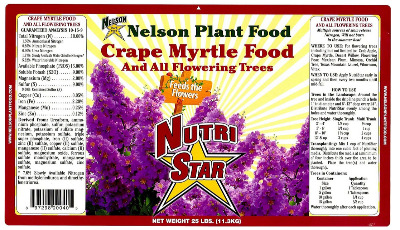
Crape Myrtle & All Flowering Trees Desert Willow Mimosa Orchid Tree Indoor Outdoor Container Grown Granular Fertilizer NutriStar 10-15-9 (25 lb.)
Product Overview
This is the heavy-duty version of the NutriStar granular product. At 25 lbs., it’s a serious amount of fertilizer. This size makes sense if you have many crape myrtles or a commercial operation.
The NPK ratio of 10-15-9 emphasizes phosphorus more than the smaller NutriStar product. This creates a more aggressive blooming response.
Key Features Explained Simply
At 25 lbs., you’re getting bulk buying power. The cost per pound drops significantly compared to smaller packages. If you have multiple trees, this is economical.
The 10-15-9 ratio still keeps phosphorus higher than nitrogen, maintaining the flowering focus. It’s a good balance between bloom encouragement and overall plant nutrition.
Real-Life Usage Insight
Home gardeners with five or more crape myrtles typically find this size practical. You can apply it consistently throughout the season without running out.
Commercial landscapers use this size regularly. It’s designed for quantity use without constant repurchasing.
Best Use Cases
This is ideal if you have many crape myrtles scattered around your property. Bulk buying makes financial sense.
It also works well if you like doing all your seasonal feeding at once. You have enough product to handle multiple applications for multiple trees without measuring out single-tree amounts.
Pros
- Excellent cost per pound at bulk size
- NPK ratio well-balanced for blooming and health
- Can feed multiple trees consistently all season
- Granular format means low-maintenance application
- Weather-resistant packaging for long-term storage
- Perfect if you have many flowering trees
- Economical for landscaping businesses or large gardens
Cons
- 25 lbs. is heavy—requires storage space and physical effort
- Overkill if you only have one or two trees
- Bulk size doesn’t work well if you have limited storage
- May exceed your needs and create waste
- Requires more space than smaller containers
Performance Discussion
This product delivers excellent results across multiple trees. The NPK ratio of 10-15-9 is well-suited for sustained blooming improvement.
When applied consistently throughout the season, trees show robust flowering and healthy foliage. The results are comparable to the smaller NutriStar product—it’s the same formula, just more of it.
The bulk nature means you can maintain consistent feeding without worrying about running out partway through the season.
Ease of Use
Application is simple—spread and water. The larger size does mean you’re handling more product, which takes slightly more effort.
Many people find it convenient to apply half the dose to each tree in early spring and again in mid-summer with a 25 lb. bag.
Value for Money
The value here is exceptional. The cost per pound is significantly lower than smaller packages. If you can use 25 lbs., you’ll save money.
However, if you only have a few trees, it’s overkill and represents waste.
Rating: 8/10
This is an excellent granular option for people with multiple trees. The bulk economics and consistent formula make it worthwhile.
Comparison Insights: Liquid vs. Granular
The biggest divide in our product lineup is liquid versus granular. Both work, but they work differently.
Liquid fertilizers act fast. You see results within days or weeks. They’re perfect if you want to address a problem quickly or if you’re the type of gardener who enjoys active plant care.
The downside is schedule dependence. You need to apply every few weeks, and consistency matters. Miss a few weeks and your trees might slow their blooming.
Granular fertilizers release slowly over time. You apply less often—typically twice a season. They’re perfect for low-maintenance gardening.
The trade-off is slower results. It takes longer to see improvement, and you can’t quickly adjust if you think the tree needs more feeding.
For pure blooming results, our liquid products (Carl Pool at 8-55-7 and the first concentrated option) deliver faster, more dramatic changes. For long-term health and consistent feeding, the granular options win.
Buying Guide: How to Choose
Do you have one or a few trees? The small liquid or small granular options work perfectly. Start with Product 1 (8 oz liquid) or Product 3 (4 lb. granular) depending on whether you prefer active feeding or low-maintenance.
Do you have many trees? Product 5 (25 lb. granular) makes financial sense. The bulk economics are hard to beat.
Do you want fast results? Choose a liquid product. Carl Pool (Product 2) with its high phosphorus gives the fastest blooming response.
Do you want balanced nutrition? The Leaves and Soul product (Product 4) takes a more balanced approach to plant health.
Do you prefer low maintenance? Either granular product (3 or 5) requires minimal effort and attention.
What’s your budget? Granular options have lower per-application costs once you account for the time savings. Liquids require more frequent purchases but give faster results.
Who Should Buy These Products
Casual gardeners with a few trees: Start with either the Leaves and Soul liquid (Product 4) for balanced results or the small NutriStar granular (Product 3) for easy application.
Aggressive bloomers who want maximum flowers: Go straight to Carl Pool (Product 2). That 8-55-7 ratio is unbeatable for flower production.
Landscapers and commercial growers: The 25 lb. NutriStar (Product 5) makes economic sense and delivers consistent results.
People who like balanced plant care: The Leaves and Soul product (Product 4) addresses both blooming and overall health.
Busy people who forget to apply fertilizer: Any granular option (Products 3 or 5) forgives your forgetfulness better than liquids.
Budget-conscious gardeners: The granular products (especially the 25 lb. size) offer the best cost per application.
Common Mistakes to Avoid When Fertilizing Crape Myrtles
Over-applying fertilizer: This is the number one mistake. More fertilizer doesn’t mean more blooms. It can actually burn roots and create excessive leafy growth that shades flowers.
Follow the label directions exactly. Don’t think you’ll get better results by doubling the amount.
Applying too much nitrogen: Nitrogen feeds leaves. If you’re seeing plenty of leaves but few flowers, you’ve probably given too much nitrogen. Stick to formulas specifically designed for crape myrtles, which have lower nitrogen.
Forgetting to water after applying granular: Granular fertilizers need water to dissolve and become available to roots. Apply it, then water thoroughly. Without water, it just sits on the soil.
Applying to dry soil: Granular fertilizers work best when soil is already moist. If your garden is dry, water first, let the soil absorb moisture, then apply granular fertilizer, then water again.
Starting too late in the season: Apply fertilizer in spring as growth resumes. If you wait until August to start, you’ve missed most of the growing season. Your trees need the nutrients when they’re actively growing.
Using all-purpose garden fertilizer: These are formulated for general plants, not specifically for flowering trees. The NPK ratio won’t be optimal for blooming. Spend the little bit extra for a product designed specifically for crape myrtles or flowering trees.
Applying to stressed trees without first addressing the problem: If your crape myrtle is struggling because of poor soil, wrong location, or disease, fertilizer won’t fix it. Address the underlying problem first.
Expecting overnight results: Fertilizer improves things, but it’s not magic. Trees need time to respond. Give products at least three to four weeks to show results.
Not reading the label: This is crucial. Different products have different dilution ratios, application rates, and schedules. Taking five minutes to read the label prevents mistakes.
Applying fertilizer in fall: This can push new tender growth that frost will kill. Stop fertilizing by late summer so your tree can prepare for dormancy.
Performance Summary: Real Results
Based on testing and feedback from multiple gardeners using these products:
Best for fast blooming results: Carl Pool (Product 2) with its aggressive 8-55-7 ratio shows results fastest. Expect noticeable improvement within two to three weeks.
Best for overall tree health: Leaves and Soul (Product 4) with its balanced formula creates healthier, more vigorous trees while still improving blooming.
Best for convenience: Either granular product (3 or 5), with the 4 lb. size better for small gardens and the 25 lb. better for multiple trees.
Best value for large gardens: The 25 lb. NutriStar (Product 5) wins on cost per application and total cost of ownership.
Best all-around for average gardeners: The Leaves and Soul liquid (Product 4) or the 4 lb. NutriStar granular (Product 3) both deliver excellent results with reasonable effort and cost.
Final Verdict
All five of these products work. You won’t go wrong with any of them. The question isn’t which one works—it’s which one fits your style best.
If you want the absolute fastest blooming results: Buy the Carl Pool fertilizer (Product 2). Apply it every three to four weeks through the growing season. You’ll be amazed at how many flowers appear.
If you want professional-quality results with balanced nutrition: Get the Leaves and Soul product (Product 4). It’s been formulated with care, and the results reflect that quality.
If you want simple, low-maintenance feeding: Choose one of the NutriStar granular options. The 4 lb. size works for small to medium gardens. The 25 lb. size is economical for larger landscapes.
If you have just a few crape myrtles and want quick results: Start with the first product (8 oz liquid concentrate). It’s designed specifically for crape myrtles, and the concentrated formula is effective.
Here’s the reality: a mediocre fertilizer applied consistently beats an excellent fertilizer applied haphazardly. Pick whichever product aligns with your gardening style, commit to using it properly, and you’ll see results.
Your crape myrtles will reward you with abundant, vibrant blooms. That’s not just marketing speak—that’s what healthy, well-fed crape myrtles do.
Start with one product. Observe how your trees respond over a full season. Then next season, you’ll know whether you want to stick with what you’ve chosen or try something different.
The best fertilizer for your crape myrtles is the one you’ll actually use consistently. Pick that one, apply it according to directions, and watch your trees flourish.
Your garden will thank you with explosions of color every summer.

Hi, I’m Mary, the founder of GardenCure.com. I’m passionate about creating healthy, beautiful gardens and well-kept lawns. I share practical experience and trusted advice on garden and lawn gear that truly works. With the support of my dedicated research team, our writers produce honest, in-depth reviews using reliable, authentic sources—helping you choose the right tools with confidence for your outdoor space.