How to Fertilize Japanese Maple?
Japanese maples are some of the most beautiful trees you can plant in your yard. Their delicate leaves, graceful branches, and stunning fall colors make them worth the effort to keep them healthy and happy. But here’s the thing—keeping a Japanese maple thriving means knowing how to feed it properly. The good news? Fertilizing your Japanese maple is easier than you might think.
In this article
In this guide, I’ll walk you through everything you need to know about Japanese maple fertilization, from spotting the signs your tree needs nutrients to applying fertilizer the right way. Let’s dig in.
Why Your Japanese Maple Needs Fertilizer
Before we talk about how to fertilize, let’s cover the “why.” Japanese maples need nutrients to grow strong, produce vibrant leaves, and develop a healthy root system. When your tree gets the right nutrients, it becomes more resistant to stress and disease.
The thing is, most Japanese maples don’t actually need as much fertilizer as you might expect. These trees are adapted to grow in forests where they thrive under natural leaf litter and organic matter. However, if your tree lives in a yard or a potted container, it loses access to that natural nutrient cycle. That’s where fertilizer comes in.
Your Japanese maple uses nutrients from the soil to build new growth, maintain leaf color, and strengthen its root system. Without enough nutrients, your tree gets weak, its leaves turn pale or yellowish, and it becomes an easy target for pests and diseases. On the flip side, too much fertilizer can also cause problems, like soft growth that’s prone to pest damage.
The goal is to find the sweet spot—giving your tree enough nutrients to thrive without overdoing it.
Signs Your Japanese Maple Needs Nutrients
How do you know when your Japanese maple is hungry? Here are the main signs to watch for.
Pale or yellowing leaves are often the first red flag. If your tree’s leaves are losing their vibrant color and turning yellow or light green, it might be lacking nitrogen, the nutrient that powers leaf growth and green color.
Slow growth is another sign. If your Japanese maple isn’t putting out much new growth or looks stunted compared to how it should look, fertilizer might help. Healthy Japanese maples produce visible new shoots and leaves during their growing season.
Weak branches that droop or snap easily suggest your tree is stressed and undernourished. Strong branches should feel firm and have healthy, robust growth.
Sparse foliage or a thin-looking canopy tells you the tree is struggling. A well-fed Japanese maple has a dense, full appearance.
Poor fall color is another clue. Japanese maples are famous for their stunning reds, oranges, and yellows. If your tree’s fall colors are dull or pale, it might need more nutrients.
Keep in mind that sometimes yellowing leaves can point to other issues, like poor drainage or disease. Before you jump to fertilizer, make sure the soil isn’t staying too wet and that there are no signs of pests or fungal problems.
The Best Time to Fertilize Japanese Maples
Timing is everything when it comes to fertilizing. Japanese maples have a natural growth cycle, and fertilizing at the right time helps you work with that cycle instead of against it.
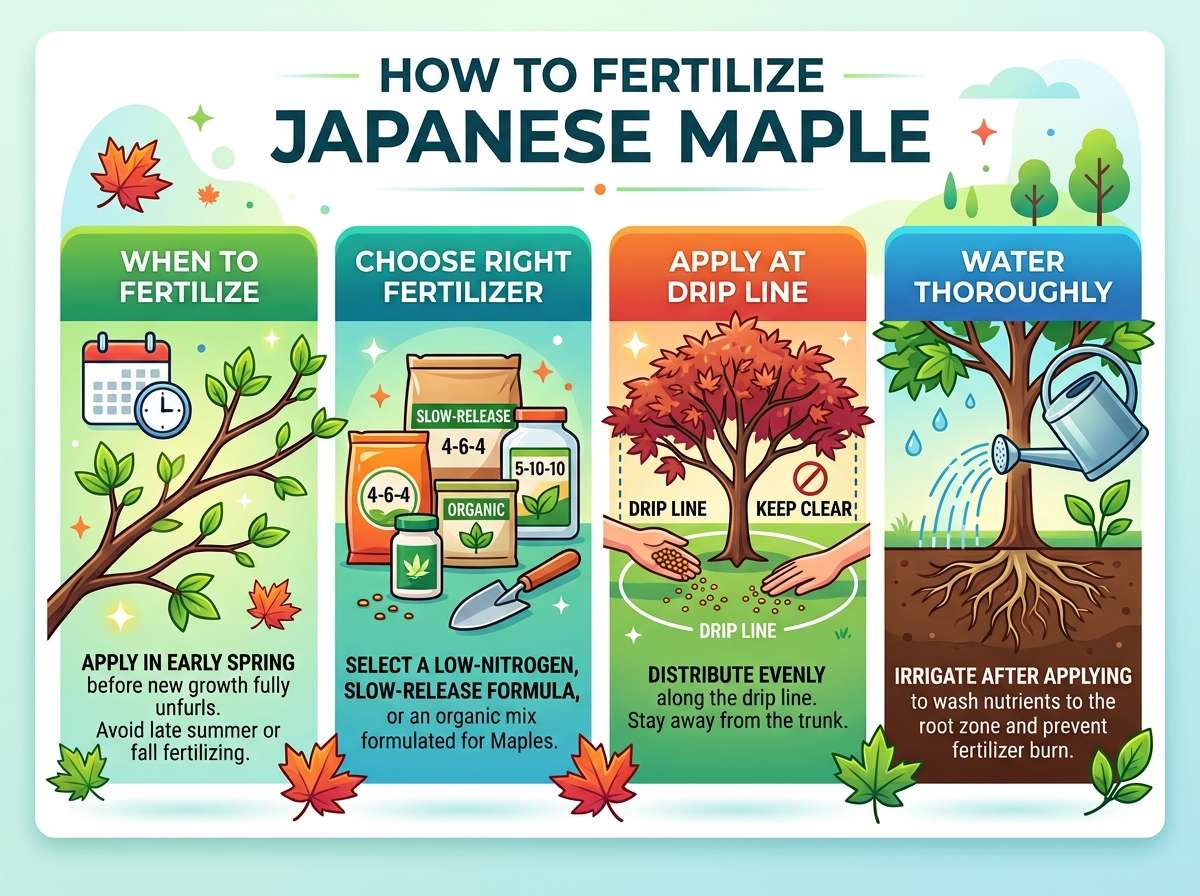
Early spring is the ideal time to fertilize. As soon as you see new leaf buds starting to open or new growth appearing, your tree is waking up and ready to use nutrients. This is when you want to apply your first dose of fertilizer. Early spring applications help fuel the flush of new growth that makes your Japanese maple look so lush.
Late spring to early summer is also a good window. Keep fertilizing while your tree is actively growing. Once your tree has finished its main growth flush—usually by early summer—you can slow down with the fertilizer.
Here’s what you should avoid: don’t fertilize in late summer or fall. Late-season fertilizing pushes soft, tender new growth right when your tree should be preparing for dormancy. This new growth is easily damaged by cold weather and frost, and it weakens your tree heading into the dormant season.
Most gardeners find that fertilizing once in early spring and maybe once more in late spring is plenty. Some people skip fertilizer altogether if their tree is growing well and their soil is rich. You can always start with less fertilizer and add more if you notice your tree needs it.
Types of Fertilizer for Japanese Maples
Not all fertilizers are created equal, and some work better for Japanese maples than others. Let’s look at your main options.
Balanced fertilizers are your safest bet for Japanese maples. A balanced formula has roughly equal parts nitrogen, phosphorus, and potassium—like a 10-10-10 or 5-5-5 ratio. These numbers tell you the percentage of each nutrient. A balanced fertilizer feeds your whole tree without pushing one nutrient over the others.
Slow-release fertilizers are fantastic for Japanese maples because they feed your tree gradually over weeks or months. You apply them once, and they work slowly, which means less risk of overfertilizing. Granular slow-release fertilizers are easy to use and give you steady nutrition all season long.
Liquid fertilizers work fast and get absorbed quickly. If your tree needs a quick nutrient boost, liquid fertilizer works well. Just dilute it to the strength recommended on the bottle and apply it to the soil around your tree. Liquid fertilizers don’t last as long as slow-release types, so you’ll need to apply them more often.
Organic fertilizers like fish emulsion, seaweed extract, and composted manure are gentle options that build soil health at the same time they feed your tree. Organic fertilizers release nutrients slowly, which matches how Japanese maples naturally take up nutrients in forest settings.
Nitrogen-heavy fertilizers can help if your tree has pale leaves and slow growth. These boost leaf growth and green color. Just use them early in the season, not late.
Here’s my take: for most home gardeners, a balanced, slow-release fertilizer is the easiest and safest choice. You don’t need to get fancy. A basic 10-10-10 granular fertilizer works great, or you can use an organic option if you prefer.
Fertilizer Ratios Explained
Those three numbers on every fertilizer bag—the NPK ratio—tell you what you’re getting. Let’s break it down so it makes sense.
Nitrogen (N) is the first number. This nutrient powers leafy green growth and boosts the color of your tree’s foliage. It’s the nutrient responsible for that deep green color Japanese maples are known for.
Phosphorus (P) is the second number. This nutrient supports root development, flowering, and overall plant structure. It helps your tree build a strong foundation.
Potassium (K) is the third number. Potassium boosts overall plant health, disease resistance, and stress tolerance. It helps your tree weather tough conditions.
For Japanese maples, you want these three nutrients in roughly equal amounts. A balanced ratio like 10-10-10, 5-5-5, or even 6-4-6 works well. You don’t need to overthink this. Just look for a balanced formula or one that’s specifically labeled for trees.
Avoid fertilizers that are way too heavy on nitrogen, like a 30-10-10 lawn fertilizer. That pushes too much soft leaf growth and makes your tree weak.
How to Apply Fertilizer to Your Japanese Maple
Application matters just as much as the type of fertilizer you choose. Here’s how to do it right.
For granular slow-release fertilizer:
Start by checking the label to see how much to apply per tree. Most labels give you a rate based on the tree’s size. For a young or small Japanese maple, you might use 1/4 to 1/2 cup. For a larger, mature tree, you might use 1 to 2 cups.
Measure out the right amount. Sprinkle the granules evenly over the soil around your tree, keeping fertilizer a few inches away from the trunk. You don’t want fertilizer piled right up against the bark. Spread the granules out to roughly where the tree’s canopy ends or a bit beyond.
Water the area well. Granular fertilizer needs water to start breaking down and releasing nutrients into the soil. A good watering after application gets the process started.
For liquid fertilizer:
Dilute the liquid fertilizer to the strength recommended on the label. Mix it with water in a watering can or sprayer.
Pour or spray the diluted fertilizer around the base of your tree, over the soil. Water the area so the liquid soaks in and reaches the roots.
Liquid fertilizers work fast, so you’ll see results within days or weeks. The tradeoff is you’ll need to apply them more often, usually every few weeks during the growing season.
For organic fertilizers like fish emulsion:
These work like liquid fertilizers. Dilute them according to the label, then apply to the soil around your tree.
One heads up: fish emulsion has a strong smell that fades over a few days. If you’re fertilizing near a patio or seating area, just know your yard might smell a bit fishy for a while.
How Much Fertilizer Does Your Japanese Maple Really Need?
This is the question that trips up most people. The answer? Less than you probably think.
Japanese maples are not heavy feeders. They don’t need massive amounts of fertilizer to thrive. In fact, overfertilizing is one of the most common mistakes people make with these trees.
Here’s a simple rule of thumb: if your tree is planted in decent garden soil and you’re mulching around it with organic material, you might not need any fertilizer at all. If your tree looks healthy, has good color, and is growing steadily, leave it alone.
If you notice signs of nutrient deficiency—pale leaves, slow growth, weak branches—then start fertilizing. Apply fertilizer once in early spring as new growth emerges. If the tree looks like it needs more help after four to six weeks, apply a second dose in late spring. That’s usually plenty.
For potted Japanese maples, you’ll likely need to fertilize more often because container soil doesn’t have access to fresh nutrients the way in-ground soil does. A light application every four to six weeks during the growing season works well for containers.
The key is to start light and watch your tree. You can always add more fertilizer, but you can’t take it out. Gentle, consistent feeding is better than dumping a bunch of fertilizer on your tree all at once.
Special Situations and Adjustments
Newly planted Japanese maples shouldn’t be fertilized right away. Let them settle into their new home for at least one full growing season before you add fertilizer. New trees need time to develop roots and adjust to their surroundings. After that first season, light fertilizing in spring is fine.
Potted Japanese maples need different care than in-ground trees. Containers don’t retain nutrients like garden soil does. Start with a balanced slow-release fertilizer applied in spring, then follow up with lighter applications or light liquid fertilizer every four to six weeks. You can also refresh the soil each spring with fresh, nutrient-rich potting mix, which reduces your need for extra fertilizer.
Japanese maples with yellowing leaves might be lacking nitrogen. If other parts of the tree look fine but the leaves are pale or light green, a dose of fertilizer with slightly higher nitrogen can help. Fish emulsion or a balanced fertilizer works well.
Stressed or diseased trees shouldn’t be fertilized heavily. A stressed tree can’t use the fertilizer effectively, and too much fertilizer might make things worse. Instead, focus on fixing the underlying problem—better watering, improved drainage, pest control, or whatever your tree needs. Once the tree recovers, you can start light fertilizing.
Mature, established trees that look healthy might not need fertilizer at all. If your Japanese maple has been in your yard for years and looks great, it’s probably fine. Established trees pull nutrients from deep in the soil and don’t need as much supplemental feeding.
Fertilizer Mistakes to Avoid
Let me highlight some common mistakes so you don’t run into trouble.
Overfertilizing is the biggest problem. Too much fertilizer burns roots, pushes soft weak growth, and causes more harm than good. Stick with light applications and watch your tree.
Fertilizing late in the season pushes tender new growth right before dormancy. Skip fertilizer after early summer.
Piling fertilizer against the trunk can burn the bark and damage the tree. Always keep fertilizer a few inches away from the base of the trunk.
Using lawn fertilizer on trees is a mistake. Lawn fertilizer is often way too high in nitrogen. Use a balanced fertilizer meant for trees or ornamentals.
Ignoring soil quality while fertilizing won’t work. If your soil drains poorly or lacks organic matter, fertilizer alone won’t fix it. Add mulch and improve soil health alongside fertilizing.
Forgetting to water after applying granular fertilizer means the granules just sit there without breaking down. Water activates granular fertilizer, so always water after applying.
Building Healthy Soil to Reduce Fertilizer Needs
Here’s a secret: the best fertilizer program starts with good soil. If your soil is rich and healthy, you need way less added fertilizer.
Mulching with organic material like wood chips or shredded leaves builds soil health over time. As mulch breaks down, it adds organic matter and nutrients to the soil. In a forest, Japanese maples are surrounded by fallen leaves that do this job naturally. In your yard, you’re recreating that by adding mulch.
Compost is another soil builder. Work some finished compost into the top few inches of soil around your tree each spring. This feeds your tree slowly and improves soil structure at the same time.
Good drainage is also key. Japanese maples don’t like soggy soil. If your soil stays too wet, roots suffer and your tree can’t take up nutrients properly. If drainage is an issue, add compost or organic matter to improve it.
When you combine good soil care with light, timely fertilizer applications, you get a healthy, thriving Japanese maple that doesn’t need constant babying.
Wrapping It Up
Fertilizing your Japanese maple doesn’t have to be complicated. Start by assessing whether your tree actually needs it. If it looks healthy and is growing well, you might be done. If you notice signs of poor nutrition—pale leaves, slow growth, weak branches—then fertilize.
Use a balanced, slow-release fertilizer in early spring as new growth emerges. Apply according to the label directions, water it in, and that’s usually enough. If your tree needs more help, add a light second application in late spring.
Avoid the temptation to overfertilize. Japanese maples thrive on modest amounts of nutrition. Build your soil with mulch and compost, water consistently, and make sure your tree has good drainage. When you combine these basics with appropriate fertilizing, your Japanese maple will stay vibrant and beautiful for years to come.
Your tree will thank you with stunning fall colors, graceful growth, and the kind of health that makes gardening rewarding.

Hi, I’m Mary, the founder of GardenCure.com. I’m passionate about creating healthy, beautiful gardens and well-kept lawns. I share practical experience and trusted advice on garden and lawn gear that truly works. With the support of my dedicated research team, our writers produce honest, in-depth reviews using reliable, authentic sources—helping you choose the right tools with confidence for your outdoor space.