5 Best Fertilizer for Tomato Plants In 2026
Growing tomatoes at home sounds simple. You stick a seedling in the ground, water it, and wait for juicy red fruits to appear. Right? Not quite. The real secret to getting thick, heavy branches loaded with bright, flavorful tomatoes lies in feeding them properly.
In this article
Think of fertilizer like a balanced diet for your plants. Just as your body needs protein, carbs, and healthy fats, tomato plants need specific nutrients to thrive. Without proper nutrition, you’ll end up with weak stems, yellowing leaves, and disappointing harvests of small, bland fruit.
The challenge is figuring out which fertilizer actually works. Walk into any garden store and you’ll see dozens of products. Some promise instant results. Others claim to be completely organic. A few seem overpriced for what you get. So how do you know which one is right for your garden?
That’s exactly why we put five popular tomato fertilizers to the test. We reviewed each product based on real performance, ease of use, cost, and what experienced gardeners actually report. By the end of this guide, you’ll know exactly which fertilizer fits your situation and growing style.
What to Look for in a Tomato Fertilizer
Before we jump into individual products, let’s talk about what makes a good tomato fertilizer.
Tomatoes are what gardeners call “heavy feeders.” This means they soak up a lot of nutrients while they grow. They need nitrogen in early growth for strong leaves and stems. As they mature, they need more phosphorus and potassium to support flowering and fruit production. Calcium is also crucial because it prevents blossom end rot, a dark spot that ruins the bottom of your tomatoes.
The numbers on any fertilizer bag tell you the nutrient ratio. A label that says “3-4-6” means 3% nitrogen, 4% phosphorus, and 6% potassium. For tomatoes, you want less nitrogen than phosphorus and potassium. Too much nitrogen and your plant gets bushy leaves but few fruits.
You should also think about whether you want granules that you sprinkle into the soil or a liquid you mix with water. Granules release nutrients slowly over time. Liquids work faster but need more frequent applications. Organic options use plant and mineral sources while synthetic fertilizers use processed chemicals. Organic is safer for food crops and builds better soil long-term, but synthetics often deliver faster results.
Miracle-Gro Shake ‘N Feed Tomato, Fruit and Vegetable Plant Food
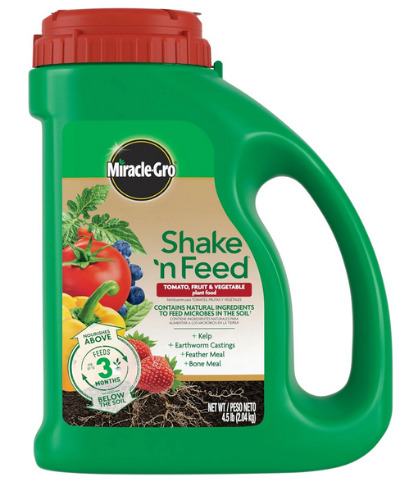
Quick Stats:
- Type: Granular synthetic fertilizer
- NPK Ratio: 6-18-6
- Coverage: Feeds up to 3 months
- Package Size: 4.5 lb
Product Description
Miracle-Gro Shake ‘N Feed is one of the most popular tomato fertilizers on the market. The product comes in a shaker bottle, so you don’t have to measure anything. Just sprinkle it around your tomato plants and water it in. The granules dissolve into the soil and feed your plants gradually over three months.
This is a synthetic fertilizer, which means it uses processed chemicals rather than organic materials. The formula is designed specifically for tomatoes, fruits, and vegetables. The company claims it produces bigger fruit and more of it compared to unfertilized plants.
Best Use Cases
This fertilizer works best for gardeners who want a simple, no-fuss approach. If you have a small garden with just a few tomato plants, the shaker bottle makes it quick to apply. It’s excellent for container gardens and in-ground plants alike. The three-month feeding window is handy because you only need to apply it a few times per season.
New gardeners often choose this product because the instructions are straightforward. You don’t need to figure out mixing ratios or measuring powders. Just shake and spread.
Key Features Explained
The NPK ratio of 6-18-6 is worth understanding. The high phosphorus (18) makes this formula focus on flowers and fruits. That’s the main reason tomatoes respond well to it. The granules are coated with a special polymer that releases nutrients slowly as your soil stays moist and warm. This means you don’t get a sudden nutrient dump followed by starvation. Instead, your plants get steady feeding.
The product also contains micronutrients like iron, magnesium, and zinc. These help with overall plant health even though they’re needed in tiny amounts. The shaker bottle design is surprisingly convenient. No bags to open, no scoop to find, no math to do.
Real-Life Usage Insight
In practice, this product delivers reliable results for most gardeners. When applied according to directions, you’ll notice healthier leaf color within a week or two. Fruit production tends to kick in noticeably. Gardeners report that their plants look fuller and flower more prolifically than with generic vegetable fertilizers.
The three-month feeding window actually works as advertised in most climates. You’ll typically apply it once at planting, once during early flowering, and possibly once more mid-season depending on your area. Regular watering is important because the slow-release coating depends on moisture to break down properly.
One thing to note: the high phosphorus might cause some magnesium deficiency in certain soil types, particularly sandy soils. This shows up as yellowing between the leaf veins. It’s easily fixed with a magnesium spray or epsom salt solution, but it’s worth knowing about.
Honest Pros and Cons
Pros:
- Simple shaker bottle application saves time
- Reliable three-month slow-release formula
- Specifically formulated for tomatoes
- Works on both container and garden plants
- Reasonably priced
- Widely available at most garden stores
- Good results for growing bigger fruit
Cons:
- Synthetic, not organic (matters if you want organic gardening)
- High phosphorus can occasionally trigger magnesium issues
- Granules don’t work well in very dry soil
- Some gardeners report inconsistent results with container plants
- Not the best choice for soil that’s already nutrient-rich
- Strong chemical smell when first applied
- Dust can irritate lungs if you apply it on windy days
Performance Discussion
This fertilizer punches above its price point in terms of actual performance. Tomato plants fed with Miracle-Gro Shake ‘N Feed show noticeably more vigorous growth and heavier fruit set than unfertilized plants. The fruits tend to be larger and the harvest season extends longer because the plant stays healthier throughout.
However, it’s not a miracle product. If your soil is poor quality or you don’t water properly, Miracle-Gro can’t overcome those problems. Similarly, if you live in a region with intense heat or heavy rain that washes out soil nutrients, you might need additional feeding beyond the three-month window.
The product works best when you have decent baseline soil and consistent watering. It’s an enhancer, not a complete replacement for healthy soil practices.
Ease of Use
This is where Miracle-Gro Shake ‘N Feed really shines. Open the bottle, shake it around your plants, water them in, and you’re done. The directions are clear and printed right on the label. You don’t need special equipment, measuring tools, or mathematical skill. Even complete beginners can apply it confidently.
The shaker bottle design means less mess compared to dumping granules from a bag. It also makes it easy to portion out the right amount without guesswork. For gardeners with arthritis or mobility issues, the light weight and easy-grip bottle are significant advantages.
Value for Money
A 4.5 lb bottle costs around $7-10, making it one of the cheapest options per pound. The three-month feeding window means you only buy it 2-3 times per season, keeping annual costs low. For the results you get, the price is fair. You’re not paying for fancy packaging or organic certification, so you get solid value in the actual fertilizer itself.
If you’re feeding multiple plants, a single bottle covers quite a bit of garden space. That makes the per-plant cost very reasonable for most home gardeners.
Burpee Organic Tomato & Vegetable Granular Plant Food
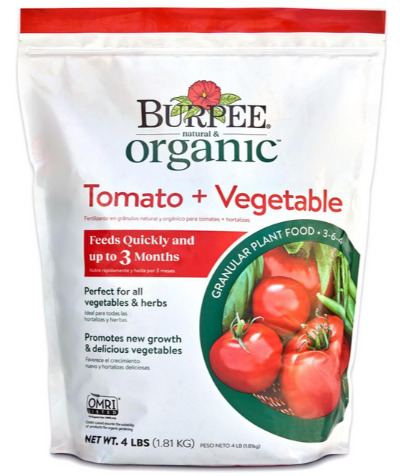
Quick Stats:
- Type: Granular organic fertilizer
- NPK Ratio: 3-7-4
- Certified Organic: Yes
- Package Size: 4 lb
Product Description
Burpee is a name gardeners have trusted for generations. Their organic tomato and vegetable fertilizer uses natural sources rather than synthetic chemicals. The granules break down in your soil, feeding microorganisms that make nutrients available to your plants. This approach builds soil health over time, not just feeding plants for one season.
The product contains ingredients like bone meal, kelp, alfalfa meal, and feather meal. These are all natural, real-world materials that decompose in your soil. Because it’s organic certified, you can feel confident using it on vegetables you’ll eat.
Best Use Cases
This fertilizer is ideal if you want organic certification for your vegetables or if you simply prefer not to use synthetic chemicals. It’s perfect for gardeners who care about long-term soil health, not just quick results. It works well in established gardens where you’ve been building soil quality for a while.
This product is also excellent for gardeners willing to apply fertilizer more frequently in exchange for better environmental practices. The slower-release formula means you’ll feed your plants 3-4 times per season rather than 2-3 times with synthetic options.
Key Features Explained
The NPK ratio of 3-7-4 is lower overall than synthetic options, but look at how balanced it is. The higher middle number (phosphorus at 7) still supports flowering and fruiting. The organic sources release nutrients slowly as microbes break them down, which means you get sustained nutrition without nutrient spikes.
Bone meal provides phosphorus and calcium, helping prevent blossom end rot. Kelp and alfalfa offer trace minerals and growth-promoting compounds. Feather meal provides slow-release nitrogen. These ingredients work together synergistically, creating nutrition that’s more complete than a simple synthetic blend.
The granules need moisture and warmth to break down, so they perform best in established gardens with good soil microbe activity. They also improve soil structure and water retention over time, making them an investment in your garden’s future.
Real-Life Usage Insight
Experienced gardeners love this product because they see improvements in soil quality over multiple seasons. In year one, you get decent results. By year two and three, your soil becomes richer and darker, microbial activity increases, and plants become more resilient to problems.
Application is straightforward: sprinkle around plants and work it into the top inch of soil, then water thoroughly. Because it breaks down gradually, you need to be proactive about timing. Most gardeners apply it at planting, then every 4-6 weeks throughout the growing season.
The slower breakdown means you rarely see nutrient deficiency problems. Plants fed with organic fertilizers tend to be more balanced nutritionally compared to those on synthetic diets. Flavoring often improves too, with tomatoes developing more complex taste.
Honest Pros and Cons
Pros:
- Certified organic, safe for food crops
- Improves soil structure and microbial life
- Balanced nutrition reduces deficiency problems
- No synthetic chemicals or processing
- Excellent long-term investment in soil health
- Less likely to cause nutrient burns
- Produces good-tasting tomatoes
- Environmentally responsible
Cons:
- More expensive than synthetic options
- Requires more frequent applications (3-4 times vs 2-3)
- Slower nutrient release than synthetic
- Needs good soil microbe activity to work effectively
- Poor performance in cold soil
- Takes longer to see visible results
- Less convenient than shaker bottles
- Harder to find in some regions
- May attract birds or insects to fresh granules
Performance Discussion
This fertilizer delivers solid performance when used correctly. It won’t produce the massive tomatoes that you might get with aggressive synthetic feeding, but it produces healthy, robust plants with good fruit quality. The results unfold more gradually, but they’re more stable and sustainable.
The key to success with Burpee Organic is proper timing and consistent application. Waiting 8 weeks between feedings is too long. You’ll see better results applying it every 4-6 weeks. You also need reasonable soil health to start with. If your soil is essentially dirt with no organic matter, this fertilizer struggles because there aren’t enough microbes to break it down.
In optimal conditions—established garden beds with decent soil, regular watering, and proper timing—this product outperforms synthetic options in terms of plant health and soil improvement. For a single season on poor soil, synthetics work better.
Ease of Use
Application is simple but requires more steps than synthetic options. You sprinkle the granules and work them into the soil surface rather than just shaking them on top. Timing is more critical because you need to apply it more frequently. New gardeners sometimes forget to reapply after 4-6 weeks and think the product didn’t work.
The granules are larger and a bit dusty, so applying on a calm day is better. Some people wear a dust mask if they’re sensitive. Storage requires keeping it dry and cool, which is fine in a garden shed.
Value for Money
This product costs more per pound than synthetic options, usually $9-14 for a 4 lb bag. However, if you consider the long-term soil improvement, the value proposition improves. You’re not just feeding plants; you’re investing in your garden’s health for years ahead.
The more frequent applications mean you’ll buy this product more often per season, increasing overall cost. But the superior soil health and often-better flavor justify the expense for many gardeners. If you’re growing tomatoes for a family to eat, the better flavor alone might be worth the premium.
Espoma Organic Tomato-Tone 3-4-6 with 8% Calcium
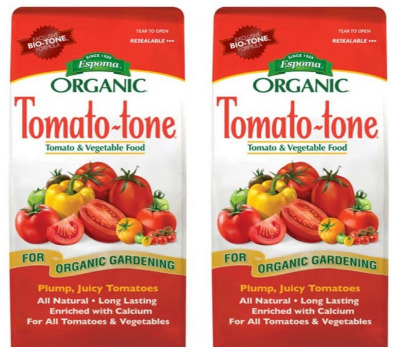
Quick Stats:
- Type: Granular organic fertilizer
- NPK Ratio: 3-4-6
- Calcium Content: 8%
- Package: 4 lb, sold as 2-pack
- Certified Organic: Yes
Product Description
Espoma is a well-established organic brand that’s been around since 1929. Their Tomato-Tone is specifically formulated for tomatoes with extra calcium to prevent blossom end rot. The product comes as a two-pack, so you’re getting 8 pounds total.
The formula uses natural ingredients plus beneficial microbes called Myco-tone. These are mycorrhizal fungi that create networks in your soil, helping your roots absorb nutrients more efficiently. It’s like giving your plants invisible helper hands.
Best Use Cases
This is the best choice if blossom end rot is your biggest problem. That 8% calcium is significantly higher than other organic options. If you’ve had blossom end rot damage in the past, this product addresses that specific issue.
It’s also excellent if you want certified organic and are willing to pay more for a premium product. The mycorrhizal fungi justify the higher cost because they genuinely improve soil function. This works great for gardeners who want real organic performance without compromises.
Key Features Explained
The 3-4-6 NPK ratio is balanced toward potassium, which supports fruit quality and plant stress resistance. That 8% calcium is the real star feature. Calcium prevents blossom end rot by ensuring consistent calcium availability throughout the growing season. This is critical in areas with inconsistent rainfall or in container gardens where water stress is common.
The Myco-tone beneficial fungi establish symbiotic relationships with tomato roots. These fungi dramatically expand the root’s surface area, allowing better nutrient and water uptake. You can’t see this happening, but it translates to healthier, more resilient plants.
The organic sources in this formula include kelp meal, fish meal, and bone meal. These provide a mix of nutrients plus beneficial compounds that synthetic formulas completely lack. The formula also contains seaweed extract, which boosts plant immunity and stress response.
Real-Life Usage Insight
Gardeners report excellent results with this product, particularly those dealing with blossom end rot. Many switch to Espoma Tomato-Tone specifically because it solved their calcium problems. The mycorrhizal fungi take a few weeks to establish, but once they do, plant performance improves noticeably.
People growing in containers find this product especially helpful because containers are prone to calcium inconsistencies. The consistent calcium availability through the season prevents the frustrating pattern of perfect fruits followed by a batch of sunken-bottom tomatoes.
The scent is fresh and earthy, not chemical. Application is easy: work the granules into the soil around your plants and water well. Most gardeners apply it at planting time and then again 3-4 weeks later.
Honest Pros and Cons
Pros:
- High calcium prevents blossom end rot
- Contains mycorrhizal fungi for better nutrient uptake
- Certified organic and completely safe
- Excellent for container gardening
- Good balance of nutrients
- Includes seaweed extract
- Works in various soil types
- Long track record of reliability
- Two-pack gives good value for multiple plants
Cons:
- Most expensive option on this list
- Myco-tone needs time to establish (2-4 weeks)
- Requires consistent moisture for fungi to thrive
- Not ideal if your soil is already alkaline
- Larger granules are dusty
- Requires more frequent applications than synthetics
- Overkill if blossom end rot isn’t your problem
- Myco-tone can’t establish in very poor, compacted soil
Performance Discussion
This is arguably the best-performing organic option for general tomato growing. The combination of balanced nutrition, targeted calcium, and beneficial fungi creates an ecosystem where tomato plants thrive. Results appear faster than with basic organic fertilizers, often within 2-3 weeks.
The mycorrhizal benefit really shows in second and subsequent applications. The fungi multiply in your soil, so performance improves throughout the season. By mid-season, plants fed consistently with Espoma show noticeably better vigor and productivity than those on other organic programs.
If you use this product for a full year in established garden beds, you’ll see cumulative improvements. The soil becomes more active, plant stress tolerance increases, and harvests improve.
Ease of Use
Application is straightforward: work granules into soil and water. The product works well whether you use it in beds or containers. Instructions are clear and portion sizes are easy to gauge. Most gardeners apply it 2-3 times per season.
The two-pack is convenient if you have multiple plants, but it means buying more product upfront. The granules are slightly larger and don’t blow away as easily as smaller products.
Value for Money
This is the premium organic option, typically running $12-18 per pound when you buy the two-pack. That’s expensive compared to synthetic options, but you’re getting mycorrhizal fungi, premium organic ingredients, and proven performance.
The value becomes apparent over a full season. If blossom end rot has been costing you 20% of your harvest, the improvement alone pays for the fertilizer. The soil improvements continue year after year, compounding the value.
For gardeners serious about organic gardening, this is money well spent. For casual gardeners just trying to grow a few tomatoes, it’s nice but not necessary.
Farmer’s Secret Tomato Booster Fertilizer (32oz) – Concentrated Liquid Formula
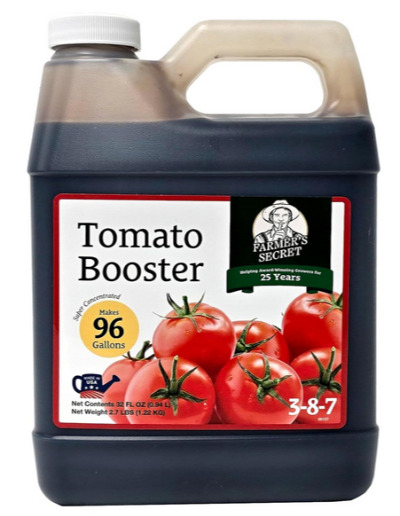
Quick Stats:
- Type: Liquid concentrate
- NPK Ratio: 3-8-7
- Volume: 32 oz (makes multiple gallons)
- Fortified With: Humic acid, iron, calcium
- Application: Weekly feeding
Product Description
Farmer’s Secret Tomato Booster is completely different from the granular products we’ve looked at so far. This is a liquid concentrate that you mix with water. One 32 oz bottle makes enough solution for many weeks of feeding. You apply it weekly as a diluted solution.
The formula is concentrated, meaning it’s strong. You measure out a small amount and add water to create your feeding solution. The company formulates it specifically for boosting flower and fruit production on tomato plants.
Best Use Cases
This product shines if you want rapid results or if you’re dealing with obvious nutrient deficiencies. Liquid fertilizers work faster than granules because nutrients are immediately available. It’s perfect for container gardeners who can feed weekly without much effort.
This is also excellent if you’re mid-season and realize your plants need more nutrition. Granules take weeks to become available. This liquid works within days. It’s the “quick fix” option when you see yellowing leaves or slow growth.
Key Features Explained
The 3-8-7 ratio emphasizes phosphorus and potassium, promoting heavy flowering and fruiting. The humic acid is interesting—it’s a complex organic compound that improves nutrient uptake and soil structure. Iron prevents chlorosis (yellowing leaves). The 8% calcium tackles blossom end rot.
The super-concentrated formula means one small bottle lasts a long time. You typically mix about 1-2 tablespoons per gallon of water, then apply that to your plants weekly. This concentration makes it economical and easy to store.
The liquid format means immediate nutrient availability. When you feed your plants, they can use the nutrients right away rather than waiting for granules to break down.
Real-Life Usage Insight
Gardeners who use this product love the fast results. If you apply it to a yellowing plant, you often see improvement within a week. Flowering increases, new growth appears vigorous and green, and fruit production noticeably picks up.
The weekly application requirement is different from granular products. Some gardeners find it more engaging—you get feedback frequently. Others find it tedious. Skipping a week doesn’t destroy your plants, but consistent feeding produces better results.
The smell is earthy but not unpleasant. The diluted solution doesn’t burn leaves or harm beneficial insects if applied in the evening. Container plants especially respond well because you can dial in exact nutrient levels for your specific situation.
Honest Pros and Cons
Pros:
- Works incredibly fast (days vs weeks)
- Highly concentrated, economical
- Immediately available nutrients
- Excellent for correcting deficiencies
- Great for container gardening
- Easy to adjust strength as needed
- Small bottle is easy to store
- Good for experimenting with feeding levels
- No granules to work into soil
Cons:
- Requires weekly applications
- Need consistent watering schedule
- You have to remember to feed weekly
- Chemical smell is strong when mixing
- Can’t just sprinkle and forget like granules
- Won’t improve soil structure
- Easy to overdose if you’re not careful
- Requires measuring and mixing
- More expensive if you forget applications and waste it
- Not organic (uses synthetic nutrients)
Performance Discussion
This product delivers impressive short-term results. If your goal is maximum fruit production in a single season, liquid feeding works well. Plants respond quickly, and you can adjust the feeding level based on what you see.
However, performance is different from other options. Granular products improve soil and plant health long-term. This liquid feeds plants but doesn’t change soil. Once you stop feeding, the effect stops. There’s no residual benefit.
It’s best used as a supplement alongside some basic soil preparation rather than as the primary nutrition source. Gardeners who use this product plus some compost at planting tend to see the best overall results.
Ease of Use
Ease of use depends on your perspective. Mixing is easy: measure the concentrate, add water, stir. But you need to do it every week. If you’re good at routines, this is no problem. If you’re forgetful, it becomes a hassle.
You also need to measure carefully. Too little and you underfeed. Too much and you can cause nutrient burns, though it’s harder to burn plants with this product than with some others. First-time users should follow the dilution instructions exactly until they gain experience.
Value for Money
A 32 oz bottle costs around $12-16 and provides many weeks of feeding. The actual cost per plant per week is very affordable. If you have multiple tomato plants and feed consistently, the per-plant cost is reasonable.
However, you need to factor in consistent feeding. If you’re an infrequent gardener or have an unpredictable schedule, this product might not be economical if you buy it but forget to use it.
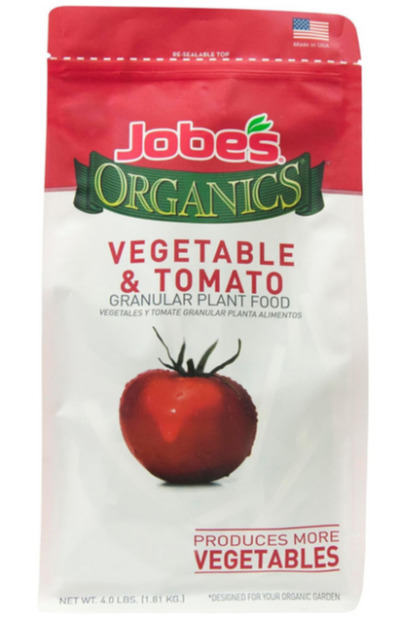
Jobe’s Organics Granular Garden Fertilizer
Quick Stats:
- Type: Granular organic fertilizer
- NPK Ratio: 4-4-4
- Contains: Mycorrhizal fungi
- Package Size: 4 lbs
- Certified Organic: Yes
Product Description
Jobe’s Organics is a mid-range organic option that uses a balanced formula. The 4-4-4 ratio means equal parts nitrogen, phosphorus, and potassium, making it versatile for all types of vegetables, not just tomatoes.
Like Espoma, this product includes mycorrhizal fungi to improve nutrient uptake. However, Jobe’s positions itself as more of a general vegetable fertilizer rather than tomato-specific, so the nutrient balance is different.
Best Use Cases
This works well if you grow multiple types of vegetables and want one fertilizer for everything. If you’re rotating crops or growing tomatoes alongside peppers, beans, and squash, this balanced formula supports them all.
It’s also good for gardeners who want organic certification without tomato-specific formulation. The mycorrhizal fungi make it effective even though it’s not a premium product. It’s a solid middle-ground choice.
Key Features Explained
The 4-4-4 NPK ratio is perfectly balanced. This means it doesn’t push any particular plant function. It provides steady overall nutrition rather than emphasizing flowering or fruiting. The mycorrhizal fungi work the same way as in Espoma—they create beneficial networks in your soil.
The organic sources include chicken feather meal, bone meal, and seabird guano. These are well-established organic fertilizer ingredients with long track records. The formula also contains microorganisms beyond just mycorrhizae, creating a complex biological product.
Real-Life Usage Insight
Gardeners report good results with this product, especially in established gardens. The balanced nutrition keeps plants healthy without pushing one characteristic too hard. Multi-vegetable gardens particularly benefit because the formula doesn’t need adjustment for different crops.
Application is straightforward: work into soil at planting and reapply 4-6 weeks later. The granules are moderate-sized and not particularly dusty. Most gardeners appreciate that this works equally well for their entire vegetable garden.
Honest Pros and Cons
Pros:
- Balanced nutrition supports all vegetables
- Contains mycorrhizal fungi
- Certified organic
- Less expensive than Espoma Tomato-Tone
- Works for multiple vegetable types
- Good granule size, not too dusty
- Long history of reliable use
- Available in most garden centers
Cons:
- Balanced formula means less calcium than tomato-specific products
- Nitrogen might be slightly higher than ideal for fruit crops
- No premium add-ins like seaweed extract
- Mycorrhizae is present but less emphasized than competitors
- Requires 4-6 week reapplication
- Slower results than liquid fertilizers
- Not specifically optimized for tomatoes
- Granules don’t work in very dry soil
Performance Discussion
This product performs solidly across the board. It’s not the absolute best for tomatoes specifically, but it’s not significantly worse either. Where it excels is versatility. If you’re feeding a diverse garden, you save money by not buying separate fertilizers for different crops.
For tomatoes specifically, you might not get the blossom end rot prevention of Espoma Tomato-Tone. However, if your soil already has adequate calcium or you’re not historically prone to that problem, the difference disappears.
The mycorrhizal benefit is real but less aggressive than specialty products. It works well in good soil, moderately well in mediocre soil.
Ease of Use
Application is simple and standard. Sprinkle, work into soil, water. The amount needed is easy to estimate from the bag. Timing reminders are your main challenge—remembering to reapply every 4-6 weeks.
The product is widely available and recognizable, so you can easily find it to reorder. No special tools or knowledge required.
Value for Money
At $8-11 for a 4 lb bag, this is moderately priced. It’s cheaper than premium organic options but more than basic synthetics. For the mycorrhizal benefit and organic certification, the price is fair.
If you grow multiple vegetables, the value is enhanced because you’re using one fertilizer for everything. If you’re growing only tomatoes, tomato-specific products might offer better value.
Product Comparison: Head-to-Head Analysis
Let’s put these five products side by side to help you choose.
Quick Comparison Table
| Product | Type | NPK | Calcium | Cost Range | Best For | Application Frequency |
|---|---|---|---|---|---|---|
| Miracle-Gro Shake ‘N Feed | Synthetic Granule | 6-18-6 | Moderate | $7-10 | Quick, easy results | Every 8 weeks |
| Burpee Organic | Organic Granule | 3-7-4 | Low | $9-14 | Soil building | Every 4-6 weeks |
| Espoma Tomato-Tone | Organic Granule | 3-4-6 | 8% (High) | $12-18 | Blossom end rot | Every 3-4 weeks |
| Farmer’s Secret | Liquid Concentrate | 3-8-7 | Moderate | $12-16 | Fast results, containers | Weekly |
| Jobe’s Organics | Organic Granule | 4-4-4 | Low | $8-11 | Multi-vegetable gardens | Every 4-6 weeks |
Cost Analysis Over a Season
If you’re feeding 4 tomato plants for a 5-month growing season:
Miracle-Gro Shake ‘N Feed: One bottle lasts all season. Cost: $7-10. Cheapest option.
Burpee Organic: Need 3 applications. Cost: $27-42. Mid-range organic cost.
Espoma Tomato-Tone: Buy the two-pack once. Cost: $12-18. Covers season with one purchase.
Farmer’s Secret: One bottle lasts season with weekly feeding. Cost: $12-16. Mid-range total.
Jobe’s Organics: Need 2-3 bags. Cost: $16-33. Mid-range organic cost.
Performance Rankings by Goal
For Maximum Fruit Production: Miracle-Gro ranks first, with Farmer’s Secret liquid a close second.
For Best Tomato Flavor: Espoma Tomato-Tone leads, with Burpee Organic close behind.
For Soil Improvement: Burpee Organic excels long-term, with Espoma good for single-season improvement.
For Container Gardening: Farmer’s Secret liquid and Miracle-Gro Shake ‘N Feed tie for easiest and fastest results.
For Organic Certification: All organic products tie, but Espoma offers the most features and best for specific tomato issues.
For Beginner Gardeners: Miracle-Gro Shake ‘N Feed is simplest, Espoma is best if you want organic.
For Budget Conscious: Miracle-Gro beats everything on total cost.
For Preventing Blossom End Rot: Espoma Tomato-Tone, with its 8% calcium, is clearly superior.
Complete Buying Guide: How to Choose the Right Fertilizer for Your Situation
Choosing the right tomato fertilizer depends on your specific circumstances. Let’s walk through the decision process.
Question 1: Do You Want Organic?
This is often the first decision. Organic means no synthetic chemicals, certified by official bodies, and made from natural sources. If you want organic certification for vegetables you’re selling or if you simply prefer natural products, stick with Burpee, Espoma, or Jobe’s.
If organic doesn’t matter to you and you want best results with minimal effort, Miracle-Gro Shake ‘N Feed wins on performance and price.
Farmer’s Secret is synthetic but not organic-certified. It’s a middle ground.
Question 2: Are You Prone to Blossom End Rot?
Blossom end rot appears as a dark, sunken spot on the bottom of tomatoes. It’s caused by inconsistent calcium availability, often from inconsistent watering. If you’ve had this problem before, Espoma Tomato-Tone’s 8% calcium directly addresses it.
If you haven’t had this problem or your watering is reliable, extra calcium isn’t necessary. Other products work fine.
Question 3: Do You Have Container Plants or In-Ground Garden?
Container plants need more attention. Soil in containers drains faster and depletes more quickly. Liquid feeding with Farmer’s Secret works beautifully for containers because you can water deeply and feed simultaneously.
For in-ground gardens with decent soil, granular products work fine. The slower release matches the root system’s ability to access nutrients from established soil.
Question 4: How Much Time Are You Willing to Spend?
Miracle-Gro Shake ‘N Feed requires the absolute minimum time. Shake, spread, water. Done.
Liquid fertilizers require weekly mixing and application. Granular organics require every 4-6 week applications. Choose based on your available time and consistency.
Question 5: What’s Your Soil Quality?
If you have rich, dark soil with visible organic matter and good structure, even basic fertilizers work well. Your soil is already doing half the job.
If your soil is poor, sandy, or compacted, you need better-quality fertilizers with microbial activity. Espoma or Burpee build soil health while feeding plants.
Question 6: How Much Are You Willing to Spend?
Budget under $10 per season: Miracle-Gro Shake ‘N Feed is your only real option.
Budget $15-25 per season: Burpee Organic, Jobe’s Organics, or Farmer’s Secret work well.
Budget $20+ per season: Espoma Tomato-Tone is the premium choice with maximum features.
Who Should Buy These Products?
Buy Miracle-Gro Shake ‘N Feed If You:
- Are a beginner gardener
- Want maximum convenience
- Have a tight budget
- Have never gardened before
- Grow only 1-4 tomato plants
- Don’t care about organic
- Want visible results quickly
- Don’t want to think about fertilizer schedules
Buy Burpee Organic If You:
- Want certified organic
- Care about long-term soil health
- Have multiple growing seasons ahead
- Plan to establish a permanent garden bed
- Are willing to apply fertilizer more frequently
- Prefer plant-based ingredients
- Grow enough vegetables to justify organic certification
- Don’t mind paying more for environmental reasons
Buy Espoma Tomato-Tone If You:
- Have had blossom end rot problems
- Want the best possible organic option
- Grow tomatoes in containers
- Want mycorrhizal fungal benefit plus premium ingredients
- Are willing to pay top dollar
- Want high calcium specifically
- Grow tomatoes as a serious hobby
- Want seaweed extract and trace minerals included
Buy Farmer’s Secret If You:
- Grow container tomatoes
- Want to see quick results from feeding
- Prefer weekly feeding routines
- Have obviously deficient plants mid-season
- Like adjusting feeding levels
- Don’t mind mixing and measuring
- Want rapid correction of yellowing leaves
- Are comfortable with synthetic products
Buy Jobe’s Organics If You:
- Grow multiple types of vegetables
- Want organic without premium pricing
- Like mycorrhizal fungi benefits
- Don’t need tomato-specific formulation
- Have established garden beds
- Want versatility
- Prefer mid-range organic products
- Grow diverse gardens, not monocultures
Common Fertilizer Mistakes to Avoid
Even with good fertilizer, gardeners make mistakes that limit results. Learn from others’ errors.
Mistake 1: Using the Wrong Nutrients at the Wrong Time
Too much nitrogen early produces leafy plants with few flowers. Too little at the end weakens the plant. The best approach is higher nitrogen early (for growth), then shift to higher phosphorus and potassium as flowering begins. Products formulated specifically for tomatoes handle this automatically. Generic vegetable fertilizers require you to manage the timing.
Mistake 2: Over-Applying Fertilizer
More fertilizer doesn’t mean better results. It actually damages plants. Excess fertilizer draws water out of roots through osmosis, causing nutrient burn. Leaves turn brown at edges, and growth stops. Always follow label directions exactly. If you’re unsure, use less rather than more.
Mistake 3: Feeding Without Consistent Water
Fertilizer nutrients dissolve in water. Without adequate water, they can’t reach roots. If your watering is inconsistent—sometimes dry, sometimes soggy—even good fertilizer underperforms. Establish a consistent watering schedule before relying on fertilizer to fix problems.
Mistake 4: Expecting Fertilizer to Fix Bad Soil
Fertilizer feeds plants, but it doesn’t fix compacted, depleted, or low-life soil. If your soil is basically dirt, adding fertilizer is like giving candy to someone who needs vitamins. Build soil health with compost and organic matter first, then feed with fertilizer.
Mistake 5: Choosing Based on Price Alone
The cheapest fertilizer isn’t always the worst value. But buying the cheapest product without considering results and your goals is backwards. Spending $15 for a product that increases your harvest by 30% is better than spending $7 on something that barely helps.
Mistake 6: Ignoring Blossom End Rot Until It’s Too Late
Blossom end rot is a calcium issue that you can prevent but can’t fix once it appears on fruit. If you’re prone to this problem, you need high calcium and consistent watering from the start. Espoma Tomato-Tone’s 8% calcium is insurance against this problem.
Mistake 7: Switching Products Mid-Season
Consistency matters. Switching from one fertilizer to another every few weeks confuses your plant’s nutrition. Pick a product and stick with it for the season. Track results and adjust for the next year if needed.
Mistake 8: Fertilizing Cold Soil
Roots can’t absorb nutrients when soil is cold. In spring, wait until soil warms up. Fertilizing newly planted seedlings in cold soil wastes product. A soil temperature of 55-60°F is the minimum for nutrient uptake. Warmer soil (65-80°F) uptake is much faster.
Mistake 9: Assuming Every Plant Needs the Same Feeding
Container plants deplete faster than in-ground gardens. Stressed plants need more nutrition than healthy ones. Sandy soil loses nutrients faster than clay. Adjust your feeding based on conditions, not just a one-size-fits-all schedule.
Mistake 10: Not Reading the Directions
Manufacturers test their products and provide recommendations. Not following directions is the number one reason people aren’t happy with results. Read the label. Follow it exactly for the first season. Once you have experience, you can adjust.
Growing Excellent Tomatoes: Beyond Fertilizer
Fertilizer is important, but it’s only one part of the equation. Here’s what else matters.
Sunshine
Tomatoes need at least 6-8 hours of direct sun daily. More is better—10+ hours produces sweeter fruit. Without sufficient light, no fertilizer will help. Location matters more than you might think.
Watering
Inconsistent water is the biggest problem for home gardeners. Drip irrigation or soaker hoses that deliver water directly to roots are far superior to overhead sprinklers. Aim for 1-1.5 inches per week, delivered consistently. Let the top inch of soil dry between waterings, but never let plants wilt.
Soil Preparation
Spend time building soil before planting. Work in 2-4 inches of compost. This costs less than intensive fertilizing and produces better long-term results. Good soil holds nutrients and water, supports beneficial microbial life, and drains well.
Plant Selection
Some varieties are naturally more productive and disease-resistant than others. Heirloom varieties often have superior flavor but less consistent production. Hybrid varieties produce reliably but can taste blander. Cherry tomatoes produce abundantly. Large beefsteaks are more dramatic but slower.
Pruning and Support
Indeterminate varieties (vining types) need pruning for best results. Pinching off suckers—the shoots that grow between the main stem and branches—directs energy to fruit rather than excess foliage. Proper staking prevents root damage and improves air circulation, reducing disease.
Disease and Pest Management
Healthy plants resist problems better than weak ones. Proper spacing, good air circulation, consistent watering (keeping leaves dry), and removing diseased parts prevent most problems. When problems do appear, address them early.
Final Verdict: Our Top Recommendation
If we had to recommend one product for most home gardeners, it would be Espoma Organic Tomato-Tone.
Here’s why: It solves the most common tomato problem (blossom end rot), it’s organic (safe for your family), it includes beneficial microbes for long-term soil benefit, and it produces genuinely great-tasting tomatoes. Yes, it costs more than other options, but the performance justifies the expense.
However, “best” depends on your situation.
Best Overall Performance: Miracle-Gro Shake ‘N Feed. It’s simple, cheap, and actually works.
Best for Organic Gardeners: Espoma Tomato-Tone. The 8% calcium and mycorrhizal fungi are unbeatable.
Best for Busy People: Miracle-Gro Shake ‘N Feed. Shake, spread, water, and you’re done for two months.
Best for Container Gardening: Farmer’s Secret Tomato Booster. Weekly feeding keeps container plants perfectly balanced.
Best for Building Soil: Burpee Organic. Year-to-year soil improvement compounds your investment.
Best Budget Option: Miracle-Gro Shake ‘N Feed. You can’t beat the combination of price and results.
Best Premium Option: Espoma Tomato-Tone. Maximum features, best calcium content, premium ingredients.
Wrapping It Up
Growing great tomatoes comes down to three things: good location, consistent water, and appropriate feeding. With any of these five products, plus basic good practices, you’ll grow far more and better tomatoes than you would with no fertilizer.
Start with one product. Stick with it for a full season. Track what works and what doesn’t. By the next season, you’ll know exactly what your garden needs and which product delivers those needs best.
The good news is you literally can’t go wrong. Each of these products works. The differences are about convenience, cost, timing, and philosophy. Pick the one that matches your style and goals.
Your future self—the one standing in mid-summer with baskets of ripe tomatoes—will thank you for taking the time to get this right. Happy growing.
Quick Reference: Application Guides
Miracle-Gro Shake ‘N Feed Schedule
- At planting: 2 tablespoons per plant
- 4 weeks later: 2 tablespoons per plant
- 8 weeks after second application: 2 tablespoons per plant
- Total: 3 applications per season
Burpee Organic Schedule
- At planting: 1/2 cup per plant, worked into soil
- 4 weeks later: 1/2 cup per plant, 1-2 inches from stem
- 8 weeks later: 1/2 cup per plant
- Total: 3 applications per season
Espoma Tomato-Tone Schedule
- At planting: 2 tablespoons per plant
- 3 weeks later: 2 tablespoons per plant
- 6 weeks later: 2 tablespoons per plant
- 9 weeks later: 2 tablespoons per plant
- Total: 4 applications per season
Farmer’s Secret Schedule
- Dilute 1 tablespoon per gallon of water
- Apply weekly around base of plant
- Water well after each application
- Total: 15-20 applications per season
Jobe’s Organics Schedule
- At planting: 1/2 cup per plant
- 4 weeks later: 1/4 cup per plant
- 8 weeks later: 1/4 cup per plant
- Total: 3 applications per season
Final Thoughts
There’s real satisfaction in growing your own tomatoes. When you bite into a fruit you grew yourself, it tastes different—not just because of the flavor, but because of the care and attention you put into it. The right fertilizer is your partner in that process. It supports your plants so they can become their best selves.
Each of the products we reviewed does that job well. Pick the one that fits your style, apply it according to directions, and enjoy the bounty. You’ve got this.

Hi, I’m Mary, the founder of GardenCure.com. I’m passionate about creating healthy, beautiful gardens and well-kept lawns. I share practical experience and trusted advice on garden and lawn gear that truly works. With the support of my dedicated research team, our writers produce honest, in-depth reviews using reliable, authentic sources—helping you choose the right tools with confidence for your outdoor space.