How to Fertilize Tomato Plants?
If you’re growing tomato plants in your garden, you already know that these plants need lots of love to produce juicy, delicious fruit. One of the most important things you can do is fertilize them properly. Think of fertilizer as a food source that keeps your tomato plants healthy and strong so they can give you tons of tomatoes all season long.
In this article
Many new gardeners worry they’ll mess up the fertilizing process, but the truth is that it’s much simpler than it seems. In this guide, I’ll walk you through everything you need to know about feeding your tomato plants so you can grow a bumper crop.
Why Tomato Plants Need Fertilizer
Tomato plants are hungry little plants. They soak up nutrients from the soil as they grow, and those nutrients eventually run out. Soil naturally contains some nutrients, but not always enough to support a tomato plant through its entire growing season.
When you fertilize your tomato plants, you’re replacing the nutrients that the soil loses and giving your plants the extra boost they need to produce more flowers and more fruit. Plants that don’t get enough nutrients grow slowly, produce fewer tomatoes, and the tomatoes they do make tend to be smaller and less tasty.
Good tomato plant nutrition means stronger stems, healthier leaves, and a better harvest at the end of the season. That’s why learning how to feed your tomato plants is one of the best investments you can make as a gardener.
The Three Main Nutrients Your Tomatoes Need
Every fertilizer has three main nutrients listed on the package in three numbers, like 10-10-10 or 5-10-5. These numbers tell you about the nitrogen, phosphorus, and potassium content. Let me break down what each one does for your tomato plants.
Nitrogen
Nitrogen is the nutrient that helps your plant grow big and strong. It makes the leaves green and keeps them healthy. When your tomato plant has plenty of nitrogen, it develops a full, leafy canopy that produces energy through photosynthesis.
However, too much nitrogen can actually hurt your tomato production. If your plants have too many leaves and too few flowers, they’re getting too much nitrogen. You want a balance so your plant grows well but still focuses on making flowers and fruit.
Phosphorus
Phosphorus is the nutrient that helps your tomato plant make flowers and fruit. It also helps the plant develop strong roots so it can absorb water and nutrients from the soil more efficiently. Without enough phosphorus, your tomato plants won’t produce as many flowers, and you’ll end up with fewer tomatoes.
Phosphorus also helps your plant stay healthy and resist disease. It’s one of the most important nutrients for fruit production, which is exactly what you want from a tomato plant.
Potassium
Potassium keeps your tomato plant healthy overall and helps it resist stress from heat, cold, and disease. It also improves the quality of the tomatoes you grow. Potassium helps your fruit develop better flavor and helps the plant use water more efficiently.
When your tomato plants have enough potassium, they stay strong even during hot spells or periods of drought. This nutrient makes your plants more resilient gardeners.
Types of Fertilizers for Tomatoes
You have lots of options when it comes to feeding your tomato plants. Let me walk you through the main types so you can decide which one works best for your garden.
Liquid Fertilizers
Liquid fertilizers come in bottles, and you mix them with water before applying them to your plants. The best part about liquid fertilizers is that they work fast. Your tomato plants can absorb the nutrients right away, so you see results quickly.
Liquid fertilizers are great for a quick nutrient boost when your plants look like they need help. They’re also easy to apply and easy to control how much you use. The downside is that you need to apply them more often because the nutrients wash away from the soil pretty quickly.
Granular or Dry Fertilizers
Granular fertilizers come in bags and look like small pellets or powder. You sprinkle them around your tomato plants and water them in. These fertilizers release their nutrients slowly over time, so you don’t need to apply them as often as liquid fertilizers.
Granular fertilizers are great for the start of the season because they provide steady nutrition throughout the growing period. Many gardeners like them because you can apply them once and then mostly forget about them. They cost less than some other options too.
Slow-Release Fertilizers
Slow-release fertilizers break down over time and feed your tomato plants steadily for weeks or even months. You apply them once, and they keep working as the season goes on. These are fantastic if you want a hands-off approach to tomato plant nutrition.
The trade-off is that slow-release fertilizers cost more than regular granular fertilizers. But many gardeners think the convenience is worth the extra cost.
Organic Fertilizers
Organic fertilizers come from natural sources like compost, manure, and plant material. They feed your soil and your plants together, building up the soil quality while also providing nutrition. Organic fertilizers work slower than synthetic fertilizers, but they improve your soil over time.
If you care about growing organic vegetables, organic fertilizers are the way to go. They’re gentle on your plants and on the environment. Some gardeners mix organic and synthetic fertilizers to get the benefits of both.
Synthetic or Chemical Fertilizers
Synthetic fertilizers are made in factories and contain nutrients in forms that plants can use right away. They work fast and give you control over exactly how much nutrition your tomato plants receive. They’re usually cheaper than organic options too.
Many gardeners like synthetic fertilizers because they’re reliable and you know exactly what you’re getting. The downside is that they don’t improve your soil quality the way organic fertilizers do, and some people prefer to avoid chemicals in their gardens.
When to Start Fertilizing Your Tomatoes
Timing matters when it comes to feeding your tomato plants. Start your fertilizing routine at the right time and you’ll set yourself up for success all season long.
Before Planting
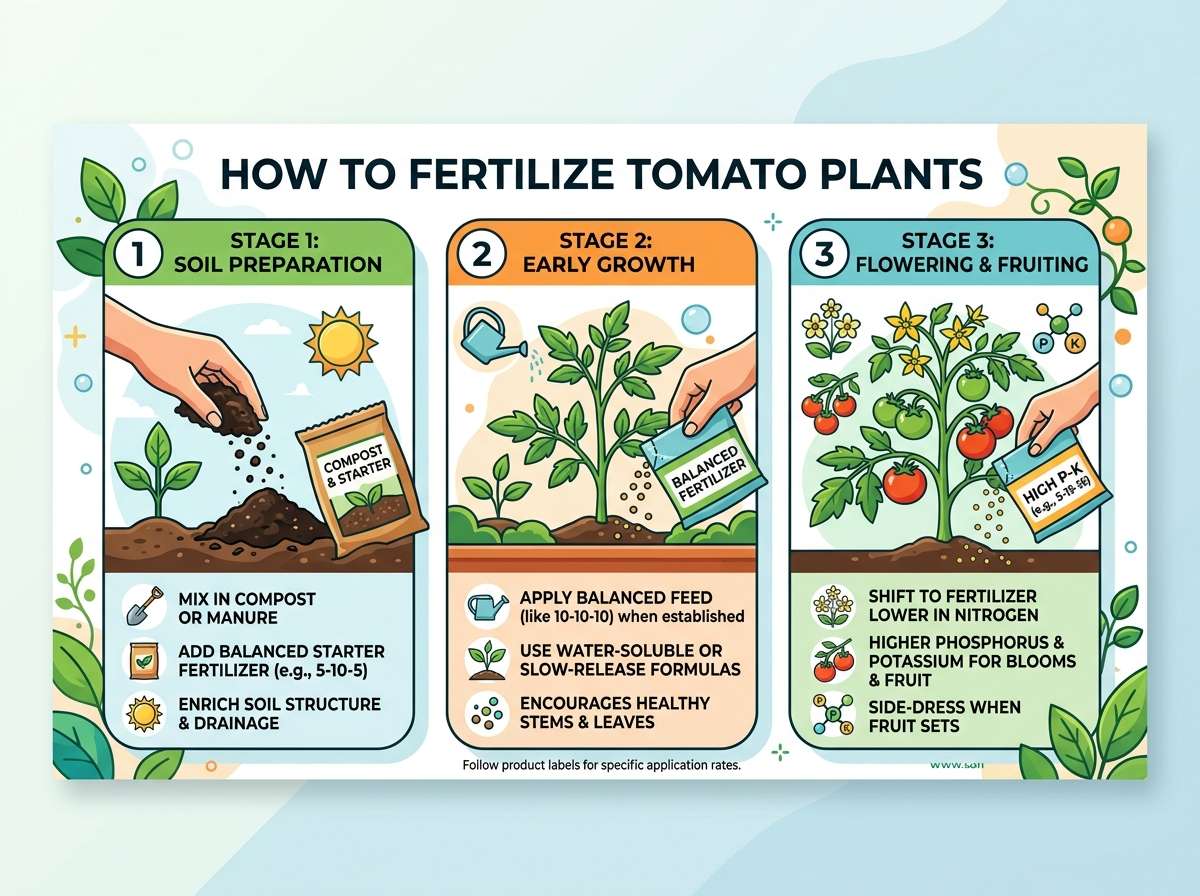
Even before you put your tomato plant in the ground, you can improve the soil by adding compost or aged manure. This gives your soil a foundation of nutrients that will feed your plant as it starts to grow. Mix compost into your soil a few weeks before planting if you can.
Right After Planting
When you first transplant your tomato seedlings into the garden, hold off on heavy fertilizing for a couple of weeks. Young transplants have tender roots that can burn from concentrated fertilizer. Let them settle in and develop their root systems first.
After two to three weeks, your tomato plants should be established and ready for their first feeding. At this point, you can start a regular fertilizing schedule.
During the Growing Season
Once your tomato plants start growing in earnest, they need steady nutrition. Most gardeners fertilize their tomato plants every two to three weeks during the growing season. Some prefer to use slow-release fertilizers once or twice, while others use liquid fertilizers more frequently.
The key is to watch your plants and respond to what you see. If your tomato plants look pale or weak, they might need fertilizer sooner. If they’re growing like crazy but not making many flowers, you might need to ease up on the nitrogen.
When Flowering Starts
When your tomato plant starts making flowers, it’s time to switch to a fertilizer with more phosphorus and potassium and less nitrogen. This shift tells your plant to focus on fruit production instead of leaf growth. Use a fertilizer with numbers like 5-10-5 or 5-10-10 to support flower and fruit development.
How Much Fertilizer to Use
Getting the amount right is crucial for healthy tomato plants. Too little fertilizer and your plants won’t get the nutrition they need. Too much fertilizer and you can burn the roots or create plants that grow too much foliage and too few tomatoes.
For Liquid Fertilizers
Always follow the instructions on the package. Most liquid fertilizers tell you to mix a certain amount with water. A typical dilution might be one tablespoon per gallon of water, but it varies by brand. Measure carefully and don’t try to make it stronger by using more fertilizer. Your plants need the proper concentration to absorb nutrients safely.
Apply liquid fertilizer directly to the soil around your tomato plant’s roots. Try to avoid getting fertilizer on the leaves because it can cause damage. Pour the fertilizer slowly so it soaks into the soil rather than running off.
For Granular Fertilizers
Granular fertilizers usually come with application instructions that tell you how much to use based on your plant size. A typical application might be one tablespoon sprinkled around the base of each plant, mixed into the top inch or two of soil.
Spread the granules out in a circle around your plant, keeping them a few inches away from the stem. Water thoroughly after applying granular fertilizer so it starts to dissolve and make nutrients available to the roots.
For Slow-Release Fertilizers
Slow-release fertilizers come with specific instructions for your tomato plant’s size. Apply them at the beginning of the season and again in the middle of the season if you want extra support. Follow the package directions carefully because these fertilizers are designed to last for a specific amount of time.
How Often to Fertilize
The frequency of your fertilizer applications depends on several factors. The type of fertilizer you choose, the size of your tomato plant, and the quality of your soil all play a role.
Liquid Fertilizer Schedule
If you use liquid fertilizer, apply it every two weeks during the growing season. Some gardeners apply it more frequently, like weekly, using a more dilute solution. This frequent, light feeding works great for tomato plants.
Stop fertilizing about four weeks before your first frost date. Your tomato plant doesn’t need extra nutrition at the end of the season, and it allows the plant to focus on ripening the fruit that’s already on it.
Granular Fertilizer Schedule
With granular fertilizers, apply them every four to six weeks during the growing season. You can start with an application three weeks after transplanting, then repeat every four to six weeks depending on how your plants look.
Slow-Release Fertilizer Schedule
Slow-release fertilizers work on their own timeline. If you use a fertilizer that lasts twelve weeks, apply it once early in the season and maybe once more in the middle. Read the package to understand how long the fertilizer lasts in your soil.
Signs Your Tomato Plants Need Fertilizer
Sometimes plants tell you exactly what they need if you pay attention. Learning to read these signs means you can adjust your fertilizing schedule to match what your plants are asking for.
Yellow Leaves
Yellow leaves, especially older leaves on the lower part of the plant, usually mean your tomato plant needs nitrogen. It’s running low on this critical nutrient and the plant is pulling it from older leaves to support new growth. Start fertilizing more frequently or switch to a fertilizer with higher nitrogen.
Poor Flower Production
If your tomato plant grows lots of leaves but makes very few flowers, it’s probably getting too much nitrogen. Switch to a fertilizer with less nitrogen and more phosphorus. You might also need to ease up on how often you fertilize.
Purple or Dark Leaves
Purple-tinged leaves, especially on the undersides, often mean your plant is struggling with phosphorus. This usually happens in cold soil early in the season when the plant’s roots can’t absorb phosphorus efficiently. Warm weather usually solves this problem, but you can also apply a phosphorus-rich fertilizer to help.
Slow Growth
If your tomato plant just isn’t growing the way it should, it might need a nutrient boost. Make sure you’ve ruled out other problems like poor water, bugs, or disease. If the plant is otherwise healthy, start a regular fertilizing schedule and you should see improvement within a couple of weeks.
Blossom End Rot
Dark, sunken spots on the bottom of your tomatoes mean the plant is struggling with calcium, which is related to inconsistent watering and fertilizing. Make sure you water regularly and fertilize consistently to prevent this problem.
Best Practices for Fertilizing Tomatoes
A few key habits will help you get the best results from your fertilizer applications.
Water Before Fertilizing
Always water your tomato plants before you apply fertilizer. Wet soil helps the plant roots absorb nutrients better and prevents fertilizer from burning the roots. If the soil is dry, water thoroughly, wait a few minutes, and then apply fertilizer.
Apply Fertilizer to Soil, Not Leaves
Fertilizer works best when it soaks into the soil where the roots can absorb it. Applying fertilizer to the leaves can burn them and wastes the nutrients. Pour liquid fertilizer slowly around the base of the plant, and keep it off the foliage.
Keep Fertilizer Away from the Stem
Leave a few inches of space between the fertilizer and the main stem of your tomato plant. Fertilizer applied directly against the stem can burn it and damage the plant. Create a small circle around the base of the plant and apply the fertilizer there.
Fertilize in the Early Morning or Evening
Apply fertilizer when it’s cool outside, either early morning or in the evening. Avoid fertilizing in the hot afternoon when the plant is stressed by heat. This timing helps the plant absorb nutrients better.
Don’t Over-Fertilize
More fertilizer doesn’t equal more tomatoes. Over-fertilizing can cause all kinds of problems, from salt buildup in the soil to excessive leaf growth with poor fruit production. Follow package directions and stick to your schedule. It’s better to under-fertilize than over-fertilize.
Test Your Soil
If you’re not sure what nutrients your soil already has, get a soil test done. Many county extension offices offer affordable soil testing. A soil test tells you exactly what nutrients your soil needs, so you can apply fertilizer more effectively. This is especially helpful if you’re having problems growing healthy tomato plants.
Feeding Tomatoes in Containers
Container gardening is great for tomatoes, but container tomatoes need more frequent fertilizing than plants in the ground. Soil in containers drains water more freely, and that water carries nutrients away with it.
For container tomato plants, apply a diluted liquid fertilizer every week or every other week during the growing season. You can also use slow-release fertilizers mixed into your container soil at planting time, which provides steady nutrition throughout the season.
Use a high-quality potting mix that contains some nutrients to start with. Mix in compost before planting your tomato seedling to give it extra nutrition and improve water retention in the container.
Organic Options for Tomato Fertilizer
If you prefer to use organic materials, you have plenty of options for feeding your tomato plants.
Compost
Compost is the gardener’s best friend. Work a few inches of finished compost into your soil before planting tomatoes. You can also add compost as a top dressing during the season, which feeds your plant and improves the soil over time.
Aged Manure
Animal manure from horses, cows, or chickens makes an excellent organic fertilizer. Make sure it’s well-aged or composted before using it because fresh manure can burn plants. Aged manure improves soil structure while providing slow, steady nutrition.
Fish Emulsion
Fish emulsion is made from fish waste and provides balanced nutrition with a good dose of nitrogen. It smells pretty funky, but plants love it. Dilute it according to package directions and apply it every two to three weeks during the growing season.
Kelp or Seaweed
Kelp and seaweed provide trace minerals that help plants thrive. They’re especially useful for fighting stress from heat or cold. Mix them into the soil before planting or apply them as a spray during the season.
Bone Meal and Blood Meal
Bone meal is high in phosphorus, which supports flower and fruit production. Blood meal is high in nitrogen, which supports leaf growth. Use bone meal once the plant starts flowering, and use blood meal early in the season if the plant needs a nitrogen boost.
Coffee Grounds and Eggshells
Save your used coffee grounds and crushed eggshells to add to your garden. Coffee grounds add nitrogen and organic matter to the soil. Eggshells provide calcium, which prevents problems like blossom end rot. Sprinkle both around your tomato plants throughout the season.
Common Fertilizing Mistakes to Avoid
Learning what not to do is just as important as learning what to do.
Fertilizing Too Early
Don’t fertilize your tomato plants right after transplanting. Wait a few weeks for them to get established. Young plants need time to develop strong roots before you start feeding them.
Using Too Much Nitrogen
A common mistake is using a general-purpose fertilizer like 10-10-10 all season long. This gives your tomato plant too much nitrogen and not enough phosphorus for good fruit production. Switch to a lower nitrogen formula once the plant starts making flowers.
Ignoring Plant Signals
Many new gardeners fertilize on a strict schedule without looking at what the plant needs. Pay attention to your plant’s color, growth, and flower production. Adjust your fertilizing based on what you see, not just on a calendar.
Fertilizing Without Watering
Dry soil and fertilizer don’t mix well. Fertilizer applied to dry soil can concentrate around the roots and burn them. Always water your plants before applying fertilizer, or apply liquid fertilizer to already-moist soil.
Using Outdated Fertilizer
Fertilizer doesn’t stay potent forever. If you have old fertilizer sitting in your shed, its nutrients may have degraded. Use fresh fertilizer for the best results.
Frequently Asked Questions About Tomato Fertilizer
Let me answer some questions that come up a lot.
Can I use vegetable fertilizer for tomatoes?
Yes, vegetable fertilizers work well for tomatoes. Look for one that’s balanced or slightly higher in phosphorus and potassium than nitrogen. A 5-10-10 formula is perfect for tomatoes.
What does the NPK number mean?
The three numbers on fertilizer packages represent nitrogen (N), phosphorus (P), and potassium (K) in that order. The numbers show the percentage of each nutrient. So 5-10-10 means five percent nitrogen, ten percent phosphorus, and ten percent potassium.
Is it better to use organic or synthetic fertilizer?
Both work great for tomatoes. Organic fertilizers build soil health over time and appeal to gardeners who want to avoid chemicals. Synthetic fertilizers work faster and give you more control. Many gardeners use both throughout the season.
Can I make my own fertilizer?
Absolutely. Compost is a homemade fertilizer that’s hard to beat. You can also make compost tea by steeping compost in water for a few days and then using the liquid to feed your plants. Other options include grass clippings, shredded leaves, and food scraps.
How do I know if I’m over-fertilizing?
Signs of over-fertilization include stunted growth, burned or scorched leaf edges, and poor fruit production despite lots of leaves. The soil may also have a crusty white salt buildup. Cut back on fertilizing and water deeply to help flush excess nutrients from the soil.
Should I fertilize my tomatoes in the rain?
If rain is expected soon, you can apply granular fertilizer because the rain will help dissolve it and carry it down to the roots. For liquid fertilizer, wait until after the rain because heavy rain can wash it away before the roots absorb it.
When should I stop fertilizing?
Stop fertilizing about four weeks before your expected first frost date. At this point, you want the plant to focus on ripening the fruit that’s already on it rather than making new growth.
Bringing It All Together
Fertilizing your tomato plants doesn’t have to be complicated. Start with a good soil that has plenty of organic matter. Choose a fertilizer type that fits your gardening style, whether that’s liquid, granular, or slow-release. Apply it at the right times and in the right amounts.
Watch your plants and listen to what they tell you. Yellow leaves mean nitrogen, poor flowering means you need to back off the nitrogen and boost phosphorus. Strong, healthy plants with lots of flowers and fruit mean you’re doing something right.
Remember that fertilizing is just one part of growing great tomatoes. Your plants also need sunlight, water, and a little bit of care. Get these basics right, and you’ll grow the most delicious tomatoes your family has ever tasted. The effort you put in now, including learning how to fertilize properly, will pay off in tomato abundance throughout the growing season. Happy growing!

Hi, I’m Mary, the founder of GardenCure.com. I’m passionate about creating healthy, beautiful gardens and well-kept lawns. I share practical experience and trusted advice on garden and lawn gear that truly works. With the support of my dedicated research team, our writers produce honest, in-depth reviews using reliable, authentic sources—helping you choose the right tools with confidence for your outdoor space.